Ältere Veranstaltungen finden Sie im Archiv!
Videoaufnahmen ausgewählter Vorträge und Veranstaltungen finden Sie in unserer Mediathek!
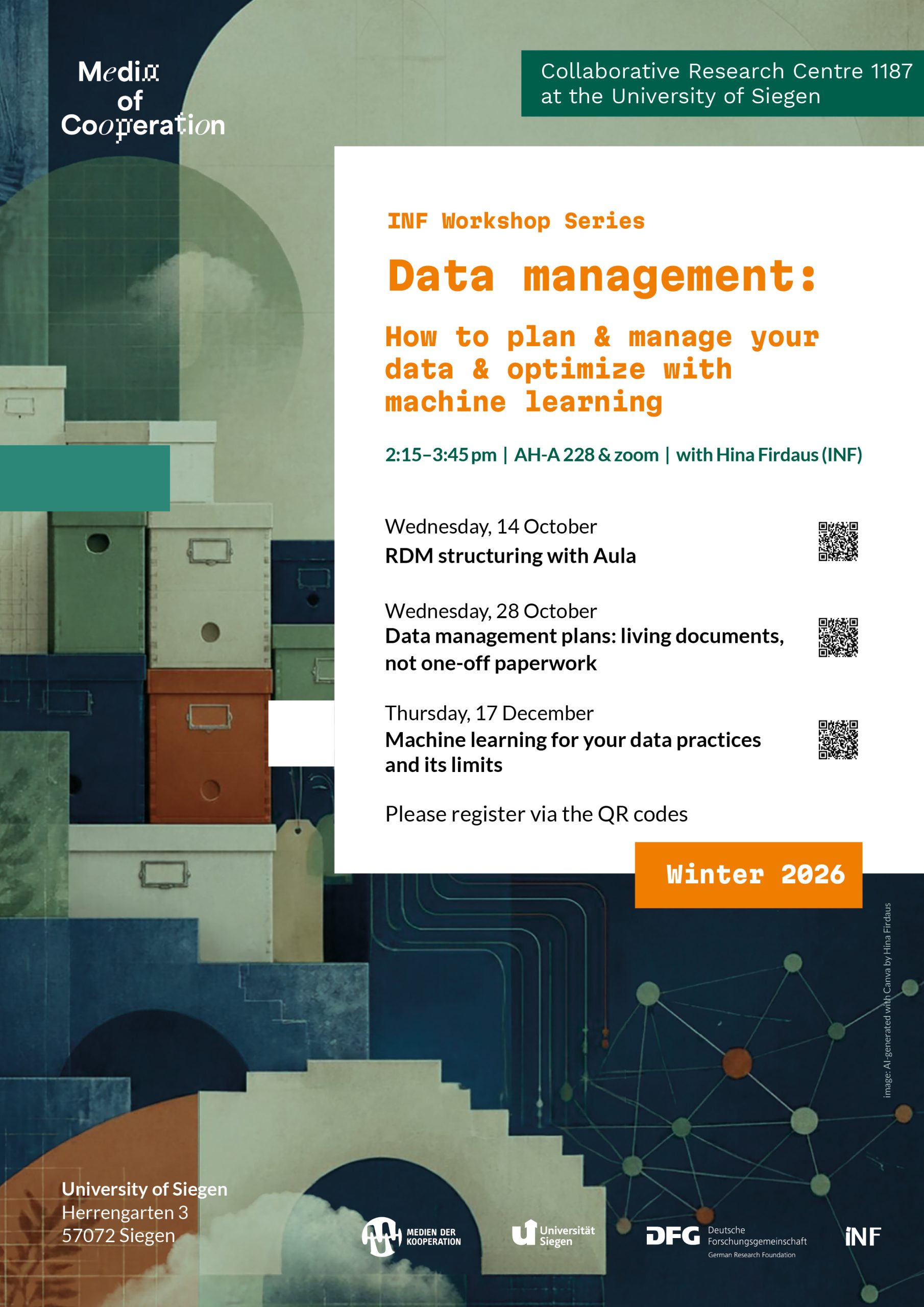
Aula is now live for the SFB. This first session walks through how to structure and manage your research data on the platform, setting up your subproject space, connecting Sciebo, describing datasets, and finding the guidance you need without leaving the platform. Bring your own data situation we will work through real cases rather than a demo dataset.
The workshop ist for all CRC members.
Here is the event link: https://umfragen.uni-siegen.de/index.php/341426?lang=en
Die mündliche Prüfung beginnt mit einem ca. 20-bis 25-minütigen Vortrag des Doktoranden und setzt sich mit einer mind. 60-minütigen Diskussion fort. Fragerecht haben nur die Kommissionsmitglieder. Die Prüfung findet unter Ausschuss der Öffentlichkeit statt.
Sensing Loss – Uni Köln goes r e t u r n: 60 Minutes AnthroLab.
Donnerstags 16:30-17:30Uhr
Prof. Dr. Alice von Bieberstein (Berlin): Sehnsucht und Berührungsängste: Westarmenien für die Nachfahren der Überlebenden des armenischen Völkermords
Die Diskussionsreihe Sensing Loss bringt ethnologische Forschungen aus der Universität ins Museum. Sozial- und Kulturanthropolog:innen aller Karrierestufen berichten aus ihren aktuellen Forschungen, wie Menschen Verlust erfahren und Verlusterfahrungen bearbeiten. Sensing Loss fragt, wie Verlust begegnet, verkörpert und verräumlicht wird – und wie aus Vertreibung, Enteignung und vergangenem Unrecht neue Zukünfte gewonnen werden können. Erfahrungen des Verlusts (loss), ihre Konfrontation und Aufarbeitung [r e t u r n] sind dabei so vielfältig wie die Situationen, in denen Menschen Kolonialismus, Marginalisierung oder Gewalt begegnen. Die öffentlichen Vorträge diskutieren Formen des Sensing, über die Menschen Verlust gewahr werden, und Sense Making, d.h. die Frage, wie Menschen Verlusterfahrungen eine Bedeutung verleihen. Trauer, Verlust und Erinnerung können zur Quelle werden, Ansprüche an die Gegenwart zu artikulieren und zwischen Menschen und Orten, Vergangenheit und Zukunft neue Verbindungen zu erarbeiten. Im Sinne der Ausstellung r e t u r n beschäftigen sich die Vorträge mit ganz unterschiedlichen Momenten und Formen der Trauer, der Nostalgie, der Erinnerungsarbeit und des gemeinsamen Aufbruchs.
————
The lecture series Sensing Loss connects anthropological thinking across university and museum spaces. Social and cultural anthropologists at all career stages discuss their ongoing research to explore how people sense and make sense of loss. Sensing Loss asks how loss is experienced, embodied and spatialized – and how displacement, dispossession and past injustices can become sources for new future-making practices. Experiences of loss, their confrontation, and the ways in which people try to come to terms with them – and find ways to r e t u r n – are as diverse as the situations in which people experience colonialism, violence or marginalization.
The public lectures discuss how grief, loss and remembrance can become resources for articulating claims on the present, and for shaping new connections between people and places, past and future. In resonance with the exhibition r e t u r n at the RJM, the lectures engage with diverse moments and forms of grief, nostalgia and memory work, as well as with joint departures into new futures.
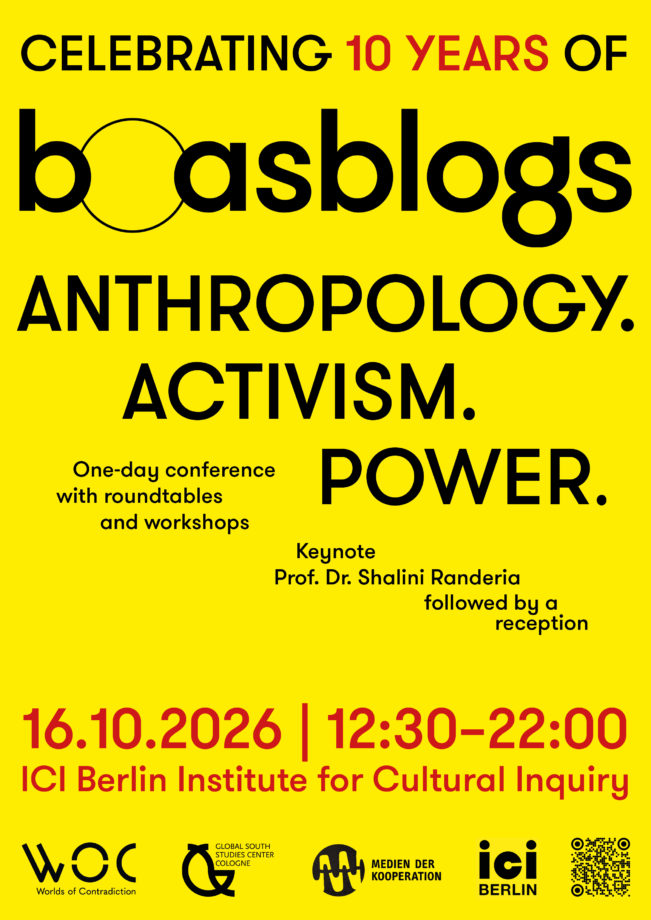
To attend in person, please register here.
 Event Website
 Im Rahmen der Disputation werden die Ergebnisse der Dissertation von Hoa Mai Trần vor der Prüfungskommission präsentiert und wissenschaftlich verteidigt. Der Titel ihrer Dissertation lautet: „Das virtuelle Selbst im Zwischenraum: Eine ethnografische Kindheitsforschung zu Existenzweisen von Kindern im digitalen Spiel“.
Wo beginnt „das Kind“ im digitalen Spiel und wo hört es auf? In ihrer dreijährigen ethnografischen Feldforschung mit drei Familien aus Deutschland untersucht Hoa Mai Trần die Erlebnisse von Kindern während des digitalen Spiels. Die erziehungswissenschaftliche Studie fragt wie sich im Spiel die Grenzen zwischen „Ich“ und „Nicht-Ich“ verschieben.
Im Zentrum steht die Forschungsfrage: Wie wird hybrides Da-Sein von Kindern beim digitalen Spielen hervorgebracht? Die These der Arbeit lautet, dass Kinder über ihre fleischlich-physischen Körpergrenzen hinaus da-sein bzw. existieren können. Zwischen Fühlen, Werden und Sterben entfaltet sich im Spiel ein Zwischenraum, in dem sich hybride, lebendige Existenzweisen von Kindern zeigen. Das Spiel von Kindern wird zu einer bedeutsamen, spürbaren und dynamischen (Zwischen)Realität. Die durch Kind und Spiel wechselseitig erzeugten Entgrenzungsphänomene ermöglichen, je nach Spielsituation, temporäre bzw. aktualisierbare Selbst- und Weltentfaltungsweisen und tragen zur Genese des virtuellen Selbst bei. Das virtuelle Selbst ist kein digitales Abbild des Kindes im Spiel, sondern die im Spiel hervorgebrachte, digital materialisierbare und mehr oder weniger personalisierbare Vorstellung, etwas bzw. jemand zu sein oder werden zu können. Digitale Spiele sind bewohnbare Orte von Kindheit, die individuelle, soziale, bildungspolitische und ökonomische Tragweite für Kinder und Gesellschaft haben.
Das Dissertationsprojekt ist im Teilprojekt B05: (Frühe) Kindheit und Smartphone angesiedelt. Die Prüfung wird auf deutsch gehalten und von Prof. Dr. Jutta Wiesemann (Erstgutachterin), Prof. Dr. Jochen Lange (Zweitgutachter) und Prof. Dr. Chantal Munsch (Prüfungskommissionsmitglied) abgenommen.
Sensing Loss – Uni Köln goes r e t u r n: 60 Minutes AnthroLab.
Donnerstags 16:30-17:30Uhr
Saleh Seid Adem, MA (Köln): Between Houses: Sensing Losses and Making Home in the Life of an Ethiopian Migrant Domestic Worker
Die Diskussionsreihe Sensing Loss bringt ethnologische Forschungen aus der Universität ins Museum. Sozial- und Kulturanthropolog:innen aller Karrierestufen berichten aus ihren aktuellen Forschungen, wie Menschen Verlust erfahren und Verlusterfahrungen bearbeiten. Sensing Loss fragt, wie Verlust begegnet, verkörpert und verräumlicht wird – und wie aus Vertreibung, Enteignung und vergangenem Unrecht neue Zukünfte gewonnen werden können. Erfahrungen des Verlusts (loss), ihre Konfrontation und Aufarbeitung [r e t u r n] sind dabei so vielfältig wie die Situationen, in denen Menschen Kolonialismus, Marginalisierung oder Gewalt begegnen. Die öffentlichen Vorträge diskutieren Formen des Sensing, über die Menschen Verlust gewahr werden, und Sense Making, d.h. die Frage, wie Menschen Verlusterfahrungen eine Bedeutung verleihen. Trauer, Verlust und Erinnerung können zur Quelle werden, Ansprüche an die Gegenwart zu artikulieren und zwischen Menschen und Orten, Vergangenheit und Zukunft neue Verbindungen zu erarbeiten. Im Sinne der Ausstellung r e t u r n beschäftigen sich die Vorträge mit ganz unterschiedlichen Momenten und Formen der Trauer, der Nostalgie, der Erinnerungsarbeit und des gemeinsamen Aufbruchs.
————
The lecture series Sensing Loss connects anthropological thinking across university and museum spaces. Social and cultural anthropologists at all career stages discuss their ongoing research to explore how people sense and make sense of loss. Sensing Loss asks how loss is experienced, embodied and spatialized – and how displacement, dispossession and past injustices can become sources for new future-making practices. Experiences of loss, their confrontation, and the ways in which people try to come to terms with them – and find ways to r e t u r n – are as diverse as the situations in which people experience colonialism, violence or marginalization.
The public lectures discuss how grief, loss and remembrance can become resources for articulating claims on the present, and for shaping new connections between people and places, past and future. In resonance with the exhibition r e t u r n at the RJM, the lectures engage with diverse moments and forms of grief, nostalgia and memory work, as well as with joint departures into new futures.
Most subprojects already have a DMP. This session is about keeping it useful, how to treat the DMP as a document that grows with your data collection, what to revise and when, and how the DMP connects to storage, archiving and the requirements that come later in the project. Practical work on your own plan, not a lecture on templates.
The workshop ist for all CRC members.
Here is the event link: https://umfragen.uni-siegen.de/index.php/785387?lang=en
At present, the discourse on artificial intelligence permeates a vast number of societal domains. We encounter it in academia as well as in journalism, in political, social, and cultural debates, in the economy, in modern working life, in medicine, in education, and tragically even in warfare. In short: discussions about artificial intelligence concern all of us in central and significant areas of life.
Opinions, assessments, perceptions, and evaluations of artificial intelligence — particularly regarding its opportunities and risks — diverge widely. For some, technological or machine intelligence represents a great promise for a better future. Others, however, fear severe social consequences arising from the use of AI.
These debates are not new. For decades, the concept of artificial intelligence has repeatedly experienced new waves of attention, booms and busts in the public sphere. Since the very beginning of the discourse on artificial intelligence, one recurring question has been how much “intelligence” truly resides in artificial intelligence.
With the surge in attention generated by AI chatbots and the economic success of predominantly US‑based companies in the field of artificial intelligence, public discourse has reached a new peak in recent years. The prevailing conviction is that in the future none of us will be able to avoid applications of artificial intelligence — not as individuals, not as users, not as citizens, not as companies, not as governments, and not as actors in the realms of business, politics, or public administration.
What is contested, however, is the fact that power over AI applications lies in the hands of only a few companies and the governments aligned with them — and that these AI instruments of power have consequences for all of us that we cannot foresee, due to mechanisms and algorithms that are opaque, incomprehensible, and secret. Key risks identified include the unlimited accumulation of citizens’ and users’ data by companies and governments, as well as phenomena such as “surveillance capitalism”, “technological imperialism”, and “AI-based warfare”.
Against this backdrop, our conference is dedicated to the potential downsides and risks of artificial intelligence applications, as well as possible counter‑strategies. This intentionally encompasses a diverse range of fields of application and associated risks:
Our three days conference is aiming at academic scholars (e,g., from socio-informatics, media sciences and human–computer interaction, sociology, political science, law and economics), as well as political actors, civil society activists, journalists and a politically engaged expert audience.
Conference date: Thursday, Oct. 29 to Saturday, Oct. 31 2026
Conference venue: University of Siegen, Germany
Conference language: English
Conference format: On-Site, maybe hybrid
Conference fee: Free of charge
Conference layout: We plan for an interactive format for exchange, discussion, co-creation in workshops, working groups, round tables. But additionally we will invite international experts to give some input.
Conference Registration: https://darksidesofai.wineme.wiwi.uni-siegen.de/registration-2/
Conference Chair:
Gihan Abouzeid (University of Siegen)
Jacob Hochhaus (University of Siegen)
Markus Rohde (University of Siegen)
and Volker Wulf (University of Siegen)
Organizational Chair
Kathrin Hoffmann (University of Siegen)
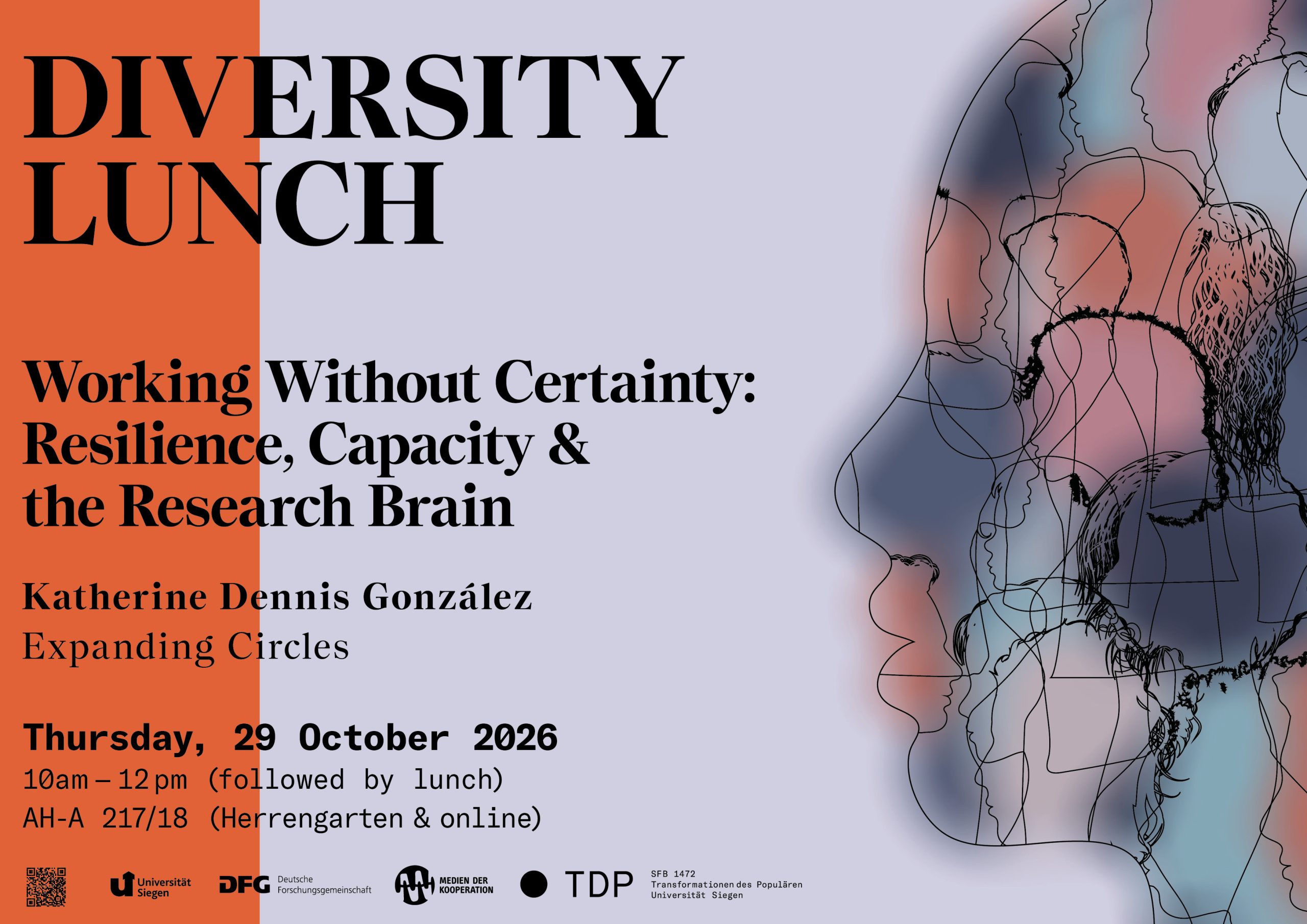
10:00 – 12:00 Uhr Vortrag und Diskussion: Katherine Dennis on „Working Without Certainty: Stress, Capacity and the Research Brain“ (AH-A 217/18)
12:00 – 14:00 Uhr Lunch (AH-A 210/11)
Die Veranstaltung findet auf Englisch statt.
Wir bitten um Anmeldung bis zum 23.10.2026 an Selina Seibt.
Über den Vortrag „Working Without Certainty: Resilience, Capacity and the Research Brain“
Research asks people to invest years of effort in questions whose answers are unknown, while funding and career progression stay uncertain too. The session introduces the neurocognitive foundations of stress, capacity and adaptation in academic work, and how prediction, perceived control, belonging and meaning shape a researcher’s ability to sustain effort. Participants leave with a clearer understanding of their own responses, practical ways to protect their attention and recovery, and a sense of where they can act.
Die Psychologin und Neuropsychologin Katherine Dennis González, Mitbegründerin von „Expanding Circles“, stellt die neurokognitiven Grundlagen von Stress, Leistungsfähigkeit und Anpassung im akademischen Arbeitsalltag vor. Sie untersucht, wie Vorhersehbarkeit, wahrgenommene Kontrolle, Zugehörigkeit und Sinnhaftigkeit die Fähigkeit eines Forschers beeinflussen, seine Anstrengungen aufrechtzuerhalten, und wie ungleichmäßig einige dieser Faktoren innerhalb der akademischen Welt verteilt sind. Die Teilnehmer gewinnen ein klareres Verständnis ihrer eigenen Reaktionen, erhalten praktische Tipps zum Schutz ihrer Aufmerksamkeit und zur Erholung sowie ein Gespür dafür, wo sie ansetzen können. Mit über 12 Jahren klinischer Erfahrung arbeitet sie an der Schnittstelle zwischen Nervensystemforschung und menschlichem Verhalten. Sie leitet Einzel- und Unternehmensprogramme und arbeitet mit Filmfestivals und Institutionen in ganz Europa zusammen. Derzeit schließt sie ein Forschungsprojekt an der Sigmund-Freud-Universität Berlin ab, in dem sie untersucht, wie Menschen Stress interpretieren und wie diese Interpretationen Selbstvorwürfe, Handlungsfähigkeit und adaptive Maßnahmen beeinflussen.
Expanding Circles ist ein in Berlin ansässiges Unternehmen für psychologische Bildung und Bewegung, das von der Psychologin Katherine Dennis González und der Trainingswissenschaftlerin Sillse Giesen gegründet wurde. Wir vermitteln Menschen, wie das Nervensystem unter Druck, in Unsicherheit und bei Veränderungen funktioniert, und helfen ihnen, dieses Verständnis in praktische Werkzeuge umzusetzen, um ihre Leistungsfähigkeit aufrechtzuerhalten. Wir arbeiten mit Organisationen, Kulturinstitutionen, Filmfestivals und Einzelpersonen in ganz Europa zusammen.
Über die Veranstaltungsreihe
Die Reihe „Diversity Lunch“ ist eine Kooperation der SFBs „Medien der Kooperation“ und „Transformationen des Populären“ und lädt alle Mitglieder und Interessierten zu einem Austausch zu aktuellen Themen und Fragestellungen rund um Diversität in der Wissenschaft ein.
Eine Teilnahme ist online als auch in Präsenz im Herrengarten möglich. Im Anschluss an die Veranstaltung laden wir herzlich zu einem kleinen Imbiss/Lunch im Herrengarten (AH-A 208/209) ein!
Poster Sensing Loss – Uni Köln goes r e t u r n: 60 Minutes AnthroLab.
Donnerstags 16:30-17:30Uhr
Prof . Dr. John Borneman (Princeton): Der Ruf der Loreley: Verlust, r e t u r n und die Neue Rechte in Deutschland (Publikumsgespräch)
Die Diskussionsreihe Sensing Loss bringt ethnologische Forschungen aus der Universität ins Museum. Sozial- und Kulturanthropolog:innen aller Karrierestufen berichten aus ihren aktuellen Forschungen, wie Menschen Verlust erfahren und Verlusterfahrungen bearbeiten. Sensing Loss fragt, wie Verlust begegnet, verkörpert und verräumlicht wird – und wie aus Vertreibung, Enteignung und vergangenem Unrecht neue Zukünfte gewonnen werden können. Erfahrungen des Verlusts (loss), ihre Konfrontation und Aufarbeitung [r e t u r n] sind dabei so vielfältig wie die Situationen, in denen Menschen Kolonialismus, Marginalisierung oder Gewalt begegnen. Die öffentlichen Vorträge diskutieren Formen des Sensing, über die Menschen Verlust gewahr werden, und Sense Making, d.h. die Frage, wie Menschen Verlusterfahrungen eine Bedeutung verleihen. Trauer, Verlust und Erinnerung können zur Quelle werden, Ansprüche an die Gegenwart zu artikulieren und zwischen Menschen und Orten, Vergangenheit und Zukunft neue Verbindungen zu erarbeiten. Im Sinne der Ausstellung r e t u r n beschäftigen sich die Vorträge mit ganz unterschiedlichen Momenten und Formen der Trauer, der Nostalgie, der Erinnerungsarbeit und des gemeinsamen Aufbruchs.
————
The lecture series Sensing Loss connects anthropological thinking across university and museum spaces. Social and cultural anthropologists at all career stages discuss their ongoing research to explore how people sense and make sense of loss. Sensing Loss asks how loss is experienced, embodied and spatialized – and how displacement, dispossession and past injustices can become sources for new future-making practices. Experiences of loss, their confrontation, and the ways in which people try to come to terms with them – and find ways to r e t u r n – are as diverse as the situations in which people experience colonialism, violence or marginalization.
The public lectures discuss how grief, loss and remembrance can become resources for articulating claims on the present, and for shaping new connections between people and places, past and future. In resonance with the exhibition r e t u r n at the RJM, the lectures engage with diverse moments and forms of grief, nostalgia and memory work, as well as with joint departures into new futures.
Part I Open to scholars of all levels
9:30- 10:30
As a continuation of Susan Slymovics lecture the previous evening, she introduces her work via a close reading of one case study or a monument that she examines in her book.
Short break
Part II For registered Masterclass participants only
11:00-12:00
Focused discussion of Susan Slyomovics’s book Monuments Decolonized. Students’ questions (collected beforehand) will be organized under thematic clusters such as mobility, decolonization, memory, materiality, and methodology and will be posed in class to have a discussion on each theme.
12:00- 13:00 practical exercise:
Each student-participant brings one material trace from their own research, such as a photo of a monument, ruin, building, or object that carries a contested or ambivalent memory. Individually or in small groups of four or five, they place their case alongside your Algeria material: is it preserved, reused, erased? Who claims it? This would give space to students who wish to shed a brief light on their own projects.
13:00- 13:30 Free questions, comments, and discussion.
Archive werden schon lange nicht mehr als neutrale Aufbewahrungsorte der Vergangenheit verstanden. Eine umfangreiche kritische Forschungsliteratur hat gezeigt, dass es sich bei ihnen um umkämpfte Infrastrukturen handelt, durch die Erinnerungen, Geschichten, Öffentlichkeiten und Machtverhältnisse geformt, ausgehandelt und ausgelöscht werden (Foucault 1972; Mbembe 2002; Stoler 2009). Dennoch befasst sich ein Großteil dieser Arbeiten nach wie vor in erster Linie mit dem Archiv als Ort der Bewahrung, der Steuerung, der Auseinandersetzung oder – in seiner gegenarchivischen Umkehrung – des Widerstands.
Anstatt diese Debatten erneut aufzugreifen, fragt dieser Workshop, wie sie aussehen, wenn man sie durch die Linse der Kooperation betrachtet. Wir verfolgen die fließenden Bewegungen und vielfältigen Anreize, durch die verschiedene Öffentlichkeiten Erinnerungen an vergangene Ereignisse mobilisieren, neu konstruieren, aufdecken, verbergen und zu löschen versuchen. Dieser Workshop richtet den Blick auf das Archivieren als fortlaufende Praxis der Zusammenarbeit, verstanden als die gemeinsame Erarbeitung der Mittel und Verfahren der Interaktion (Schüttpelz und Gießmann 2015). Er untersucht, wie und warum die Vergangenheit in der Gegenwart durch Medien, Infrastrukturen, Institutionen, Technologien und Umgebungen in Erinnerung bleibt und öffentlich gemacht wird; wie bestimmte Versionen davon zirkulieren und Autorität erlangen; und wie ihre Spuren bewahrt, transformiert, umstritten oder ausgelöscht werden. Aus dieser Perspektive wird das Archiv als eine Infrastruktur der Zusammenarbeit betrachtet, die auf verteilten, materiellen und vermittelten Praktiken der Erinnerungsarbeit beruht, durch die vergangene Ereignisse wahrnehmbar gemacht, Öffentlichkeiten gebildet und Zukünfte imaginiert werden.
Eine solche Herangehensweise an Archive verlagert den Fokus von dem, was Archive enthalten, hin zu den heterogenen Praktiken und Beziehungen, durch die sie zusammengestellt werden. Er rückt die kooperative Arbeit in den Vordergrund, die Erinnerungen, ihre Hüter sowie die materiellen und vermittelten Spuren, durch die sie fortbestehen, miteinander verbindet, und zeigt gleichzeitig auf, wie Erinnerungen produziert, stabilisiert, angefochten und transformiert werden, während verschiedene Öffentlichkeiten konkurrierende Versionen der Vergangenheit mobilisieren. Wie alle Formen der Zusammenarbeit können diese Prozesse ins Stocken geraten, ausgrenzen, fragmentieren oder zusammenbrechen.
Der Workshop fragt, welche Formen kooperativer Arbeit Archive entstehen lassen, sie zusammenhalten, sie transformieren oder ihren Zerfall zulassen. Er folgt archivarischen Spuren, während sie durch Landschaften, religiöse Netzwerke, Migrationsbewegungen, Museumssammlungen, künstlerische Praktiken, Verwaltungsunterlagen und digitale Plattformen zirkulieren. Wie werden ein koloniales Wasserversorgungssystem, eine militärische Ruine, eine Marienstatue, ein Museumsobjekt, eine Verwaltungsakte, ein alter Zugfahrplan oder eine Sensoraufzeichnung in neue Formen der Zusammenarbeit eingebunden, die Öffentlichkeiten zusammenführen und Bedeutungen jenseits ihres ursprünglichen Zwecks generieren?
Der Workshop bringt Susan Slyomovics’ Arbeit zu Erinnerung, Kulturerbe, Volksarchiven und postkolonialer Gerechtigkeit in Nordafrika und im Nahen Osten (Slyomovics 1998, 2005) in einen Dialog mit aktuellen Forschungsarbeiten im Rahmen des SFB „Media of Cooperation“, um Archive als Infrastrukturen der Zusammenarbeit zu untersuchen, durch die Erinnerungen, Öffentlichkeiten und mögliche Zukünfte kontinuierlich geschaffen und neu gestaltet werden.
Vorläufiges Programm:
Keynote-Vortrag
Susan Slyomovics (UCLA), Keynote-Vortrag; Diskutantin: Sevi Bayraktar (HfmtKöln)
Panel I: Bewahren: Die Arbeit, die Erinnerungen an die Vergangenheit zusammenhält
Wie wird die Vergangenheit durch Wiederholung, Weitergabe, Pflege und Fürsorge am Leben erhalten, und wer ist an dieser Arbeit beteiligt?
Carla Tiefenbacher (B04): Katholische Netzwerke, Voluntourismus, reisende Marienstatuen, Friedhöfe und transnationale katholische Erinnerung
P01 (Meyer/Mondada): Sinnesvermittlung, verkörperte Erinnerung und kooperative Praktiken der Weitergabe
Nina ter Laan (B04) Transnationaler Erinnerungsaktivismus und zeitgenössische Auseinandersetzungen mit den materiellen Überresten des Kolonialismus im Rif
Panel II: Aufbrechen und Wahrnehmen: Abwesenheiten, Lücken und gescheiterte Zusammenarbeit
Was geschieht, wenn die Zusammenarbeit im Archivbereich scheitert, und wie wird dies wahrgenommen und sinngebend interpretiert?
A04 (Potthast) Institutionelle Infrastrukturen, Instandhaltung und Zusammenbruch, öffentliche Verwaltung
P06 (Bareikyte) Kriegswahrnehmung, Dokumentation und Konfliktarchive
Martin Zillinger (B04) „Spukende“ Wasserinfrastrukturen, landwirtschaftlicher Modernismus und ökologische Nachwirkungen kolonialer und postkolonialer Entwicklung in Marokko
Panel III: Zukunftsgestaltung: Kollektive, Ansprüche und Wiedergutmachung vorstellen
Wie konstruieren Archivpraktiken Identität/Kollektive und entwerfen Zukunftsvisionen, unter anderem durch Restitution und historische Gerechtigkeit?
Birgit Meyer (Universität Utrecht): Religiöses Erbe, Vermittlung, Museen und Restitution
Anna Brus (Universität zu Köln): Museumssammlungen und Provenienzforschung
A01 (Gießmann): Historische Medieninfrastrukturen, vernetzte Archive und Archivpraktiken
Podiumsdiskussion
Abschließende Podiumsdiskussion mit allen Teilnehmenden, Reflexion über übergreifende Themen.
Sensing Loss – Uni Köln goes r e t u r n: 60 Minutes AnthroLab.
Donnerstags 16:30-17:30Uhr
Prof. Dr. Birgit Meyer (Utrecht): „Undemonise!“ Verlust und Wiederaneignung spiritueller Artefakte der Eʋe in Ghana und Togo
Die Diskussionsreihe Sensing Loss bringt ethnologische Forschungen aus der Universität ins Museum. Sozial- und Kulturanthropolog:innen aller Karrierestufen berichten aus ihren aktuellen Forschungen, wie Menschen Verlust erfahren und Verlusterfahrungen bearbeiten. Sensing Loss fragt, wie Verlust begegnet, verkörpert und verräumlicht wird – und wie aus Vertreibung, Enteignung und vergangenem Unrecht neue Zukünfte gewonnen werden können. Erfahrungen des Verlusts (loss), ihre Konfrontation und Aufarbeitung [r e t u r n] sind dabei so vielfältig wie die Situationen, in denen Menschen Kolonialismus, Marginalisierung oder Gewalt begegnen. Die öffentlichen Vorträge diskutieren Formen des Sensing, über die Menschen Verlust gewahr werden, und Sense Making, d.h. die Frage, wie Menschen Verlusterfahrungen eine Bedeutung verleihen. Trauer, Verlust und Erinnerung können zur Quelle werden, Ansprüche an die Gegenwart zu artikulieren und zwischen Menschen und Orten, Vergangenheit und Zukunft neue Verbindungen zu erarbeiten. Im Sinne der Ausstellung r e t u r n beschäftigen sich die Vorträge mit ganz unterschiedlichen Momenten und Formen der Trauer, der Nostalgie, der Erinnerungsarbeit und des gemeinsamen Aufbruchs.
————
The lecture series Sensing Loss connects anthropological thinking across university and museum spaces. Social and cultural anthropologists at all career stages discuss their ongoing research to explore how people sense and make sense of loss. Sensing Loss asks how loss is experienced, embodied and spatialized – and how displacement, dispossession and past injustices can become sources for new future-making practices. Experiences of loss, their confrontation, and the ways in which people try to come to terms with them – and find ways to r e t u r n – are as diverse as the situations in which people experience colonialism, violence or marginalization.
The public lectures discuss how grief, loss and remembrance can become resources for articulating claims on the present, and for shaping new connections between people and places, past and future. In resonance with the exhibition r e t u r n at the RJM, the lectures engage with diverse moments and forms of grief, nostalgia and memory work, as well as with joint departures into new futures.

The 2026 annual conference of the Collaborative Research Center 1187 “Media of Cooperation” explores the politics of cooperative sensing and sense-making in a time marked by geopolitical and climate catastrophes, anti-democratic backlashes and the rise of authoritarian regimes—all of which are phenomena closely intertwined with increasing datafication, generative AI developments, and the growing power of Big Tech.
Around the world, we find ourselves confronted with these complex entanglements, whose environmental, political and societal costs are distributed unevenly. While digital technologies enable new forms of cooperation, their energy consumption also contributes to environmental disasters. At the same time, it is precisely these digital technologies and infrastructures that are increasingly becoming sites of violence, from algorithmic discrimination to gendered and racialized forms of harassment and disinformation.
Against this backdrop, the annual conference examines how cooperation is being reshaped in today’s sociotechnical environments. It explores how various alliances—between states and Big Tech companies on the one hand, and between researchers, activists, artists, and communities on the other—negotiate the possibilities and limits of public action and perception. How do media and data practices contribute to new forms of control and how are they challenged via digital protests or anti-tech initiatives? And how can cooperative practices and protests also enable resistance and democratic engagement?
Bringing together scholars, activists, artists, filmmakers and journalists, the conference invites participants to inquire into the politics of media, data, and sensory practices, and to explore the role of cooperative forms of sensing and sense-making.
The conference is organized around three key thematic areas:
Area 1: Digital Power and Techfascism
In this section, we examine emerging alliances between governments, technology corporations, and far-right digital cultures. It focuses on current formations of violence and power: the cooperation between governments and Big Tech on the one hand, and the rise of the global far-right enabled by deregulated social networks on the other. Topics include digital violence, disinformation campaigns, the affective politics of online communities, techfascisms, and debates around digital sovereignty.
Area 2: Sensory Conflicts and Mediated Wars
This area explores how contemporary conflicts, from wars to geopolitical tensions, are experienced, mediated, and interpreted through digital technologies. It addresses major geopolitical and media-technological shifts, including the digitally mediated forms of witnessing wars and conflicts, as well as the fundamental expropriations of land, water, and resources underpinning digital media, which become visible through practices of extractivism, and the sensory confusion produced by disinformation and generative AI.
Area 3: Resistance, Cooperation and Democratic Practices
Alongside critical diagnoses discussed in the other two areas, this part of the program highlights practices of resistance and democratic engagement from activist research and digital anti-facist initiatives. The third section therefore explores interventions in the radicalization and fascistization of societies, how scholars and universities can act together with civil society to counter anti-democratic processes in which Big Tech and other corporations are actively implicated.
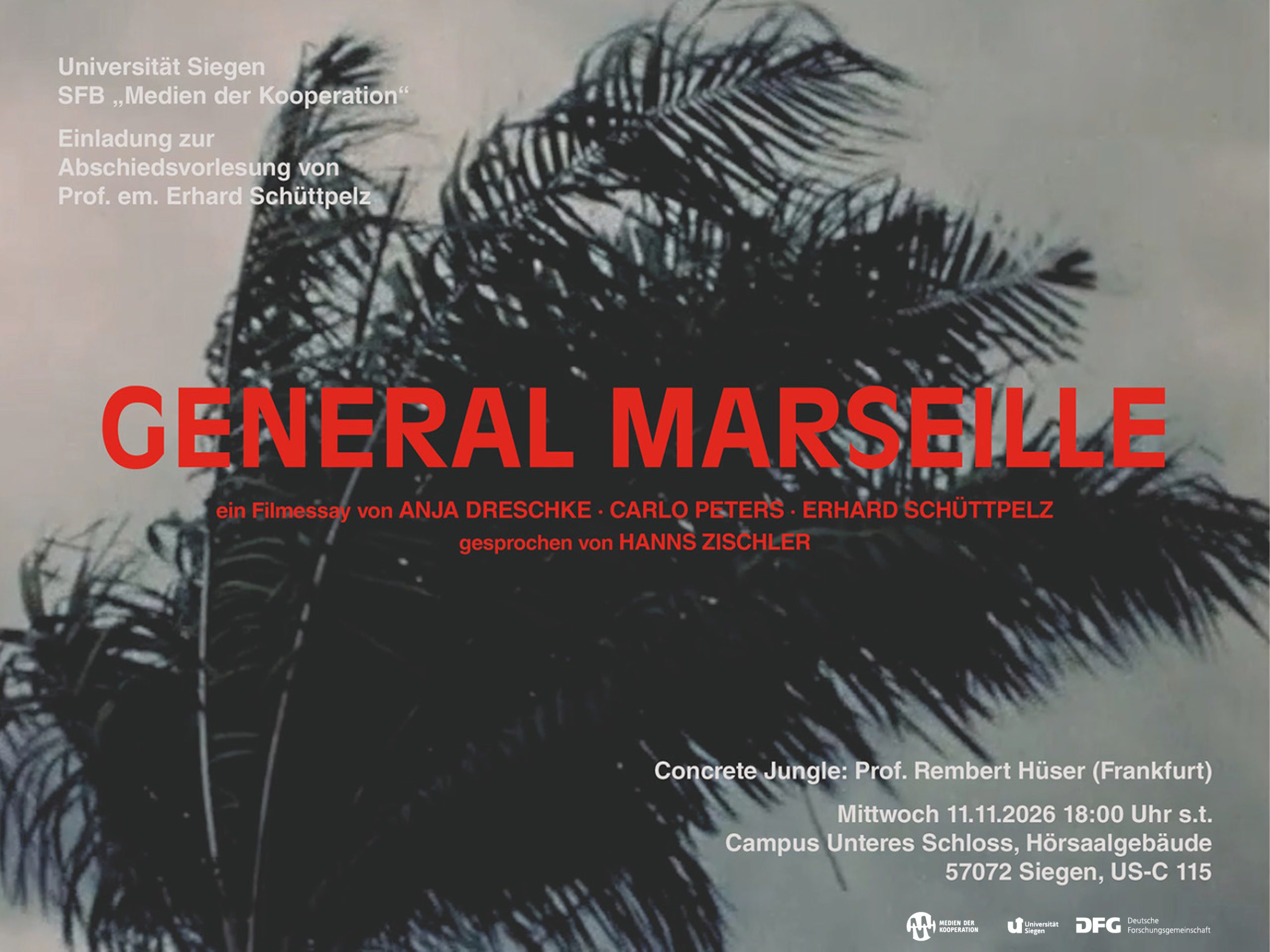
As part of the annual conference, Prof. Dr. Erhard Schüttpelz will deliver his farewell lecture, which will include a laudatory address by Prof. Dr. Rembert Hüser. The farewell ceremony will be held in German.
Der SFB lädt herzlich zur Abschiedsvorlesung von Prof. em. Erhard Schüttpelz. Die Abschiedsvorlesung findet im Rahmen der SFB-Jahrestagung statt.
Wir bitten um Anmeldung →hier
Erhard Schüttpelz war Gründungssprecher des SFB 1187 Medien der Kooperation und des Graduiertenkollegs „Locating Media“ (2012-2021) und hat in diesen Funktionen das interdisziplinäre Forschungsprofil der Universität im Bereich von Digitalisierung und Medien wesentlich bestimmt. Mit seinen Arbeiten zur ethnographischen Fundierung medienwissenschaftlicher Konzeptbildung hat er ein neues Forschungsparadigma von internationaler Bedeutung etabliert. Erhard Schüttpelz war zudem Fachgutachter der DFG und Mitglied des Hochschulrates. In den letzten Jahren hat E. Schüttpelz zudem als öffentlicher Intellektueller politische Diskurse, insbesondere auch zur jüngsten deutschen Geschichte, aufgeworfen und geprägt, siehe beispielsweise die Diskussion um den Bedeutung des 8. Mais 1945: https://blnreview.de/ausgaben/2025-05/erhard-schuettpelz-tag-der-befreiung-8-mai-displaced-persons
In seiner Abschiedsvorlesung präsentiert und diskutiert Erhard Schüttpelz seinen Filmessay „General Marseille“, den er gemeinsam mit Anja Dreschke und Carlo Peters produziert hat. Die Laudatio hält Prof. Rembert Hüter.
Anschließend lädt der SFB zum Umtrunk ein.
More information coming soon.
Die Vorstandssitzungen enthalten Berichte, Themenpunkte und Verschiedenes, die für alle SFB Mitglieder öffentlich sind. Personenbezogene Anträge und Finanzen sind nicht öffentlich und werden nach dem öffentlichen Teil besprochen. Webex-Links für Online-Teilnahmen werden am vorherigen Freitag verschickt. Teilnahme vor Ort ist möglich.
Digitale Protokolle des öffentlichen Teils werden über sciebo zur Verfügung gestellt.
Sensing Loss – Uni Köln goes r e t u r n: 60 Minutes AnthroLab.
Donnerstags 16:30-17:30Uhr
Prof. Dr. Erella Grassiani (Amsterdam): Arboreal Nationalism: Planted landscapes of death and return in Israel / Palestine
Die Diskussionsreihe Sensing Loss bringt ethnologische Forschungen aus der Universität ins Museum. Sozial- und Kulturanthropolog:innen aller Karrierestufen berichten aus ihren aktuellen Forschungen, wie Menschen Verlust erfahren und Verlusterfahrungen bearbeiten. Sensing Loss fragt, wie Verlust begegnet, verkörpert und verräumlicht wird – und wie aus Vertreibung, Enteignung und vergangenem Unrecht neue Zukünfte gewonnen werden können. Erfahrungen des Verlusts (loss), ihre Konfrontation und Aufarbeitung [r e t u r n] sind dabei so vielfältig wie die Situationen, in denen Menschen Kolonialismus, Marginalisierung oder Gewalt begegnen. Die öffentlichen Vorträge diskutieren Formen des Sensing, über die Menschen Verlust gewahr werden, und Sense Making, d.h. die Frage, wie Menschen Verlusterfahrungen eine Bedeutung verleihen. Trauer, Verlust und Erinnerung können zur Quelle werden, Ansprüche an die Gegenwart zu artikulieren und zwischen Menschen und Orten, Vergangenheit und Zukunft neue Verbindungen zu erarbeiten. Im Sinne der Ausstellung r e t u r n beschäftigen sich die Vorträge mit ganz unterschiedlichen Momenten und Formen der Trauer, der Nostalgie, der Erinnerungsarbeit und des gemeinsamen Aufbruchs.
————
The lecture series Sensing Loss connects anthropological thinking across university and museum spaces. Social and cultural anthropologists at all career stages discuss their ongoing research to explore how people sense and make sense of loss. Sensing Loss asks how loss is experienced, embodied and spatialized – and how displacement, dispossession and past injustices can become sources for new future-making practices. Experiences of loss, their confrontation, and the ways in which people try to come to terms with them – and find ways to r e t u r n – are as diverse as the situations in which people experience colonialism, violence or marginalization.
The public lectures discuss how grief, loss and remembrance can become resources for articulating claims on the present, and for shaping new connections between people and places, past and future. In resonance with the exhibition r e t u r n at the RJM, the lectures engage with diverse moments and forms of grief, nostalgia and memory work, as well as with joint departures into new futures.
The SFB 1187 „Media of Cooperation“ is pleased to welcome Kirill Maslinsky (INALCO, Paris) for a guest lecture on the methodological promises and pitfalls of using large language models in empirical research. The lecture continues the SFB’s ongoing discussion of AI-based research methods, including the Synthetic Methods series and the Critical Data Schools on AI methods. It looks at a question that becomes urgent once LLM agents are used to analyse whole corpora: when do the numbers they produce actually support the claims we want to make?
Abstract
Modern LLMs have made it possible to automate content analysis tasks with a much higher level of semantic and contextual understanding than earlier NLP technologies. By analogy with Web 2.0, this transition may be labelled Content Analysis 2.0. The recent surge of agentic workflows has made these capabilities applicable at scale to real corpora. Isn’t this the dream of mixed-methods research, where qualitative understanding translates into quantitative results with only modest time and budget requirements?
The problem with this scaling is that in the naive setting, where we simply instruct agents and collect results, we risk running estimation without identification. Estimation is the procedure that produces the numbers of interest that characterise the content of a corpus: proportions, trends, and effect sizes. Identification is the argument that the data at hand can support the claim we wish to make. The apparent fluency of LLM-generated results masks the lack of identification for some of the claims they produce. In this lecture, I will discuss methods to ensure the identification of text-based claims in the context of agentic workflows.
About the speaker
Kirill Maslinsky is a quantitative researcher in the humanities and a research engineer at INALCO (Institut national des langues et civilisations orientales) in Paris. His background is cross-disciplinary: he trained in linguistics and literary studies and holds a PhD in cultural anthropology. His current work focuses on computational literary studies, including a quantitative history of Soviet children’s book publishing, and he contributes to the ERC project „Theory of Tone“. His methodological toolkit combines causal inference, Bayesian statistical modelling, and agentic workflows adapted for text analysis. He is committed to open data and open research practices and to building digital research infrastructure.
The lecture will be held in English and is open to all SFB members, students, and interested guests. It takes place on-site with a hybrid option. Please register via email to info@sfb1187.uni-siegen.de to receive the Zoom link.
Sensing Loss – Uni Köln goes r e t u r n: 60 Minutes AnthroLab.
Donnerstags 16:30-17:30Uhr
Dr. Hilal Alkan (Berlin): Return, stay, back-and-forth: Syncing migrant-time with plant-time
Die Diskussionsreihe Sensing Loss bringt ethnologische Forschungen aus der Universität ins Museum. Sozial- und Kulturanthropolog:innen aller Karrierestufen berichten aus ihren aktuellen Forschungen, wie Menschen Verlust erfahren und Verlusterfahrungen bearbeiten. Sensing Loss fragt, wie Verlust begegnet, verkörpert und verräumlicht wird – und wie aus Vertreibung, Enteignung und vergangenem Unrecht neue Zukünfte gewonnen werden können. Erfahrungen des Verlusts (loss), ihre Konfrontation und Aufarbeitung [r e t u r n] sind dabei so vielfältig wie die Situationen, in denen Menschen Kolonialismus, Marginalisierung oder Gewalt begegnen. Die öffentlichen Vorträge diskutieren Formen des Sensing, über die Menschen Verlust gewahr werden, und Sense Making, d.h. die Frage, wie Menschen Verlusterfahrungen eine Bedeutung verleihen. Trauer, Verlust und Erinnerung können zur Quelle werden, Ansprüche an die Gegenwart zu artikulieren und zwischen Menschen und Orten, Vergangenheit und Zukunft neue Verbindungen zu erarbeiten. Im Sinne der Ausstellung r e t u r n beschäftigen sich die Vorträge mit ganz unterschiedlichen Momenten und Formen der Trauer, der Nostalgie, der Erinnerungsarbeit und des gemeinsamen Aufbruchs.
————
The lecture series Sensing Loss connects anthropological thinking across university and museum spaces. Social and cultural anthropologists at all career stages discuss their ongoing research to explore how people sense and make sense of loss. Sensing Loss asks how loss is experienced, embodied and spatialized – and how displacement, dispossession and past injustices can become sources for new future-making practices. Experiences of loss, their confrontation, and the ways in which people try to come to terms with them – and find ways to r e t u r n – are as diverse as the situations in which people experience colonialism, violence or marginalization.
The public lectures discuss how grief, loss and remembrance can become resources for articulating claims on the present, and for shaping new connections between people and places, past and future. In resonance with the exhibition r e t u r n at the RJM, the lectures engage with diverse moments and forms of grief, nostalgia and memory work, as well as with joint departures into new futures.
Workshopzeiten
Donnerstag: 10 – 17 Uhr
Freitag: 10 – 13 Uhr
About the Masterclass
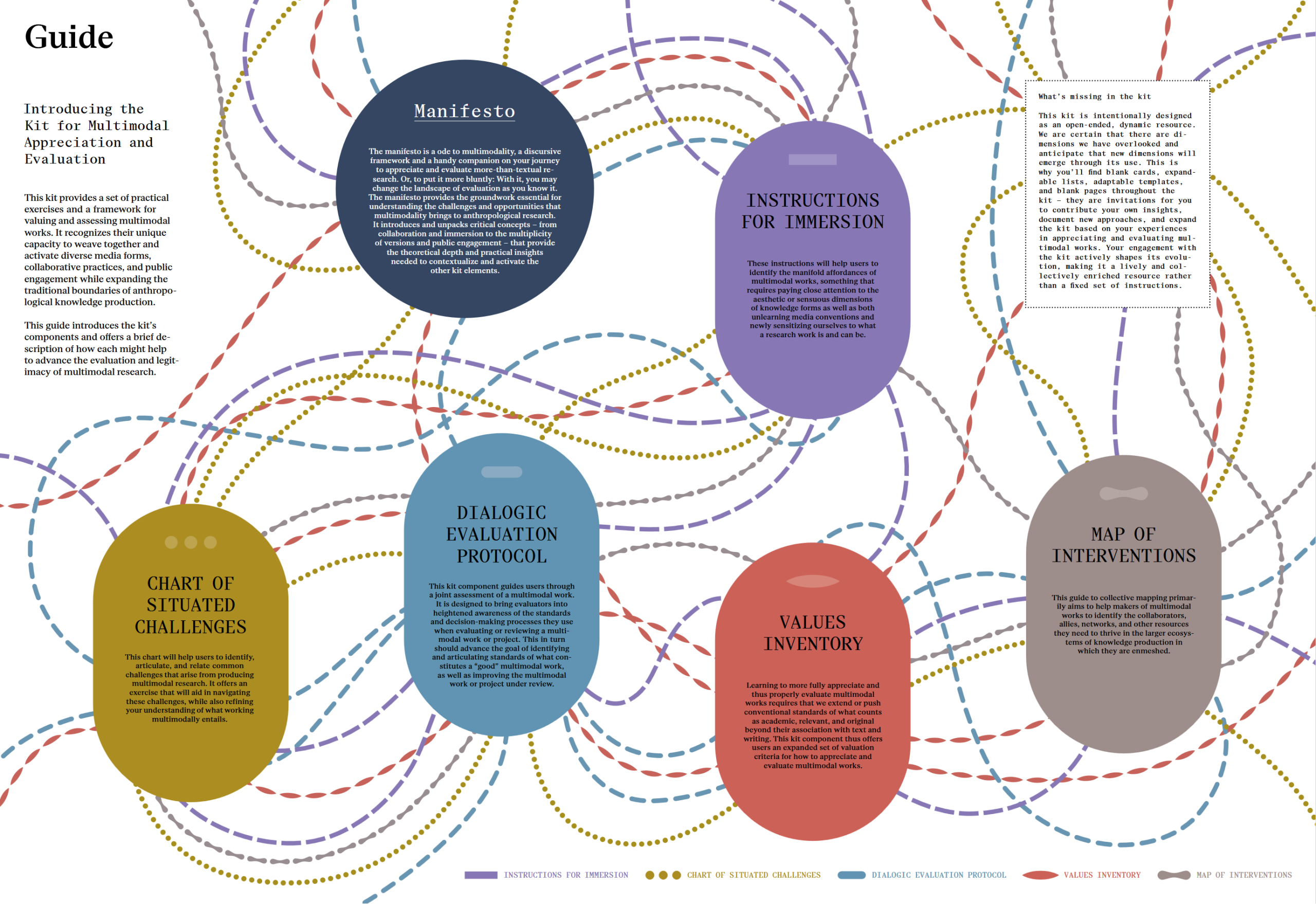
Are you a maker of multimodal works—a film, a game, a performance, a comic, a city walk, a web platform, an exhibit, a sound installation— but concerned about their legitimacy in institutional contexts that privilege text-based formats? Is it possible for us to appreciate and evaluate a multimodal work as academically relevant without becoming an expert in the specific affordances of each media format? What kind of pitfalls and risks exist when conceptualizing and practicing multimodal research, and are there ways to anticipate or even avoid them?
This workshop will draw upon the recently published Multimodal Appreciation Kit (Albrecht, Criado, Farias, Gilbert and Maier, 2025), and feature sessions devoted to identifying and articulating the value of multimodal works, as well as planning for and designing more-than-textual research. It will be of interest to those who have a multimodal practice, those who are considering incorporating multimodality into their research, as well as those who are curious about more-than-textual research and how to evaluate it.
Andrew Gilbert is a sociocultural anthropologist specializing in multisensory and multimodal ethnography, experimental and collaborative research design, and the politics of social transformation in contexts of historical upheaval. He is professor of design anthropology at the Burg Giebichenstein University of Art and Design in Halle, and former co-director of the Stadtlabor for Multimodal Anthropology at Humboldt University in Berlin.
About the series „Masterclass Media Ethnography“
The use of audiovisual media has sparked an increasingly diverse methodological debate within the history of ethnographic research approaches. This has provided innovative impetus for the reciprocal collaborative relationships that are developing between ethnographic researchers, research participants, the audience of ethnographic research findings, and the various media involved. In the Cologne-Siegen Masterclass in Media Ethnography, leading figures in visual ethnology will present their work and research approaches and discuss their respective research material with the participants.
Sensing Loss – Uni Köln goes r e t u r n: 60 Minutes AnthroLab.
Donnerstags 16:30-17:30Uhr
Hamid Bouhlal (Autor und spirituelles Oberhaupt der ʿIsāwa Shaym u Muhtār, Meknes-Paris), Sebastian Eschenbach (Filmemacher, Uckermark), Prof. Dr. Martin Zillinger (Köln): Selbstverlust und Selbstgewinn: Trauer, Trance und soziale Gemeinschaft in Marokko
Die Diskussionsreihe Sensing Loss bringt ethnologische Forschungen aus der Universität ins Museum. Sozial- und Kulturanthropolog:innen aller Karrierestufen berichten aus ihren aktuellen Forschungen, wie Menschen Verlust erfahren und Verlusterfahrungen bearbeiten. Sensing Loss fragt, wie Verlust begegnet, verkörpert und verräumlicht wird – und wie aus Vertreibung, Enteignung und vergangenem Unrecht neue Zukünfte gewonnen werden können. Erfahrungen des Verlusts (loss), ihre Konfrontation und Aufarbeitung [r e t u r n] sind dabei so vielfältig wie die Situationen, in denen Menschen Kolonialismus, Marginalisierung oder Gewalt begegnen. Die öffentlichen Vorträge diskutieren Formen des Sensing, über die Menschen Verlust gewahr werden, und Sense Making, d.h. die Frage, wie Menschen Verlusterfahrungen eine Bedeutung verleihen. Trauer, Verlust und Erinnerung können zur Quelle werden, Ansprüche an die Gegenwart zu artikulieren und zwischen Menschen und Orten, Vergangenheit und Zukunft neue Verbindungen zu erarbeiten. Im Sinne der Ausstellung r e t u r n beschäftigen sich die Vorträge mit ganz unterschiedlichen Momenten und Formen der Trauer, der Nostalgie, der Erinnerungsarbeit und des gemeinsamen Aufbruchs.
————
The lecture series Sensing Loss connects anthropological thinking across university and museum spaces. Social and cultural anthropologists at all career stages discuss their ongoing research to explore how people sense and make sense of loss. Sensing Loss asks how loss is experienced, embodied and spatialized – and how displacement, dispossession and past injustices can become sources for new future-making practices. Experiences of loss, their confrontation, and the ways in which people try to come to terms with them – and find ways to r e t u r n – are as diverse as the situations in which people experience colonialism, violence or marginalization.
The public lectures discuss how grief, loss and remembrance can become resources for articulating claims on the present, and for shaping new connections between people and places, past and future. In resonance with the exhibition r e t u r n at the RJM, the lectures engage with diverse moments and forms of grief, nostalgia and memory work, as well as with joint departures into new futures.
more information coming soon
As sensor technologies increasingly permeate everyday practices in mobility, traffic, health and care, the capture, processing, and interpretation of data have become central to socio-technical organisation, planning, monitoring, and decision-making. This one-day workshop is a cross-project initiative (A03 Navigation in/through Smart Cycling, A05 Healthcare, P05 Traffic Interaction) that invites researchers to critically examine the politics, ethics, and technical challenges inherent in negotiating and handling sensory data.
Besides technologically generated sensor data, research on sensory and embodied knowledge foregrounds the distributed sensorium, highlighting how sensing through bodies and environments produces situated forms of data and knowledge that coexist and interact with technical modes of sensing.
Moving beyond mere data presentation, this workshop explores how conceptions and practices of visualisation act as a form of distributed sense-making, posing the question how complexity can be handled and, where possible, reduced without losing accessibility. Participants will engage with critical tensions regarding data ownership and access (e.g. public vs. private platforms), interoperability across domains, and the (in)visibility of interpretative processes that define “prosocial” behavior, pertain to “good governance”, or shape care practices.
Through interactive “show-and-tell” talks, collaborative mapping and graphic recording, the workshop addresses the negotiation work that goes into making sensory data accessible, including for non-visual modalities (audio/haptic), and accountable to diverse stakeholders. The goal is to produce a shared framework for understanding the distributed socio-technical sensorium, identify frictions in current data practices and infrastructures, and formulate a research agenda for future working papers on the politics of sensing.
If you want to particiapte at the workshop, please register via email to Akib Shahriar Khan.
Die Vorstandssitzungen enthalten Berichte, Themenpunkte und Verschiedenes, die für alle SFB Mitglieder öffentlich sind. Personenbezogene Anträge und Finanzen sind nicht öffentlich und werden nach dem öffentlichen Teil besprochen. Webex-Links für Online-Teilnahmen werden am vorherigen Freitag verschickt. Teilnahme vor Ort ist möglich.
Digitale Protokolle des öffentlichen Teils werden über sciebo zur Verfügung gestellt.
Most subprojects already have a DMP. This session is about keeping it useful, how to treat the DMP as a document that grows with your data collection, what to revise and when, and how the DMP connects to storage, archiving and the requirements that come later in the project. Practical work on your own plan, not a lecture on templates.
The workshop is for all CRC members.
Here is the event link: https://umfragen.uni-siegen.de/index.php/785387?lang=en
Die Vorstandssitzungen enthalten Berichte, Themenpunkte und Verschiedenes, die für alle SFB Mitglieder öffentlich sind. Personenbezogene Anträge und Finanzen sind nicht öffentlich und werden nach dem öffentlichen Teil besprochen. Webex-Links für Online-Teilnahmen werden am vorherigen Freitag verschickt. Teilnahme vor Ort ist möglich.
Digitale Protokolle des öffentlichen Teils werden über sciebo zur Verfügung gestellt.
more info coming soon.
Die Vorstandssitzungen enthalten Berichte, Themenpunkte und Verschiedenes, die für alle SFB Mitglieder öffentlich sind. Personenbezogene Anträge und Finanzen sind nicht öffentlich und werden nach dem öffentlichen Teil besprochen. Webex-Links für Online-Teilnahmen werden am vorherigen Freitag verschickt. Teilnahme vor Ort ist möglich.
Digitale Protokolle des öffentlichen Teils werden über sciebo zur Verfügung gestellt.
More information coming soon.
More information will follow soon
Sensing Loss – Uni Köln goes r e t u r n: 60 Minutes AnthroLab.
Donnerstags 16:30-17:30Uhr
Dr. Simone Pfeifer (Goethe-Universität Frankfurt): Wer wird gehört? Postdigitale Erinnerung nach rechter Gewalt in der postmigrantischen Gesellschaft
Die Diskussionsreihe Sensing Loss bringt ethnologische Forschungen aus der Universität ins Museum. Sozial- und Kulturanthropolog:innen aller Karrierestufen berichten aus ihren aktuellen Forschungen, wie Menschen Verlust erfahren und Verlusterfahrungen bearbeiten. Sensing Loss fragt, wie Verlust begegnet, verkörpert und verräumlicht wird – und wie aus Vertreibung, Enteignung und vergangenem Unrecht neue Zukünfte gewonnen werden können. Erfahrungen des Verlusts (loss), ihre Konfrontation und Aufarbeitung [r e t u r n] sind dabei so vielfältig wie die Situationen, in denen Menschen Kolonialismus, Marginalisierung oder Gewalt begegnen. Die öffentlichen Vorträge diskutieren Formen des Sensing, über die Menschen Verlust gewahr werden, und Sense Making, d.h. die Frage, wie Menschen Verlusterfahrungen eine Bedeutung verleihen. Trauer, Verlust und Erinnerung können zur Quelle werden, Ansprüche an die Gegenwart zu artikulieren und zwischen Menschen und Orten, Vergangenheit und Zukunft neue Verbindungen zu erarbeiten. Im Sinne der Ausstellung r e t u r n beschäftigen sich die Vorträge mit ganz unterschiedlichen Momenten und Formen der Trauer, der Nostalgie, der Erinnerungsarbeit und des gemeinsamen Aufbruchs.
————
The lecture series Sensing Loss connects anthropological thinking across university and museum spaces. Social and cultural anthropologists at all career stages discuss their ongoing research to explore how people sense and make sense of loss. Sensing Loss asks how loss is experienced, embodied and spatialized – and how displacement, dispossession and past injustices can become sources for new future-making practices. Experiences of loss, their confrontation, and the ways in which people try to come to terms with them – and find ways to r e t u r n – are as diverse as the situations in which people experience colonialism, violence or marginalization.
The public lectures discuss how grief, loss and remembrance can become resources for articulating claims on the present, and for shaping new connections between people and places, past and future. In resonance with the exhibition r e t u r n at the RJM, the lectures engage with diverse moments and forms of grief, nostalgia and memory work, as well as with joint departures into new futures.
The conference, entitled ‘Language Connects: Cooperative Communicative Practices in Media Societies’, focuses on all types of linguistic and communicative media practices (in the broadest sense) through which actors, acting (more or less) in accordance with the situation, work towards facilitating cooperation and/or sustainably promoting cohesion, or counteracting the production of categories of social difference.
A conference itself also constitutes a cooperative communicative practice sui generis. This becomes particularly evident when it is not merely an academic conference. This conference is being held to mark the 60th birthday of Prof. Dr Stephan Habscheid, and the organising team is delighted to be able to engage in in-depth discussions with the speakers and all conference participants on specific and, in our view, highly relevant aspects of cooperative communicative practices.
To aid planning, the organising team would ask that you send an informal registration to Jan Gerwinski (gerwinski[at]germanistik.uni-siegen.de) by 15 September 2026.
Konferenz-Website Ankommen
Grußworte und Einführung
Vortrag: Wissing bei Lanz: Wie man der Versuchung destruktiver Praktiken widersteht
Prof. Dr. Werner Holly (Chemnitz)
Vortrag: Zuschauen als soziale Praxis – außerhalb der Medienrezeption
Prof. Dr. Heike Baldauf-Quilliatre (Lyon)
Kaffeepause mit Kuchenbuffet
Vortrag: Kooperation im Straßenverkehr
Prof. Dr. Arnulf Deppermann (Mannheim)
Vortrag: Kooperation inter- und transdisziplinär: Wie ein gemeinsames Ziel Wissenschaft und Praxisfelder zusammenhalten kann
Prof. Dr. Maija Hirvonen (Tampere)
Glückwünsche
Fingerfood-Buffet
Ankommen
Begrüßung
Vortrag: Wie ein Kalendereintrag entsteht
Prof. Dr. Ruth Ayaß (Bielefeld)
Kaffeepause
Vortrag: Aufmerksamkeit beim Sprecherwechsel. Systemtheoretische Überlegungen zu einem sprachwissenschaftlichen Problem
Prof. Dr. Niels Werber (Siegen)
Vortrag: „Wir von ...“ Filme auf Unternehmenshomepages als Mittel zur Herstellung von Zusammenhalt
Prof. Dr. Monika Dannerer (Innsbruck)
Ausklang und Häppchen
Sensing Loss – Uni Köln goes r e t u r n: 60 Minutes AnthroLab.
Donnerstags 16:30-17:30Uhr
PD Dr. Omar Kasmani (Freie Universität, Berlin): After Love. On Loss, Home and Other Heartbreak
Die Diskussionsreihe Sensing Loss bringt ethnologische Forschungen aus der Universität ins Museum. Sozial- und Kulturanthropolog:innen aller Karrierestufen berichten aus ihren aktuellen Forschungen, wie Menschen Verlust erfahren und Verlusterfahrungen bearbeiten. Sensing Loss fragt, wie Verlust begegnet, verkörpert und verräumlicht wird – und wie aus Vertreibung, Enteignung und vergangenem Unrecht neue Zukünfte gewonnen werden können. Erfahrungen des Verlusts (loss), ihre Konfrontation und Aufarbeitung [r e t u r n] sind dabei so vielfältig wie die Situationen, in denen Menschen Kolonialismus, Marginalisierung oder Gewalt begegnen. Die öffentlichen Vorträge diskutieren Formen des Sensing, über die Menschen Verlust gewahr werden, und Sense Making, d.h. die Frage, wie Menschen Verlusterfahrungen eine Bedeutung verleihen. Trauer, Verlust und Erinnerung können zur Quelle werden, Ansprüche an die Gegenwart zu artikulieren und zwischen Menschen und Orten, Vergangenheit und Zukunft neue Verbindungen zu erarbeiten. Im Sinne der Ausstellung r e t u r n beschäftigen sich die Vorträge mit ganz unterschiedlichen Momenten und Formen der Trauer, der Nostalgie, der Erinnerungsarbeit und des gemeinsamen Aufbruchs.
————
The lecture series Sensing Loss connects anthropological thinking across university and museum spaces. Social and cultural anthropologists at all career stages discuss their ongoing research to explore how people sense and make sense of loss. Sensing Loss asks how loss is experienced, embodied and spatialized – and how displacement, dispossession and past injustices can become sources for new future-making practices. Experiences of loss, their confrontation, and the ways in which people try to come to terms with them – and find ways to r e t u r n – are as diverse as the situations in which people experience colonialism, violence or marginalization.
The public lectures discuss how grief, loss and remembrance can become resources for articulating claims on the present, and for shaping new connections between people and places, past and future. In resonance with the exhibition r e t u r n at the RJM, the lectures engage with diverse moments and forms of grief, nostalgia and memory work, as well as with joint departures into new futures.
Histories of Tracking
Université de Luxembourg | Universität Siegen
September 30 – October 2, 2026
Surveillance has become ubiquitous in digital media environments and is now taken for granted. With every PayPal interaction, at the least more than 600 trackers eavesdrop on its transactional data (Schneier 2018). While there is no lack of critique on digital surveillance and its discontents, its ubiquity and naturalization itself require more explanation. Which historical and economical trajectories have led into the current escalation of digital tracking, tracing, monitoring, classification, intelligence service, and advertising? How can we discover and mobilize counter-points and narratives that explain digital surveillance otherwise? Do micro-level media, data, and sensor practices represent “yet another mutation of capitalism,” to quote from Gilles Deleuze’s famous Postscript on the Societies of Control (1990)?
Tracking persons, emotions, objects, apparatuses, money, signs and data is a veritable environing technique. It is also one of the key business applications of platform and data economies, which provide for the infrastructures of state-side institutional surveillance and control. With our joint Luxembourg-Siegen conference on Histories of Tracking we aim to track the trackers historiographically, technologically, and ecologically.
In a seminal text, Phil Agre (2003 [1994]) has encouraged us to think about the difference between rather centralized regimes of (visual) surveillance and data-based institutional regimes of “capture.” Agre has paved the way for a logistical theory of digital surveillance that investigates its micropolitics. While non-visual alphanumeric modes of capturing data do not feel like surveillance, they nonetheless establish an ever more mundane and affective mode of ubiquitous surveillance. What if we follow Agre’s analysis of institutional “grammars of action” that afford a whole spectrum of capturing, monitoring, sensing, and surveillant practices? Histories of tracking, we assume, are histories of the institutions, corporations, and agencies that create the tapestry of surveillance (Lauer 2017). That tapestry might seem all-encompassing and seamless by now, even if it contains loose threads, loopholes, and islands of encryption.
Histories of tracking are co-operative histories that involve the consent, non-consent and dissent of digital media usage (Jones 2024). They are also business histories that rely on what Shoshana Zuboff (2019) has aptly called a “behavioral surplus” of data––without properly historicizing its inception. Last but not least, histories of tracking are histories of its public scrutiny and accountability, from opposing civil rights movements to the political and legal controversies that make the case for regulation.
We thus invite dedicated contributions from Media and Cultural Studies, History, Science and Technology Studies, Surveillance Studies, Platform Studies, Code Studies, Socio-Informatics, Law, and Sociology that combine historiographic and empirical work with grounded theoretical approaches. Activist and artistic positions that rethink tracking and/in/as media environments are highly welcome!
Scientific committee
Organisation
With the support of Collaborative Reseacg Centra 1187 Media of Cooperation, Siegen; project A01: Digital Network Technologies between Specialization and Generalization; C²DH, Université de Luxembourg; FNR, Luxembourg and DFG, Germany
References
Agre, Philip E. “Surveillance and Capture. Two Models of Privacy.” In theNewMediaReader, edited by Noah Wardrip-Fruin and Nick Montfort. MIT Press, 2003 [1994].
Deleuze, Gilles. “Postscript on the Societies of Control.” October 59 (1992): 3–7.
Jones, Meg Leta. The Character of Consent. The History of Cookies and the Future of Technology Policy. Information Policy. MIT Press, 2024.
Lauer, Josh. Creditworthy. A History of Consumer Surveillance and Financial Identity in America. Columbia University Press, 2017.
Schneier, Bruce. “The 600+ Companies PayPal Shares Your Data With – Schneier on Security.” Schneier on Security, March 14, 2018. https://www.schneier.com/blog/archives/2018/03/the_600_compani.html.
Zuboff, Shoshana. The Age of Surveillance Capitalism. The Fight for a Human Future at the New Frontier of Power. Public Affairs, 2019.
Programm Sensoriality in social interaction has been a topic raising increasing interest in Ethnomethodology and Conversation Analysis (EMCA) these last years (Fele 2019, Goodwin, MH 2017, Liberman 2022, Meyer & Meier 2016, Meyer 2021, Mondada 2018, 2021, Mondada & Cekaite 2020), expanding previous work on multimodality (Goodwin, C 2018, Mondada 2019) and inspired by insights coming from, amongst others, Scottish moral philosophy, early Simmelian insights, phenomenology, and the anthropology of the senses. The issue has been to put multisensoriality on the agenda of interaction studies, with a special focus on how sensorial and perceptual practices relating to, and establishing, the world and others are publicly and recognizably achieved and shared in social interaction.
Building on this background, this workshop further discusses multisensoriality in social interaction, and in particular the potentials and prospects of the concept of synaesthesia for interaction research. Here, synaesthesia is not understood as a clinical or psychological condition, but as an everyday practical phenomenon—inspired by its phenomenological sense developed, among others, by Merleau-Ponty and Sartre. On this view, our experience of the world already involves constant cross-sensory supplementation and translation—for example, visual experience is routinely complemented by, and intertwined with, other sensory familiarities. Sartre famously stated that we ‘see’ the sourness of a lemon: “each of its qualities is extended throughout each of the others. It is the sourness of the lemon which is yellow, it is the yellow of the lemon which is sour. We eat the color of a cake, and the taste of this cake is the instrument which reveals its shape and its color to what we may call the alimentary intuition.” Merleau-Ponty similarly describes glass: we see its “hardness and brittleness (…), and when, with a tinkling sound, it breaks, this sound is conveyed by the visible glass.” The issue is for us to reflect about these insights within an interactional framework and on the basis of video analysis, within the epistemology and methodology of EMCA.
While we do not doubt the ongoing cross-sensorial supplementation and translation during perception, it is the generality of such descriptions that we would like to examine and discuss in the workshop. E.g., when do they apply in general, and when are perceptions only manifested through specific senses, and not others, or are not at all cross-sensorial, according to the particularities of the interactional situation and activity? How are sensory experiences and synaesthesias made accountable and sequentially fed into interaction? So far, the complementarity, substitutability, translatability, and mutual elaboration of sensory modes has mainly been discussed in studies of the individual perceptor. In this workshop, we will discuss empirical studies showing how participants ongoingly accomplish and also presuppose this phenomenon for their co-participants, as part of the assumed „objectivity of the world“, and use it in interaction—both in (1) interactionally achieved co-perception and co-sensing of relevant objects and in (2) co-bodily (including intercorporeal) interaction, where participants make their sensory perceptions, orientations and access accountable to one another up to and including having co-experiences.
Registration/Contact:
All are welcome, please send a short e-mail until 22.09. to: clemens.eisenmann[æt]uni-konstanz.de
Program & Abstracts Introduction
“Synesthetic Interaction and Interactional Synesthesia: How the Senses Complement, Substitute, Elaborate, and Translate One Another in Interaction”
Christian Meyer (University of Konstanz)
“Multimodality, multisensoriality and synaesthesia in social interaction”
Lorenza Mondada (University of Basel)
LUNCH
“Learning to see through touch: The interactional accomplishment of synaesthetic perception in vine-pruning instruction”
Giolo Fele (University of Trento)
COFFEE
“In Praise of My Transmodal Hands”
Jürgen Streeck (University of Texas at Austin)
“Co-perception and co-sensing of human subjects/objects”
Asta Cekaite (Linköping University)
Formal dinner: providing an opportunity to discuss topics in greater detail in one-on-one conversations
“At the interface of sound and touch”
Leelo Keevallik (University of Linköping)
“Senses of Correction: Comparing Correction Practices in Movement”
Robert Mitchell (University of Mainz)
Lunch
“Kinaesthetic Sensing in Dance: Embodying the Percept of Others and Achieving Intercorporeality”
Chiara Bassetti (University of Trento)
Joint closing discussion
Chair: Clemens Eisenmann (University of Konstanz/Siegen)
Sensing Loss – Uni Köln goes r e t u r n: 60 Minutes AnthroLab.
Donnerstags 16:30-17:30Uhr
Prof. Dr. Franz Krause (Köln): Sensing Loss im Mackenzie-Delta: Auf der Suche in den Sedimenten vergangener Zukünfte
Die Diskussionsreihe Sensing Loss bringt ethnologische Forschungen aus der Universität ins Museum. Sozial- und Kulturanthropolog:innen aller Karrierestufen berichten aus ihren aktuellen Forschungen, wie Menschen Verlust erfahren und Verlusterfahrungen bearbeiten. Sensing Loss fragt, wie Verlust begegnet, verkörpert und verräumlicht wird – und wie aus Vertreibung, Enteignung und vergangenem Unrecht neue Zukünfte gewonnen werden können. Erfahrungen des Verlusts (loss), ihre Konfrontation und Aufarbeitung [r e t u r n] sind dabei so vielfältig wie die Situationen, in denen Menschen Kolonialismus, Marginalisierung oder Gewalt begegnen. Die öffentlichen Vorträge diskutieren Formen des Sensing, über die Menschen Verlust gewahr werden, und Sense Making, d.h. die Frage, wie Menschen Verlusterfahrungen eine Bedeutung verleihen. Trauer, Verlust und Erinnerung können zur Quelle werden, Ansprüche an die Gegenwart zu artikulieren und zwischen Menschen und Orten, Vergangenheit und Zukunft neue Verbindungen zu erarbeiten. Im Sinne der Ausstellung r e t u r n beschäftigen sich die Vorträge mit ganz unterschiedlichen Momenten und Formen der Trauer, der Nostalgie, der Erinnerungsarbeit und des gemeinsamen Aufbruchs.
————
The lecture series Sensing Loss connects anthropological thinking across university and museum spaces. Social and cultural anthropologists at all career stages discuss their ongoing research to explore how people sense and make sense of loss. Sensing Loss asks how loss is experienced, embodied and spatialized – and how displacement, dispossession and past injustices can become sources for new future-making practices. Experiences of loss, their confrontation, and the ways in which people try to come to terms with them – and find ways to r e t u r n – are as diverse as the situations in which people experience colonialism, violence or marginalization.
The public lectures discuss how grief, loss and remembrance can become resources for articulating claims on the present, and for shaping new connections between people and places, past and future. In resonance with the exhibition r e t u r n at the RJM, the lectures engage with diverse moments and forms of grief, nostalgia and memory work, as well as with joint departures into new futures.

Social media platforms are increasingly shaped by the integration of generative AI alongside long-standing analytical and predictive models. Today’s algorithmic systems are moving from the background infrastructure to the forefront of digital social life – intervening in the content feeds as conversational agents like xAI’s Grok, reshaping identity through synthetic likenesses of OpenAI’s Sora-2, and expanding the social ecosystem itself through projects like Butterflies AI and Moltbook, where autonomous AI agents operate in coexistence with (or independently of) human users. As these developments rapidly outpace existing research frameworks, the need for mixed critical methodologies grows more urgent.
Synthetic social media research takes as its starting point the recognition that platforms shaped by generative AI are not simply data-processing systems but cultural environments organized through algorithms, interfaces, and shared ways of feeling and knowing. Analytically, the attribute “synthetic” implies more than artificial arrangements of collective agency. Rather than treating AI as a radical rupture, it situates generative systems within broader arrangements of human-machine co-creation that amplify specific imaginaries, values, and concerns. Methodologically, it foregrounds ambiguities in how AI platforms recalibrate meaning and how users develop a practical “feel” for algorithmic systems while negotiating their constraints.
Critical digital methods have responded to these developments by treating chatbots and generative systems as part of the research design as well as objects of inquiry in their own right. Synthetic text, images, and sounds are no longer exceptional artifacts but common platform vernaculars, sustained by entangled practices of prompting, remixing, and circulation. Within platform studies, interface methods, visual digital methods, and emerging forms of synthetic ethnography, AI systems have been repurposed for formatting, summarization, annotation, labeling, and the generation of synthetic data, while being interrogated for how they shape knowledge production. This work has foregrounded questions of method: Are we merely studying AI slop, distracted by the automated excess of content stripped of context and meaning, or are we witnessing the redefinition of social media itself along with its affordances and cultures of use?
The 2026 Autumn School edition of the CRC “Media of Cooperation” tackles this question by focusing on generative AI as an infrastructural, cultural, and regulated component of social media platforms across three intersecting dimensions: At the cultural level of everyday use, it refers to the routinized practices of prompting or interacting with platform-embedded generative systems through multimodal inputs. Infrastructurally, it signals a shift in agency, as platforms keep multiplying affordances that nudge us into co-producing synthetic outputs. Finally, it foregrounds research techniques for probing AI models in their entanglements with the platform governance and moderation regimes.
Against this background, we invite participants to submit short contributions inspired by, though not limited to, one of the following „how to“ prompts:
Participants are invited to submit a short abstract (maximum 500 words excluding references) outlining how their work relates to the event’s theme. Presentations should raise questions or provocations rather than present finished research. Accepted abstracts will be grouped into thematic sessions and discussed in a collaborative, dialogue-focused format.
Submit your proposal by 30. April 2026
Notification of acceptance by 15 May 2026
Registration by 15 June 2026
The event opens with a one-day conference and moves into hands-on workshops and project work. Accepted abstracts will be grouped into thematic sessions curated by the organising team. Presenters will be connected via email ahead of time to coordinate their contributions. The first day is about presentations and discussions. The next three days are dedicated to exploring and developing methods – hands-on! We invite you to join a team of interdisciplinary scholars and data designers in probing new methodological combinations. Each of our project teams will present a research question alongside a specific method to be collaboratively explored. Please bring your laptops. The project titles will be announced soon. The event is free of charge, though attendees are responsible for arranging and covering their travel and accommodation in Siegen.
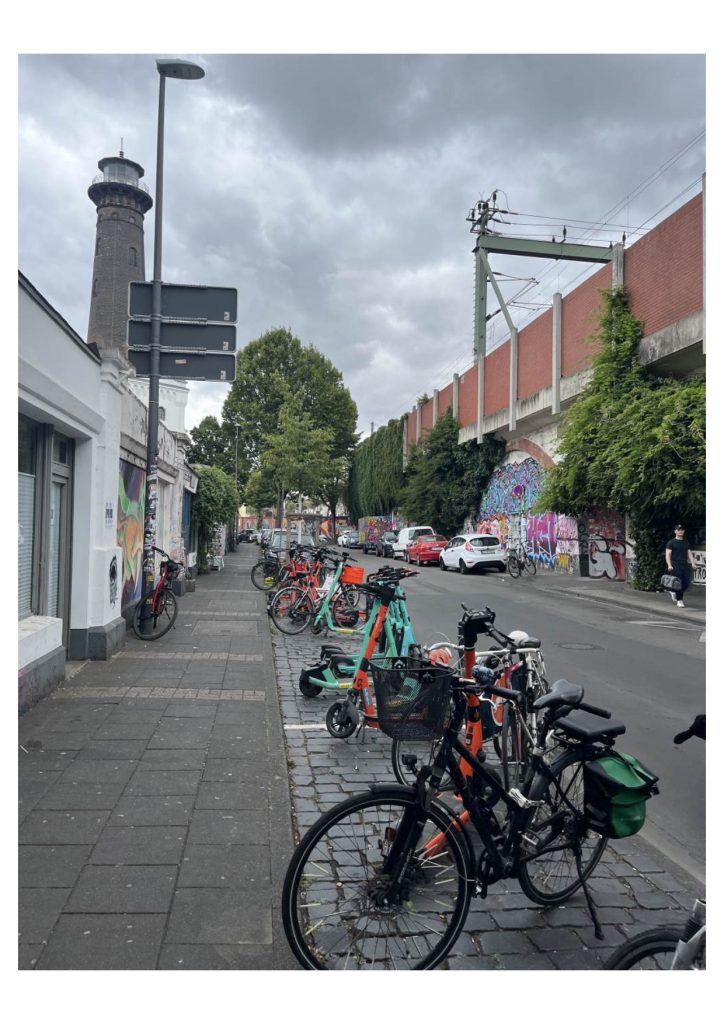
Leihfahrräder, E-Scooter und App-basierte Mobilitätsdienste sind zu einem vertrauten Bestandteil des städtischen Lebens geworden. Diese Dienste, die häufig als nahtlose, nachhaltige und barrierefreie Verkehrsmittel beworben werden, prägen zunehmend die Art und Weise, wie sich Menschen in Städten fortbewegen. Die sogenannte geteilte Mikromobilität ist zudem ein disruptiver Faktor im Straßenraum, da sie neue Reibungspunkte, Hindernisse und Risiken schafft, die gewohnte Bewegung durch die Stadt destabilisieren. Da die geteilte Mikromobilität zudem den Aufbau neuer Infrastrukturen mit sich bringt, wirft sie grundlegende Fragen zu öffentlichem Raum, Technologieökonomie, Datenverwaltung, Barrierefreiheit und Bürgerbeteiligung auf, die sich quer durch die damit verbundenen Veränderungen und die alltäglichen Erfahrungen des Stadtlebens ziehen.
Dieser Workshop lädt Teilnehmende mit unterschiedlichen Hintergründen ein – darunter Nutzer*innen und Nicht-Nutzer*innen von Shared-Mobility-Diensten, Anwohner*innen, politische Entscheidungsträger*innen, Mobilitätsplaner*innen, Aktivist*innen, Forscher*innen und Vertreter*innen der Industrie –, um gemeinsam die Rolle der geteilten Mikromobilität in der Stadt Köln zu beobachten, zu beschreiben und zu analysieren. Der Workshop wird kreative Methoden einsetzen, um alltägliche Begegnungen mit Shared-Mobility-Systemen in den Straßen Ehrenfelds zu untersuchen. Durch situative Mobilitätserfahrungen, die gemeinsame Beobachtung von Mikromobilitätssituationen, Diskussionen und Kartierungsübungen wollen wir die Infrastrukturen, Akteur*innen, Technologien und Be/Wertungspraktiken sichtbar machen, die die aktuelle urbane Mobilität prägen.
Der Workshop orientiert sich an einer Reihe von Fragen: Wie nahtlos – oder eher “nahtreich” (seamful) – und möglicherweise disruptiv – sind die Erfahrungen mit geteilter Mikromobilität in der Praxis? Welche Infrastrukturen, Datenströme, Arbeitsformen und Governance-Strukturen tragen dazu bei, dass diese Dienste (nicht) funktionieren? Wessen Bedürfnisse, Perspektiven und Interessen spiegeln sich in den aktuellen Mobilitätssystemen wider und wessen werden übersehen? Wie gestalten – und stören – digitale Plattformen und Mobilitäts-Apps den Zugang zum städtischen Raum, die Mobilitätsentscheidungen, die Privatsphäre und die Teilhabe? Und wie sollten Fragen der Nachhaltigkeit in diesem Zusammenhang verstanden werden – nicht nur in ökologischer Hinsicht, sondern auch im Zusammenhang mit sozialer Gerechtigkeit, Barrierefreiheit und demokratischer Mitbestimmung?
Indem diese Fragen aus verschiedenen Perspektiven und Blickwinkeln beleuchtet werden, zielt der Workshop darauf ab, eine gemeinsame Auseinandersetzung mit den Chancen, Reibungspunkten und Folgen geteilter Mikromobilität anzuregen. Ziel ist es somit, den Blickwinkel darauf zu erweitern, was verschiedene Anspruchsgruppen als relevant ansehen, um somit die Auswirkungen und Risiken des Ausbaus der Mikromobilitätsinfrastrukturen zu verstehen und gemeinsam zu erörtern. Durch die kreative Dokumentation unserer Begegnungen mit Mikromobilität auf der Ebene des Stadtviertels, können wir digitale Transformationen und Umbrüche in unserer Umgebung sowie die damit verbundenen Probleme auf kollektive Weise zum Ausdruck bringen.
Von künstlerischen Forscher*innen geleitete gemeinsame Kartierung und narrative Modellierung ermöglichen die Analyse unserer gemeinsamen Beobachtungen zu Begegnungen im Bereich der Mikromobilität. Diese narrative Darstellung bildet die Grundlage für einen öffentlich zugänglichen Bericht über die Seams – Nahtstellen, Reibungspunkte, und Bruchstellen – der geteilten Mobilität in Köln.
Der Workshop wird vom Projekt A03: „Navigation in Online-/Offline-Räumen“ im Sonderforschungsbereich „Medien der Kooperation“ an der Universität Siegen organisiert. Das Projekt untersucht, wie mobile Medien, Plattformen und digitale Infrastrukturen das Navigieren und die Bewegungen durch urbane Umgebungen verändern und neugestalten.
Hauptbeteiligt bei der Organisation des Workshops sind: Carolin Gerlitz, Daniela van Geenen, Max Kanderske (Universität Siegen/University of Siegen) & Noortje Marres (CIM Warwick, https://warwick.ac.uk/fac/cross_fac/cim/), Künstlerische Forscher*innen: Yasmine Boudiaf (Ambient Information Systems, London) & Mukul Patel
Einführung
Unterwegs in Ehrenfeld
Mittagessen
Präsentation: Einführung in die Methode
Kartieren: Jede Gruppe kartiert und erzählt ihre Begegnungen
Erzählerische Darstellung: Begleitet von Künstler:innen setzen die Gruppen ihre Begegnungen um innerhalb eines narrativen Modells
Erzählen: Die Gruppen schildern ihre Begegnungen anhand der narrativen Modellierung
Ausklang
Rückblick auf die narrative Darstellung und gemeinsames Erarbeiten von Interpretationen
Mittagessen
Wie geht es weiter?
Abschließende Worte, Getränke und Häppchen
Mobilität ist ein kooperativer Prozess, der durch vielfältige mediale, soziale und infrastrukturelle Praktiken hervorgebracht wird. Auch das Fahrradfahren wird durch ein Zusammenspiel vielfältiger Technologien, Infrastrukturen, Körper, Bilder und Öffentlichkeiten bedingt. Zugleich ist Fahrradmobilität nicht neutral oder für alle gleichermaßen zugänglich: Sie ist geprägt von gesellschaftlichen Machtverhältnissen und unterschiedlichen Erfahrungswelten.
Vor diesem Hintergrund untersucht die Jahrestagung des Forschungsprojekts „Fahrradmedien – kooperative Praktiken der Mobilität“ (SFB 1187 „Medien der Kooperation“) das Fahrrad selbst als Medium von Öffentlichkeit und Teilhabe: als eine Mobilitätsform, die Menschen, Orte, Perspektiven und Wissen miteinander verbindet und dabei eine spezifische Aneignung von Raum ermöglicht. Ausgangspunkt der Tagung ist ein erweiterter Medienbegriff, der nicht nur audiovisuelle und digitale Formate umfasst, sondern auch (Sorge-)Praktiken wie Reparatur, Aktivismus oder kollektives Fahren als Formen der Vermittlung versteht.
Welche Perspektive wir auf das Radfahren haben, wird durch Medien bestimmt. Umgekehrt prägt das Fahrradfahren auch mediale Räume. In diesem Zusammenhang untersuchen die Beiträge der Jahrestagung das Fahrrad(-fahren) als Medium verkörperter Erfahrung und Wahrnehmung, insbesondere in Auseinandersetzungen mit öffentlichen Diskursen, Affekten, Körpern und Infrastrukturen. Dabei werden diversitätssensible und intersektionale Perspektiven auf Fahrradmobilität diskutiert, etwa im Hinblick auf Mobilitätskonflikte, Gender- und Klassenverhältnisse sowie ungleiche Zugangsvoraussetzungen und Repräsentationen.
Wir laden herzlich zur Teilnahme und Diskussion ein.
B09 Webseite Begrüßung & Einführung: Fahrrad als Medium
Mittagspause
Panel 1: Medien/Diskurse: Media Discourses on Refugee Women Learning to Ride Bikes; Polizeimeldungen über getötete Radfahrer*innen; Saddlesisters. Fahrradfeminismus im Spannungsfeld von Road Rage und Wiki Rage
Aram Lee; Marlene Sattler; Xenia Waporidis & Hannah Schmedes
Pause
Panel 2: Körper- und Affektwelten des Radfahrens: Sweat Mode on – Die Ambiguität kollektiven Schwitzens als strukturierende Dimension von Praxis, Körpern und Artefakten im Indoor-Cycling; Milieuspezifische Lebenswelten des Radfahrens. Einblick in Forschungsdaten einer Cultural-Probes-Studie; Radfahren im Spektrum. Sichtbarkeit, Affekt und Bewegung
Christopher Kirschner; Caro Baaske; Herbert Schwaab
Pause
Panel 3: Mobilitätskonflikte: Fahrradmobilität, Klassenkonflikte und der Backlash der Mobilitätswende; "Violences routières". Konflikte zwischen Rad- und Fußverkehr in Paris
Thomas Klinger, Sören Groth & Joschua Kuckherm; Gabriele Schabacher
Gemeinsames Abendessen
Filmscreening: "Bici-bles" - Fahrradaktivismus als Medium der Kollektivierung und Kollaboration
Sarah Sander
Ankunft & Kaffeepause
Panel 3: Urbane Räume: Fatshaming, Bequemlichkeit und Technikdeterminismus. E-Bike-Disruption in Amsterdam; Städtische Fahrradkulturen im Wandel - Eine kreislaufwirtschaftliche Perspektive auf Reparatur, Konsum und Distinktion; „50 Tage – 50 Stadtteile“. Stadtteilerkundungen mit dem Fahrrad
Markus Stauff; Maximilian Hoor; Katharina Sakowski
Kaffeepause
Panel 4: Sichtbarkeiten: Ausdauer streamen. Plattformisierung und die Medialität des Fahrradfahrens am Race AcrossAmerica 2026; O Acidente - Fahrrad, Vulnerabilität und (post-)koloniale Verkehrsplanung
Julia Willms; Maximilian Rünker
Mittagessen
Gemeinsame Fahrradtour
Sensing Loss – Uni Köln goes r e t u r n: 60 Minutes AnthroLab.
Donnerstags 16:30-17:30Uhr
Nanette Snoep (Rautenstrauch-Joest Museum Köln) & Prof. Dr. Martin Zillinger (Köln): Einführung. Senses, Sensors, Sensing: Eine kurze Einführung in die Ethnologie der Sinne
Dr. Simon Holdermann, Carla Tiefenbacher, MA (Köln): Sensory Walk
Die Diskussionsreihe Sensing Loss bringt ethnologische Forschungen aus der Universität ins Museum. Sozial- und Kulturanthropolog:innen aller Karrierestufen berichten aus ihren aktuellen Forschungen, wie Menschen Verlust erfahren und Verlusterfahrungen bearbeiten. Sensing Loss fragt, wie Verlust begegnet, verkörpert und verräumlicht wird – und wie aus Vertreibung, Enteignung und vergangenem Unrecht neue Zukünfte gewonnen werden können. Erfahrungen des Verlusts (loss), ihre Konfrontation und Aufarbeitung [r e t u r n] sind dabei so vielfältig wie die Situationen, in denen Menschen Kolonialismus, Marginalisierung oder Gewalt begegnen. Die öffentlichen Vorträge diskutieren Formen des Sensing, über die Menschen Verlust gewahr werden, und Sense Making, d.h. die Frage, wie Menschen Verlusterfahrungen eine Bedeutung verleihen. Trauer, Verlust und Erinnerung können zur Quelle werden, Ansprüche an die Gegenwart zu artikulieren und zwischen Menschen und Orten, Vergangenheit und Zukunft neue Verbindungen zu erarbeiten. Im Sinne der Ausstellung r e t u r n beschäftigen sich die Vorträge mit ganz unterschiedlichen Momenten und Formen der Trauer, der Nostalgie, der Erinnerungsarbeit und des gemeinsamen Aufbruchs.
————
The lecture series Sensing Loss connects anthropological thinking across university and museum spaces. Social and cultural anthropologists at all career stages discuss their ongoing research to explore how people sense and make sense of loss. Sensing Loss asks how loss is experienced, embodied and spatialized – and how displacement, dispossession and past injustices can become sources for new future-making practices. Experiences of loss, their confrontation, and the ways in which people try to come to terms with them – and find ways to r e t u r n – are as diverse as the situations in which people experience colonialism, violence or marginalization.
The public lectures discuss how grief, loss and remembrance can become resources for articulating claims on the present, and for shaping new connections between people and places, past and future. In resonance with the exhibition r e t u r n at the RJM, the lectures engage with diverse moments and forms of grief, nostalgia and memory work, as well as with joint departures into new futures.
Topics can be submitted to the board meetings via the status representatives two weeks before the meeting at the latest. Invitations go out two weeks before the meeting. Funding applications must be submitted at least two weeks in advance via the coordination (Dominik Schrey), including an explanation, cost estimate, detailed cost overview, and programme.
Applications must be submitted at least two weeks in advance via the coordination (Dominik Schrey), including an explanation and additional documents. For further information, please refer to the following templates. Please note that the templates are only available in German. For english versions please contact Dominik Schrey:
The board meetings include reports, public topics, and various which are open to all SFB members. Personal and financial matters won’t be public and will be discussed after the public part. Webex links for online participation will be sent out on the previous Friday. Attendance on-site is possible.
Digital protocols will be provided via sciebo.
“Games and play are at once material and imaginary. They are real – but they trouble commonsense notions of reality; they offer multiple realities of fantasy, performance and intense experience” (Giddings 2014, S. 3).
In der Fortsetzung des Gesprächs- und Filmformats „Kameraethnographie trifft Seth Giddings“ explorieren wir unterschiedliche Spielräume in digitalen Kindheiten anhand aktueller Filme aus unserem Projekt, die wir entlang von Seth Giddings‘ „Gameworlds” (2014) diskutieren. Wir fragen, auf welche Weisen Vorstellungskraft zwischen Körpern, Dingen, Medien und Spielsystemen hervorgebracht wird und wie im Spiel Medientechnologien, Sounds, Spielzeuge und Rhythmen etc. alternative Raum-Zeitlichkeiten erzeugen.
Wir diskutieren den mikroethologischen Ansatz von Giddings mit seinem Schwerpunkt auf (digitaler) Materialität entlang gelebter Spielerfahrungen von Kindern. Wir vergleichen diesen mit dem mikroethnographischen Ansatz und der Kamera-Ethnographie als methodologische Grundlagen im Projekt mit der Frage: Wie wird Imagination von Kindern im Spiel beobachtbar?
Literatur:
Giddings, Seth (2014): Gameworlds. Virtual Media and Children’s Everyday Play. London, New York: Bloomsbury Academic
Wer teilnehmen möchte, sendet bitte eine Mail an hoa.mai.tran@uni-siegen.de, um den Webex-Link und den Text im Vorfeld zu erhalten.
Der SFB lädt herzlich zur mündlichen Prüfung im Promotionsverfahren von Niklas Strüver ein.
Montag, 27. Juli 2026 um 11 Uhr, in Raum AH-A 217/18.
Im Rahmen der Disputation werden die Ergebnisse seiner Dissertation vor der Prüfungskommission präsentiert und wissenschaftlich verteidigt. Der Titel seiner Dissertation lautet: „Speaking on behalf of the periphery: Third-party relationships in Amazons’s Alexa ecosystem“ und untersucht die Entwicklungszusammenhänge des Sprachassistenten Alexa aus den Perspektiven der Infrastruktur- und Plattformtheorie. Anhand der vier vorgelegten Artikel wird herausgearbeitet, wie Alexa als Infrastruktur und Plattform für Drittanbieter in Wirtschaft und Wissenschaft fungiert und welche soziotechnischen Machtgefälle dabei entstehen. Diese Analyse erlaubt die Untersuchung der sozialen Beziehungen, in die Amazon als Hersteller mit den Komplementäranbietern am Rande der Plattform eingeht. Durch verschiedene empirische Zugänge kann trotz üblicher Geheimhaltung durch Großkonzerne ein Blick auf die Entwicklung von Technologien geworfen werfen, die im Alltag vieler Menschen präsent sind.
Die Prüfung wird auf deutsch gehalten und von den beiden Gutachtern Dagmar Hoffmann & Armin Beverungen betreut.
Schedule
|
Time |
Thursday, 23 July 2026 |
|
09:00 – 09:50 |
Daniela van Geenen |
|
09:50 – 10:00 |
Coffee break |
|
10:00 – 10:50 |
Ksenia Rybak |
|
10:50 – 11:00 |
Coffee break |
|
11:00 – 11:50 |
Damaris Lehmann |
|
11:50 – 12:00 |
Coffee break |
|
12:00 – 12:50 |
Hina Firdaus |
|
12:50 – 14:00 |
Lunch break: Food Court (Mensa US) |
|
14:00 – 14:50 |
Athena Grandis |
|
14:50 – 15:00 |
Coffee break |
|
15:00 – 15:50 |
Clara Cardoso |
|
15:50 – 16:00 |
Coffee break |
|
16:00 – 16:50 |
Anne Schreiber |
|
16:50 – 17:00 |
Coffee break |
|
17:00 – 17:50 |
Akib Shariar Khan |
|
18:30 |
Joint Dinner (venue t.b.a.) |
|
Time |
Friday, 24 July 2026 |
|
09:00 – 09:50 |
Johanna Hiebl |
|
09:50 – 10:00 |
Coffee break |
|
10:00 – 10:50 |
Michael Brilka |
|
10:50 – 11:00 |
Coffee break |
|
11:00 – 11:50 |
Vesna Schierbaum |
|
11:50 – 12:00 |
Coffee break |
|
12:00 – 12:50 |
Anna Kalinina |
|
12:50 – 14:00 |
Lunch break: Food Court (Mensa US) |
|
14:00 – 14:50 |
Final discussions |
Programm The conference is preceded by a small ‚pre-conference‘ on Wednesday afternoon, 15 July, following the research forum, entitled: „Navigating an Archive.“
Keynote
Waverly Duck, who will be traveling to Siegen from UC Santa Barbara, will give the keynote lecture:
“Negroes Gone Wrong”: Pauli Murray, Passing, and the Interactional Practices of Race, Gender, Sexuality, and Power in Garfinkel’s 1940 “Color Trouble”
The keynote will take place in Herrengarten, AHA 217/218, on 16 July, from 17:15–18:45h.
The rest of the program can be found below.

Program Opening and Introductory Remarks
Clemens Eisenmann (University of Konstanz/Siegen) & Lorenza Mondada (U of Basel)
Subaltern tasks: what they reveal about the organisation of collective action
Lorenza Mondada (University of Basel)
Lunch (Mensa)
Productive asymmetries: Of manuscripts, “members,” and methods; Asymmetries in "Human–Machine" Encounters: Walking, Talking, and Commonality
Philippe Sormani (ZhdK Zürich); Jakub Mlynar (HES-SO Valais-Wallis)
Coffee break
Preliminary Considerations on a Conversation Analytic Approach to Intersectionality
Kevin Whitehead (UC Santa Barbara)
“Negroes Gone Wrong”: Pauli Murray, Passing, and the Interactional Practices of Race, Gender, Sexuality, and Power in Garfinkel’s 1940 “Color Trouble”
Waverly Duck (UC Santa Barbara)
Concluding discussion
Anne W. Rawls (Bentley University)
Dinner (Brasserie Ristorante e Piazza, Unteres Schloß 1, 57072 Siegen)