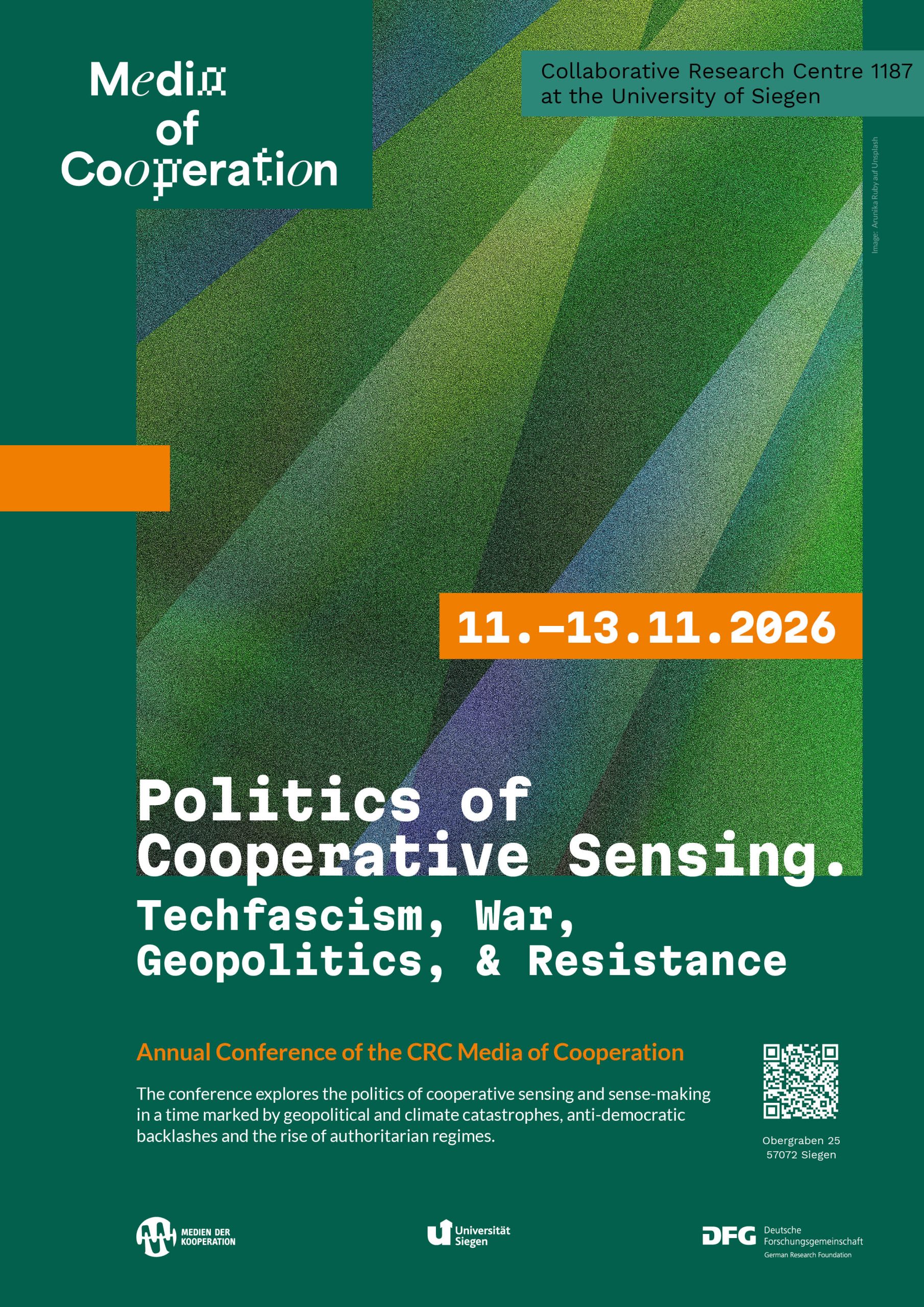
Annual Conference 2026

“Politics of Cooperative Sensing.
Techfascism, War, Geopolitics, and Resistance”
University of Siegen, 11 – 13 November 2026
Unteres Schloss / Lower Castle (Room US-C 115)
Obergraben 25 ( Room US-S 001 / 002)
57072 Siegen
Registration
Please fill out the registration form. You will receive a confirmation email.
For online participation on Friday, we will send the zoom link the day before the workshops.
About the conference
The 2026 annual conference of the Collaborative Research Center 1187 “Media of Cooperation” explores the politics of cooperative sensing and sense-making in a time marked by geopolitical and climate catastrophes, anti-democratic backlashes and the rise of authoritarian regimes—all of which are phenomena closely intertwined with increasing datafication, generative AI developments, and the growing power of Big Tech.
Around the world, we find ourselves confronted with these complex entanglements, whose environmental, political and societal costs are distributed unevenly. While digital technologies enable new forms of cooperation, their energy consumption also contributes to environmental disasters. At the same time, it is precisely these digital technologies and infrastructures that are increasingly becoming sites of violence, from algorithmic discrimination to gendered and racialized forms of harassment and disinformation.
Against this backdrop, the annual conference examines how cooperation is being reshaped in today’s sociotechnical environments. It explores how various alliances—between states and Big Tech companies on the one hand, and between researchers, activists, artists, and communities on the other—negotiate the possibilities and limits of public action and perception. How do media and data practices contribute to new forms of control and how are they challenged via digital protests or anti-tech initiatives? And how can cooperative practices and protests also enable resistance and democratic engagement?
Bringing together scholars, activists, artists, filmmakers and journalists, the conference invites participants to inquire into the politics of media, data, and sensory practices, and to explore the role of cooperative forms of sensing and sense-making.
The conference is organized around three key thematic areas:
Area 1: Digital Power and Techfascism
In this section, we examine emerging alliances between governments, technology corporations, and far-right digital cultures. It focuses on current formations of violence and power: the cooperation between governments and Big Tech on the one hand, and the rise of the global far-right enabled by deregulated social networks on the other. Topics include digital violence, disinformation campaigns, the affective politics of online communities, techfascisms, and debates around digital sovereignty.
Area 2: Sensory Conflicts and Mediated Wars
This area explores how contemporary conflicts, from wars to geopolitical tensions, are experienced, mediated, and interpreted through digital technologies. It addresses major geopolitical and media-technological shifts, including the digitally mediated forms of witnessing wars and conflicts, as well as the fundamental expropriations of land, water, and resources underpinning digital media, which become visible through practices of extractivism, and the sensory confusion produced by disinformation and generative AI.
Area 3: Resistance, Cooperation and Democratic Practices
Alongside critical diagnoses discussed in the other two areas, this part of the program highlights practices of resistance and democratic engagement from activist research and digital anti-facist initiatives. The third section therefore explores interventions in the radicalization and fascistization of societies, how scholars and universities can act together with civil society to counter anti-democratic processes in which Big Tech and other corporations are actively implicated.
As part of the annual conference, Prof. Dr. Erhard Schüttpelz will deliver his farewell lecture, which will include a laudatory address by Prof. Dr. Rembert Hüser. The farewell ceremony will be held in German.
Program
Preliminary Program
11 November 2026 (US-C 115, Unteres Schloss / Lower Castle)
16:00 Welcome & Introduction
16:15-17:30 “Fault Line: Survival as Unrest”. A lecture performance by Rebel-IST-hah! with Azadeh Ganjeh
17:30-18:00 Coffee break
18:00-20:00 Farewell Lecture by Erhard Schüttpelz: „General Marseille – ein Film von Anja Dreschke, Carlo Peters, Erhard Schüttpelz”
with welcoming remarks by Rector Stefanie Reese and Pro-Dean Veronika Albrecht-Birkner, and a laudatory speech by Rembert Hüser
20:00-21:30 Dinner
12 November 2026 (US-S, Obergraben 25)
09:30-10:00 Arrival & Coffee
10:00-12:30 Panel 1: Technocooperations: Tech-Oligarchy, Tech Fascism & Digital Fascism
with Laura Hille, Maja-Lee Voigt, Gerko Egert, Sara Morais dos Santos Bruss and Daniela Wentz
12:30-13:30 Lunch break
13:30-15:00 Panel 2: Sensory Conflicts and Mediated Wars
with Ksenia Rybak, Asia Bazdyrieva, and Tetyana Lokot
15:00-16:00 Coffee and cake
16:00-18:30 Film screenings, followed by a Q&A
“War Songs” (48 min., Sashko Protyah, Freefilmers UA)
“Teen Angst” (38 min., Inga Pylypchuk)
18:30 Dinner
13 November 2026 (US-S, Obergraben 25)
09:30-10:00 Arrival & coffee
10:00-12:30 Parallel Workshops on Interventions, Cooperation with Civil Society and Antifascism:
Heat is increasingly becoming a defining condition of everyday life. Yet despite its growing political importance, heat often remains difficult to communicate and collectively negotiate. This workshop explores heat not merely as a climatic phenomenon but as a sensory and political medium. Bringing together perspectives from cultural sociology, media theory, and STS, the workshop introduces sweat as a particularly revealing site for understanding contemporary politics of sensing. Sweat is simultaneously a biological process, a cultural sign, a technological interface, and an object of political intervention. From wearable cooling technologies and thermal infrastructures to changing norms of bodily exposure and adaptation, the workshop asks how societies learn to sense and negotiate increasingly unequal thermal environments. Combining short theoretical inputs with discussion and collaborative reflection, participants will develop concepts for analysing heat as a sensory practice and explore how changing thermal conditions reshape everyday life and climate politics.
In recent years, interest in the critique and analysis of contemporary fascism has intensified. However, the question regarding possibilities for resistance receives somewhat less attention, both historically and in the present: In this panel discussion, we are interested in practical anti-fascist approaches, operative dimensions, and resistant modes of knowledge production within the university.
Neo-fascist movements are currently also sharpening the educational policies of right-wing parties: As institutions, universities are affected by these processes through the synergies of austerity politics and right-wing culture wars. The coming years could mark a rupture that will fundamentally alter the societal position of higher education in a post-migrant, aging society fractured by segregation and division. In accordance with their democratic mandate, it is the task of universities—across institutional practice, teaching, and research—to contribute to equality and participation, as well as to produce robust analyses and transformative critiques of the multiple crises that fuel processes of fascistization. At the same time, as educational institutions, universities are inscribed in multiple ways into societal divisions and differential structures of discrimination that also give rise to right-wing violence, as well as into economies from which right-wing agendas profit: The everyday business of academic work is already conditioned by technical infrastructures and economies of extraction, dispossession, and alienation.
In this panel, we are therefore interested in this contradictory position of the university, its possible futures, and resilient avenues for resistance.
About the Working Group: Universität gegen Faschismus (University Against Fascism)
The working group Uni gegen Faschismus (University Against Fascism) is a forum that emerged from the field of media studies, dedicated to academic anti-fascist networking and solidarity.
Based on the practice-oriented research project ‘Unlearning Anti-Feminism on TikTok’ (UlAT), this workshop will explore how counter-strategies against antifeminist and misogynist content on social media platforms can be developed. We will present insights into the project’s research and design processes and demonstrate how young people can be supported in recognising, contextualising and critically questioning antifeminist content circulating in and around the manosphere. Participants will learn about the media-pedagogical perspectives of the project before putting the ‘TikTok Puzzle’, a core UlAT method, to the test. This method enables participants to identify and analyse antifeminist narratives in social media discourse. By jointly examining TikTok videos, screenshots, hashtags, and comment sections, participants will learn to recognise and evaluate the manifestations of discriminatory and degrading attitudes, and understand how platform mechanisms facilitate the dissemination of such narratives on social media.
12:30-13:30 Lunch Break
13:30-14:30 Closing Discussion
Venue
University of Siegen
Campus Unteres Schloss
US-S 001 / 002
Obergraben 25
57072 Siegen