Veranstaltungsarchiv
Sensing Loss – Uni Köln goes r e t u r n: 60 Minutes AnthroLab.
Donnerstags 16:30-17:30Uhr
Dr. Simone Pfeifer (Goethe-Universität Frankfurt): Wer wird gehört? Postdigitale Erinnerung nach rechter Gewalt in der postmigrantischen Gesellschaft
Die Diskussionsreihe Sensing Loss bringt ethnologische Forschungen aus der Universität ins Museum. Sozial- und Kulturanthropolog:innen aller Karrierestufen berichten aus ihren aktuellen Forschungen, wie Menschen Verlust erfahren und Verlusterfahrungen bearbeiten. Sensing Loss fragt, wie Verlust begegnet, verkörpert und verräumlicht wird – und wie aus Vertreibung, Enteignung und vergangenem Unrecht neue Zukünfte gewonnen werden können. Erfahrungen des Verlusts (loss), ihre Konfrontation und Aufarbeitung [r e t u r n] sind dabei so vielfältig wie die Situationen, in denen Menschen Kolonialismus, Marginalisierung oder Gewalt begegnen. Die öffentlichen Vorträge diskutieren Formen des Sensing, über die Menschen Verlust gewahr werden, und Sense Making, d.h. die Frage, wie Menschen Verlusterfahrungen eine Bedeutung verleihen. Trauer, Verlust und Erinnerung können zur Quelle werden, Ansprüche an die Gegenwart zu artikulieren und zwischen Menschen und Orten, Vergangenheit und Zukunft neue Verbindungen zu erarbeiten. Im Sinne der Ausstellung r e t u r n beschäftigen sich die Vorträge mit ganz unterschiedlichen Momenten und Formen der Trauer, der Nostalgie, der Erinnerungsarbeit und des gemeinsamen Aufbruchs.
————
The lecture series Sensing Loss connects anthropological thinking across university and museum spaces. Social and cultural anthropologists at all career stages discuss their ongoing research to explore how people sense and make sense of loss. Sensing Loss asks how loss is experienced, embodied and spatialized – and how displacement, dispossession and past injustices can become sources for new future-making practices. Experiences of loss, their confrontation, and the ways in which people try to come to terms with them – and find ways to r e t u r n – are as diverse as the situations in which people experience colonialism, violence or marginalization.
The public lectures discuss how grief, loss and remembrance can become resources for articulating claims on the present, and for shaping new connections between people and places, past and future. In resonance with the exhibition r e t u r n at the RJM, the lectures engage with diverse moments and forms of grief, nostalgia and memory work, as well as with joint departures into new futures.
Veranstaltungsort
Köln
Kontakt
ctiefen1[æt]uni-koeln.de
Sensing Loss – Uni Köln goes r e t u r n: 60 Minutes AnthroLab.
Donnerstags 16:30-17:30Uhr
PD Dr. Omar Kasmani (Freie Universität, Berlin): After Love. On Loss, Home and Other Heartbreak
Die Diskussionsreihe Sensing Loss bringt ethnologische Forschungen aus der Universität ins Museum. Sozial- und Kulturanthropolog:innen aller Karrierestufen berichten aus ihren aktuellen Forschungen, wie Menschen Verlust erfahren und Verlusterfahrungen bearbeiten. Sensing Loss fragt, wie Verlust begegnet, verkörpert und verräumlicht wird – und wie aus Vertreibung, Enteignung und vergangenem Unrecht neue Zukünfte gewonnen werden können. Erfahrungen des Verlusts (loss), ihre Konfrontation und Aufarbeitung [r e t u r n] sind dabei so vielfältig wie die Situationen, in denen Menschen Kolonialismus, Marginalisierung oder Gewalt begegnen. Die öffentlichen Vorträge diskutieren Formen des Sensing, über die Menschen Verlust gewahr werden, und Sense Making, d.h. die Frage, wie Menschen Verlusterfahrungen eine Bedeutung verleihen. Trauer, Verlust und Erinnerung können zur Quelle werden, Ansprüche an die Gegenwart zu artikulieren und zwischen Menschen und Orten, Vergangenheit und Zukunft neue Verbindungen zu erarbeiten. Im Sinne der Ausstellung r e t u r n beschäftigen sich die Vorträge mit ganz unterschiedlichen Momenten und Formen der Trauer, der Nostalgie, der Erinnerungsarbeit und des gemeinsamen Aufbruchs.
————
The lecture series Sensing Loss connects anthropological thinking across university and museum spaces. Social and cultural anthropologists at all career stages discuss their ongoing research to explore how people sense and make sense of loss. Sensing Loss asks how loss is experienced, embodied and spatialized – and how displacement, dispossession and past injustices can become sources for new future-making practices. Experiences of loss, their confrontation, and the ways in which people try to come to terms with them – and find ways to r e t u r n – are as diverse as the situations in which people experience colonialism, violence or marginalization.
The public lectures discuss how grief, loss and remembrance can become resources for articulating claims on the present, and for shaping new connections between people and places, past and future. In resonance with the exhibition r e t u r n at the RJM, the lectures engage with diverse moments and forms of grief, nostalgia and memory work, as well as with joint departures into new futures.
Veranstaltungsort
Köln
Kontakt
The conference, entitled ‘Language Connects: Cooperative Communicative Practices in Media Societies’, focuses on all types of linguistic and communicative media practices (in the broadest sense) through which actors, acting (more or less) in accordance with the situation, work towards facilitating cooperation and/or sustainably promoting cohesion, or counteracting the production of categories of social difference.
A conference itself also constitutes a cooperative communicative practice sui generis. This becomes particularly evident when it is not merely an academic conference. This conference is being held to mark the 60th birthday of Prof. Dr Stephan Habscheid, and the organising team is delighted to be able to engage in in-depth discussions with the speakers and all conference participants on specific and, in our view, highly relevant aspects of cooperative communicative practices.
To aid planning, the organising team would ask that you send an informal registration to Jan Gerwinski (gerwinski[at]germanistik.uni-siegen.de) by 15 September 2026.
Veranstaltungsort
Seminarzentrum Obergraben (US-S)
Am Obergraben 25
57072 Siegen
Links
 Konferenz-Website
 Programm
1.10.2026
Tag 1
Ankommen
Grußworte und Einführung
Vortrag: Wissing bei Lanz: Wie man der Versuchung destruktiver Praktiken widersteht
Prof. Dr. Werner Holly (Chemnitz)
Vortrag: Zuschauen als soziale Praxis – außerhalb der Medienrezeption
Prof. Dr. Heike Baldauf-Quilliatre (Lyon)
Kaffeepause mit Kuchenbuffet
Vortrag: Kooperation im Straßenverkehr
Prof. Dr. Arnulf Deppermann (Mannheim)
Vortrag: Kooperation inter- und transdisziplinär: Wie ein gemeinsames Ziel Wissenschaft und Praxisfelder zusammenhalten kann
Prof. Dr. Maija Hirvonen (Tampere)
Glückwünsche
Fingerfood-Buffet
2.10.2026
Tag 2
Ankommen
Begrüßung
Vortrag: Wie ein Kalendereintrag entsteht
Prof. Dr. Ruth Ayaß (Bielefeld)
Kaffeepause
Vortrag: Aufmerksamkeit beim Sprecherwechsel. Systemtheoretische Überlegungen zu einem sprachwissenschaftlichen Problem
Prof. Dr. Niels Werber (Siegen)
Vortrag: „Wir von ...“ Filme auf Unternehmenshomepages als Mittel zur Herstellung von Zusammenhalt
Prof. Dr. Monika Dannerer (Innsbruck)
Ausklang und Häppchen
Kontakt
Dr. Christine Gebhard; Dr. Jan Gerwinski; Dr. Tim Hector
gerwinski[æt]germanistik.uni-siegen.de
Histories of Tracking
Université de Luxembourg | Universität Siegen
September 30 – October 2, 2026
International conference jointly organised by the C²DH – University of Luxembourg and Universität Siegen
Surveillance has become ubiquitous in digital media environments and is now taken for granted. With every PayPal interaction, at the least more than 600 trackers eavesdrop on its transactional data (Schneier 2018). While there is no lack of critique on digital surveillance and its discontents, its ubiquity and naturalization itself require more explanation. Which historical and economical trajectories have led into the current escalation of digital tracking, tracing, monitoring, classification, intelligence service, and advertising? How can we discover and mobilize counter-points and narratives that explain digital surveillance otherwise? Do micro-level media, data, and sensor practices represent “yet another mutation of capitalism,” to quote from Gilles Deleuze’s famous Postscript on the Societies of Control (1990)?
Tracking persons, emotions, objects, apparatuses, money, signs and data is a veritable environing technique. It is also one of the key business applications of platform and data economies, which provide for the infrastructures of state-side institutional surveillance and control. With our joint Luxembourg-Siegen conference on Histories of Tracking we aim to track the trackers historiographically, technologically, and ecologically.
In a seminal text, Phil Agre (2003 [1994]) has encouraged us to think about the difference between rather centralized regimes of (visual) surveillance and data-based institutional regimes of “capture.” Agre has paved the way for a logistical theory of digital surveillance that investigates its micropolitics. While non-visual alphanumeric modes of capturing data do not feel like surveillance, they nonetheless establish an ever more mundane and affective mode of ubiquitous surveillance. What if we follow Agre’s analysis of institutional “grammars of action” that afford a whole spectrum of capturing, monitoring, sensing, and surveillant practices? Histories of tracking, we assume, are histories of the institutions, corporations, and agencies that create the tapestry of surveillance (Lauer 2017). That tapestry might seem all-encompassing and seamless by now, even if it contains loose threads, loopholes, and islands of encryption.
Histories of tracking are co-operative histories that involve the consent, non-consent and dissent of digital media usage (Jones 2024). They are also business histories that rely on what Shoshana Zuboff (2019) has aptly called a “behavioral surplus” of data––without properly historicizing its inception. Last but not least, histories of tracking are histories of its public scrutiny and accountability, from opposing civil rights movements to the political and legal controversies that make the case for regulation.
We thus invite dedicated contributions from Media and Cultural Studies, History, Science and Technology Studies, Surveillance Studies, Platform Studies, Code Studies, Socio-Informatics, Law, and Sociology that combine historiographic and empirical work with grounded theoretical approaches. Activist and artistic positions that rethink tracking and/in/as media environments are highly welcome!
Scientific committee
- Sebastian Giessmann
- Valérie Schafer
- Tatjana Seitz
- Anne Schreiber
- Inga Schuppener
Organisation
- C²DH – University of Luxembourg
- Universität Siegen
With the support of Collaborative Reseacg Centra 1187 Media of Cooperation, Siegen; project A01: Digital Network Technologies between Specialization and Generalization; C²DH, Université de Luxembourg; FNR, Luxembourg and DFG, Germany
References
Agre, Philip E. “Surveillance and Capture. Two Models of Privacy.” In theNewMediaReader, edited by Noah Wardrip-Fruin and Nick Montfort. MIT Press, 2003 [1994].
Deleuze, Gilles. “Postscript on the Societies of Control.” October 59 (1992): 3–7.
Jones, Meg Leta. The Character of Consent. The History of Cookies and the Future of Technology Policy. Information Policy. MIT Press, 2024.
Lauer, Josh. Creditworthy. A History of Consumer Surveillance and Financial Identity in America. Columbia University Press, 2017.
Schneier, Bruce. “The 600+ Companies PayPal Shares Your Data With – Schneier on Security.” Schneier on Security, March 14, 2018. https://www.schneier.com/blog/archives/2018/03/the_600_compani.html.
Zuboff, Shoshana. The Age of Surveillance Capitalism. The Fight for a Human Future at the New Frontier of Power. Public Affairs, 2019.
Veranstaltungsort
Black Box, Maison des Sciences humaines
11, Porte des Sciences
4366, Esch-sur-Alzette, Luxembourg
Links
Programm Kontakt
Sensing Loss – Uni Köln goes r e t u r n: 60 Minutes AnthroLab.
Donnerstags 16:30-17:30Uhr
Prof. Dr. Franz Krause (Köln): Sensing Loss im Mackenzie-Delta: Auf der Suche in den Sedimenten vergangener Zukünfte
Die Diskussionsreihe Sensing Loss bringt ethnologische Forschungen aus der Universität ins Museum. Sozial- und Kulturanthropolog:innen aller Karrierestufen berichten aus ihren aktuellen Forschungen, wie Menschen Verlust erfahren und Verlusterfahrungen bearbeiten. Sensing Loss fragt, wie Verlust begegnet, verkörpert und verräumlicht wird – und wie aus Vertreibung, Enteignung und vergangenem Unrecht neue Zukünfte gewonnen werden können. Erfahrungen des Verlusts (loss), ihre Konfrontation und Aufarbeitung [r e t u r n] sind dabei so vielfältig wie die Situationen, in denen Menschen Kolonialismus, Marginalisierung oder Gewalt begegnen. Die öffentlichen Vorträge diskutieren Formen des Sensing, über die Menschen Verlust gewahr werden, und Sense Making, d.h. die Frage, wie Menschen Verlusterfahrungen eine Bedeutung verleihen. Trauer, Verlust und Erinnerung können zur Quelle werden, Ansprüche an die Gegenwart zu artikulieren und zwischen Menschen und Orten, Vergangenheit und Zukunft neue Verbindungen zu erarbeiten. Im Sinne der Ausstellung r e t u r n beschäftigen sich die Vorträge mit ganz unterschiedlichen Momenten und Formen der Trauer, der Nostalgie, der Erinnerungsarbeit und des gemeinsamen Aufbruchs.
————
The lecture series Sensing Loss connects anthropological thinking across university and museum spaces. Social and cultural anthropologists at all career stages discuss their ongoing research to explore how people sense and make sense of loss. Sensing Loss asks how loss is experienced, embodied and spatialized – and how displacement, dispossession and past injustices can become sources for new future-making practices. Experiences of loss, their confrontation, and the ways in which people try to come to terms with them – and find ways to r e t u r n – are as diverse as the situations in which people experience colonialism, violence or marginalization.
The public lectures discuss how grief, loss and remembrance can become resources for articulating claims on the present, and for shaping new connections between people and places, past and future. In resonance with the exhibition r e t u r n at the RJM, the lectures engage with diverse moments and forms of grief, nostalgia and memory work, as well as with joint departures into new futures.
Veranstaltungsort
Köln
Kontakt
ctiefen1[æt]uni-koeln.de
Sensoriality in social interaction has been a topic raising increasing interest in Ethnomethodology and Conversation Analysis (EMCA) these last years (Fele 2019, Goodwin, MH 2017, Liberman 2022, Meyer & Meier 2016, Meyer 2021, Mondada 2018, 2021, Mondada & Cekaite 2020), expanding previous work on multimodality (Goodwin, C 2018, Mondada 2019) and inspired by insights coming from, amongst others, Scottish moral philosophy, early Simmelian insights, phenomenology, and the anthropology of the senses. The issue has been to put multisensoriality on the agenda of interaction studies, with a special focus on how sensorial and perceptual practices relating to, and establishing, the world and others are publicly and recognizably achieved and shared in social interaction.
Building on this background, this workshop further discusses multisensoriality in social interaction, and in particular the potentials and prospects of the concept of synaesthesia for interaction research. Here, synaesthesia is not understood as a clinical or psychological condition, but as an everyday practical phenomenon—inspired by its phenomenological sense developed, among others, by Merleau-Ponty and Sartre. On this view, our experience of the world already involves constant cross-sensory supplementation and translation—for example, visual experience is routinely complemented by, and intertwined with, other sensory familiarities. Sartre famously stated that we ‘see’ the sourness of a lemon: “each of its qualities is extended throughout each of the others. It is the sourness of the lemon which is yellow, it is the yellow of the lemon which is sour. We eat the color of a cake, and the taste of this cake is the instrument which reveals its shape and its color to what we may call the alimentary intuition.” Merleau-Ponty similarly describes glass: we see its “hardness and brittleness (…), and when, with a tinkling sound, it breaks, this sound is conveyed by the visible glass.” The issue is for us to reflect about these insights within an interactional framework and on the basis of video analysis, within the epistemology and methodology of EMCA.
While we do not doubt the ongoing cross-sensorial supplementation and translation during perception, it is the generality of such descriptions that we would like to examine and discuss in the workshop. E.g., when do they apply in general, and when are perceptions only manifested through specific senses, and not others, or are not at all cross-sensorial, according to the particularities of the interactional situation and activity? How are sensory experiences and synaesthesias made accountable and sequentially fed into interaction? So far, the complementarity, substitutability, translatability, and mutual elaboration of sensory modes has mainly been discussed in studies of the individual perceptor. In this workshop, we will discuss empirical studies showing how participants ongoingly accomplish and also presuppose this phenomenon for their co-participants, as part of the assumed „objectivity of the world“, and use it in interaction—both in (1) interactionally achieved co-perception and co-sensing of relevant objects and in (2) co-bodily (including intercorporeal) interaction, where participants make their sensory perceptions, orientations and access accountable to one another up to and including having co-experiences.
Registration/Contact:
All are welcome, please send a short e-mail until 22.09. to: clemens.eisenmann[æt]uni-konstanz.de
Veranstaltungsort
Data Theatre, Raum ZT 1204
Konstanz
Links
Program & Abstracts Programm
Thursday 24.9.
Introduction
“Synesthetic Interaction and Interactional Synesthesia: How the Senses Complement, Substitute, Elaborate, and Translate One Another in Interaction”
Christian Meyer (University of Konstanz)
“Multimodality, multisensoriality and synaesthesia in social interaction”
Lorenza Mondada (University of Basel)
LUNCH
“Learning to see through touch: The interactional accomplishment of synaesthetic perception in vine-pruning instruction”
Giolo Fele (University of Trento)
COFFEE
“In Praise of My Transmodal Hands”
Jürgen Streeck (University of Texas at Austin)
“Co-perception and co-sensing of human subjects/objects”
Asta Cekaite (Linköping University)
Formal dinner: providing an opportunity to discuss topics in greater detail in one-on-one conversations
Friday 25.9.
“At the interface of sound and touch”
Leelo Keevallik (University of Linköping)
“Senses of Correction: Comparing Correction Practices in Movement”
Robert Mitchell (University of Mainz)
Lunch
“Kinaesthetic Sensing in Dance: Embodying the Percept of Others and Achieving Intercorporeality”
Chiara Bassetti (University of Trento)
Joint closing discussion
Chair: Clemens Eisenmann (University of Konstanz/Siegen)
Kontakt

Social media platforms are increasingly shaped by the integration of generative AI alongside long-standing analytical and predictive models. Today’s algorithmic systems are moving from the background infrastructure to the forefront of digital social life – intervening in the content feeds as conversational agents like xAI’s Grok, reshaping identity through synthetic likenesses of OpenAI’s Sora-2, and expanding the social ecosystem itself through projects like Butterflies AI and Moltbook, where autonomous AI agents operate in coexistence with (or independently of) human users. As these developments rapidly outpace existing research frameworks, the need for mixed critical methodologies grows more urgent.
Synthetic social media research takes as its starting point the recognition that platforms shaped by generative AI are not simply data-processing systems but cultural environments organized through algorithms, interfaces, and shared ways of feeling and knowing. Analytically, the attribute “synthetic” implies more than artificial arrangements of collective agency. Rather than treating AI as a radical rupture, it situates generative systems within broader arrangements of human-machine co-creation that amplify specific imaginaries, values, and concerns. Methodologically, it foregrounds ambiguities in how AI platforms recalibrate meaning and how users develop a practical “feel” for algorithmic systems while negotiating their constraints.
Critical digital methods have responded to these developments by treating chatbots and generative systems as part of the research design as well as objects of inquiry in their own right. Synthetic text, images, and sounds are no longer exceptional artifacts but common platform vernaculars, sustained by entangled practices of prompting, remixing, and circulation. Within platform studies, interface methods, visual digital methods, and emerging forms of synthetic ethnography, AI systems have been repurposed for formatting, summarization, annotation, labeling, and the generation of synthetic data, while being interrogated for how they shape knowledge production. This work has foregrounded questions of method: Are we merely studying AI slop, distracted by the automated excess of content stripped of context and meaning, or are we witnessing the redefinition of social media itself along with its affordances and cultures of use?
The 2026 Autumn School edition of the CRC “Media of Cooperation” tackles this question by focusing on generative AI as an infrastructural, cultural, and regulated component of social media platforms across three intersecting dimensions: At the cultural level of everyday use, it refers to the routinized practices of prompting or interacting with platform-embedded generative systems through multimodal inputs. Infrastructurally, it signals a shift in agency, as platforms keep multiplying affordances that nudge us into co-producing synthetic outputs. Finally, it foregrounds research techniques for probing AI models in their entanglements with the platform governance and moderation regimes.
Against this background, we invite participants to submit short contributions inspired by, though not limited to, one of the following „how to“ prompts:
- How to repurpose AI personas as research personas
- How to rethink walkthrough methods in light of platforms’ generative affordances
- How to approach cultural biases conditioned by AI systems and prompt cultures
- How to study AI moderation as platform policy in action
- How to explore platform agency and its steering ideologies
- How to integrate screenshots as a method for capturing synthetic situations
- How to account for the ambiguities emerging from human-machine co-creation
- How to develop non-extractive approaches to researching AI platforms
Participants are invited to submit a short abstract (maximum 500 words excluding references) outlining how their work relates to the event’s theme. Presentations should raise questions or provocations rather than present finished research. Accepted abstracts will be grouped into thematic sessions and discussed in a collaborative, dialogue-focused format.
Submit your proposal by 30. April 2026
Notification of acceptance by 15 May 2026
Registration by 15 June 2026
The event opens with a one-day conference and moves into hands-on workshops and project work. Accepted abstracts will be grouped into thematic sessions curated by the organising team. Presenters will be connected via email ahead of time to coordinate their contributions. The first day is about presentations and discussions. The next three days are dedicated to exploring and developing methods – hands-on! We invite you to join a team of interdisciplinary scholars and data designers in probing new methodological combinations. Each of our project teams will present a research question alongside a specific method to be collaboratively explored. Please bring your laptops. The project titles will be announced soon. The event is free of charge, though attendees are responsible for arranging and covering their travel and accommodation in Siegen.
Veranstaltungsort
Campus Herrengarten
AH-A 217/18
Herrengarten 3
57072 Siegen
Kontakt
Sensing Loss – Uni Köln goes r e t u r n: 60 Minutes AnthroLab.
Donnerstags 16:30-17:30Uhr
Nanette Snoep (Rautenstrauch-Joest Museum Köln) & Prof. Dr. Martin Zillinger (Köln): Einführung. Senses, Sensors, Sensing: Eine kurze Einführung in die Ethnologie der Sinne
Dr. Simon Holdermann, Carla Tiefenbacher, MA (Köln): Sensory Walk
Die Diskussionsreihe Sensing Loss bringt ethnologische Forschungen aus der Universität ins Museum. Sozial- und Kulturanthropolog:innen aller Karrierestufen berichten aus ihren aktuellen Forschungen, wie Menschen Verlust erfahren und Verlusterfahrungen bearbeiten. Sensing Loss fragt, wie Verlust begegnet, verkörpert und verräumlicht wird – und wie aus Vertreibung, Enteignung und vergangenem Unrecht neue Zukünfte gewonnen werden können. Erfahrungen des Verlusts (loss), ihre Konfrontation und Aufarbeitung [r e t u r n] sind dabei so vielfältig wie die Situationen, in denen Menschen Kolonialismus, Marginalisierung oder Gewalt begegnen. Die öffentlichen Vorträge diskutieren Formen des Sensing, über die Menschen Verlust gewahr werden, und Sense Making, d.h. die Frage, wie Menschen Verlusterfahrungen eine Bedeutung verleihen. Trauer, Verlust und Erinnerung können zur Quelle werden, Ansprüche an die Gegenwart zu artikulieren und zwischen Menschen und Orten, Vergangenheit und Zukunft neue Verbindungen zu erarbeiten. Im Sinne der Ausstellung r e t u r n beschäftigen sich die Vorträge mit ganz unterschiedlichen Momenten und Formen der Trauer, der Nostalgie, der Erinnerungsarbeit und des gemeinsamen Aufbruchs.
————
The lecture series Sensing Loss connects anthropological thinking across university and museum spaces. Social and cultural anthropologists at all career stages discuss their ongoing research to explore how people sense and make sense of loss. Sensing Loss asks how loss is experienced, embodied and spatialized – and how displacement, dispossession and past injustices can become sources for new future-making practices. Experiences of loss, their confrontation, and the ways in which people try to come to terms with them – and find ways to r e t u r n – are as diverse as the situations in which people experience colonialism, violence or marginalization.
The public lectures discuss how grief, loss and remembrance can become resources for articulating claims on the present, and for shaping new connections between people and places, past and future. In resonance with the exhibition r e t u r n at the RJM, the lectures engage with diverse moments and forms of grief, nostalgia and memory work, as well as with joint departures into new futures.
Veranstaltungsort
Köln
Kontakt
ctiefen1[æt]uni-koeln.de
Jahrestagung des Teilprojekts B09 „Fahrradmedien: Kooperative Medien der Mobilität“
Mobilität ist ein kooperativer Prozess, der durch vielfältige mediale, soziale und infrastrukturelle Praktiken hervorgebracht wird. Auch das Fahrradfahren wird durch ein Zusammenspiel vielfältiger Technologien, Infrastrukturen, Körper, Bilder und Öffentlichkeiten bedingt. Zugleich ist Fahrradmobilität nicht neutral oder für alle gleichermaßen zugänglich: Sie ist geprägt von gesellschaftlichen Machtverhältnissen und unterschiedlichen Erfahrungswelten.
Vor diesem Hintergrund untersucht die Jahrestagung des Forschungsprojekts „Fahrradmedien – kooperative Praktiken der Mobilität“ (SFB 1187 „Medien der Kooperation“) das Fahrrad selbst als Medium von Öffentlichkeit und Teilhabe: als eine Mobilitätsform, die Menschen, Orte, Perspektiven und Wissen miteinander verbindet und dabei eine spezifische Aneignung von Raum ermöglicht. Ausgangspunkt der Tagung ist ein erweiterter Medienbegriff, der nicht nur audiovisuelle und digitale Formate umfasst, sondern auch (Sorge-)Praktiken wie Reparatur, Aktivismus oder kollektives Fahren als Formen der Vermittlung versteht.
Welche Perspektive wir auf das Radfahren haben, wird durch Medien bestimmt. Umgekehrt prägt das Fahrradfahren auch mediale Räume. In diesem Zusammenhang untersuchen die Beiträge der Jahrestagung das Fahrrad(-fahren) als Medium verkörperter Erfahrung und Wahrnehmung, insbesondere in Auseinandersetzungen mit öffentlichen Diskursen, Affekten, Körpern und Infrastrukturen. Dabei werden diversitätssensible und intersektionale Perspektiven auf Fahrradmobilität diskutiert, etwa im Hinblick auf Mobilitätskonflikte, Gender- und Klassenverhältnisse sowie ungleiche Zugangsvoraussetzungen und Repräsentationen.
Wir laden herzlich zur Teilnahme und Diskussion ein.
Veranstaltungsort
Kortumstraße 90
44787 Bochum
Links
B09 Webseite Programm
17.09.26
Tag 1
Begrüßung & Einführung: Fahrrad als Medium
Mittagspause
Panel 1: Medien/Diskurse: Media Discourses on Refugee Women Learning to Ride Bikes; Polizeimeldungen über getötete Radfahrer*innen; Saddlesisters. Fahrradfeminismus im Spannungsfeld von Road Rage und Wiki Rage
Aram Lee; Marlene Sattler; Xenia Waporidis & Hannah Schmedes
Pause
Panel 2: Körper- und Affektwelten des Radfahrens: Sweat Mode on – Die Ambiguität kollektiven Schwitzens als strukturierende Dimension von Praxis, Körpern und Artefakten im Indoor-Cycling; Milieuspezifische Lebenswelten des Radfahrens. Einblick in Forschungsdaten einer Cultural-Probes-Studie; Radfahren im Spektrum. Sichtbarkeit, Affekt und Bewegung
Christopher Kirschner; Caro Baaske; Herbert Schwaab
Pause
Panel 3: Mobilitätskonflikte: Fahrradmobilität, Klassenkonflikte und der Backlash der Mobilitätswende; "Violences routières". Konflikte zwischen Rad- und Fußverkehr in Paris
Thomas Klinger, Sören Groth & Joschua Kuckherm; Gabriele Schabacher
Gemeinsames Abendessen
Filmscreening: "Bici-bles" - Fahrradaktivismus als Medium der Kollektivierung und Kollaboration
Sarah Sander
18.09.26
Tag 2
Ankunft & Kaffeepause
Panel 3: Urbane Räume: Fatshaming, Bequemlichkeit und Technikdeterminismus. E-Bike-Disruption in Amsterdam; Städtische Fahrradkulturen im Wandel - Eine kreislaufwirtschaftliche Perspektive auf Reparatur, Konsum und Distinktion; „50 Tage – 50 Stadtteile“. Stadtteilerkundungen mit dem Fahrrad
Markus Stauff; Maximilian Hoor; Katharina Sakowski
Kaffeepause
Panel 4: Sichtbarkeiten: Ausdauer streamen. Plattformisierung und die Medialität des Fahrradfahrens am Race AcrossAmerica 2026; O Acidente - Fahrrad, Vulnerabilität und (post-)koloniale Verkehrsplanung
Julia Willms; Maximilian Rünker
Mittagessen
Gemeinsame Fahrradtour
Kontakt
Projekt B09
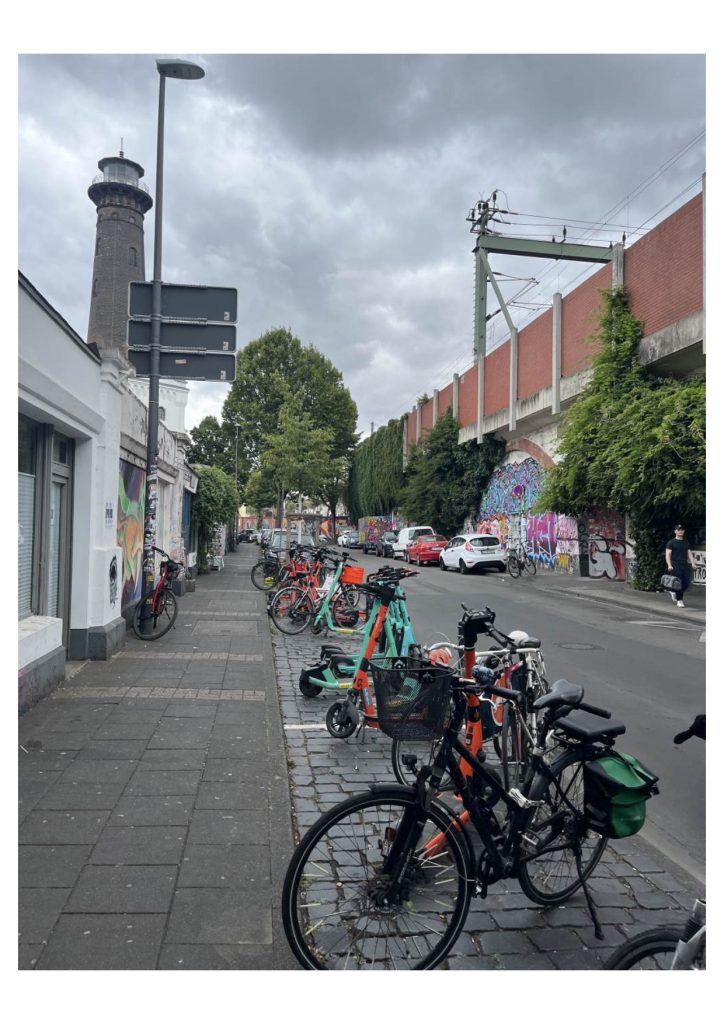
Leihfahrräder, E-Scooter und App-basierte Mobilitätsdienste sind zu einem vertrauten Bestandteil des städtischen Lebens geworden. Diese Dienste, die häufig als nahtlose, nachhaltige und barrierefreie Verkehrsmittel beworben werden, prägen zunehmend die Art und Weise, wie sich Menschen in Städten fortbewegen. Die sogenannte geteilte Mikromobilität ist zudem ein disruptiver Faktor im Straßenraum, da sie neue Reibungspunkte, Hindernisse und Risiken schafft, die gewohnte Bewegung durch die Stadt destabilisieren. Da die geteilte Mikromobilität zudem den Aufbau neuer Infrastrukturen mit sich bringt, wirft sie grundlegende Fragen zu öffentlichem Raum, Technologieökonomie, Datenverwaltung, Barrierefreiheit und Bürgerbeteiligung auf, die sich quer durch die damit verbundenen Veränderungen und die alltäglichen Erfahrungen des Stadtlebens ziehen.
Dieser Workshop lädt Teilnehmende mit unterschiedlichen Hintergründen ein – darunter Nutzer*innen und Nicht-Nutzer*innen von Shared-Mobility-Diensten, Anwohner*innen, politische Entscheidungsträger*innen, Mobilitätsplaner*innen, Aktivist*innen, Forscher*innen und Vertreter*innen der Industrie –, um gemeinsam die Rolle der geteilten Mikromobilität in der Stadt Köln zu beobachten, zu beschreiben und zu analysieren. Der Workshop wird kreative Methoden einsetzen, um alltägliche Begegnungen mit Shared-Mobility-Systemen in den Straßen Ehrenfelds zu untersuchen. Durch situative Mobilitätserfahrungen, die gemeinsame Beobachtung von Mikromobilitätssituationen, Diskussionen und Kartierungsübungen wollen wir die Infrastrukturen, Akteur*innen, Technologien und Be/Wertungspraktiken sichtbar machen, die die aktuelle urbane Mobilität prägen.
Der Workshop orientiert sich an einer Reihe von Fragen: Wie nahtlos – oder eher “nahtreich” (seamful) – und möglicherweise disruptiv – sind die Erfahrungen mit geteilter Mikromobilität in der Praxis? Welche Infrastrukturen, Datenströme, Arbeitsformen und Governance-Strukturen tragen dazu bei, dass diese Dienste (nicht) funktionieren? Wessen Bedürfnisse, Perspektiven und Interessen spiegeln sich in den aktuellen Mobilitätssystemen wider und wessen werden übersehen? Wie gestalten – und stören – digitale Plattformen und Mobilitäts-Apps den Zugang zum städtischen Raum, die Mobilitätsentscheidungen, die Privatsphäre und die Teilhabe? Und wie sollten Fragen der Nachhaltigkeit in diesem Zusammenhang verstanden werden – nicht nur in ökologischer Hinsicht, sondern auch im Zusammenhang mit sozialer Gerechtigkeit, Barrierefreiheit und demokratischer Mitbestimmung?
Indem diese Fragen aus verschiedenen Perspektiven und Blickwinkeln beleuchtet werden, zielt der Workshop darauf ab, eine gemeinsame Auseinandersetzung mit den Chancen, Reibungspunkten und Folgen geteilter Mikromobilität anzuregen. Ziel ist es somit, den Blickwinkel darauf zu erweitern, was verschiedene Anspruchsgruppen als relevant ansehen, um somit die Auswirkungen und Risiken des Ausbaus der Mikromobilitätsinfrastrukturen zu verstehen und gemeinsam zu erörtern. Durch die kreative Dokumentation unserer Begegnungen mit Mikromobilität auf der Ebene des Stadtviertels, können wir digitale Transformationen und Umbrüche in unserer Umgebung sowie die damit verbundenen Probleme auf kollektive Weise zum Ausdruck bringen.
Von künstlerischen Forscher*innen geleitete gemeinsame Kartierung und narrative Modellierung ermöglichen die Analyse unserer gemeinsamen Beobachtungen zu Begegnungen im Bereich der Mikromobilität. Diese narrative Darstellung bildet die Grundlage für einen öffentlich zugänglichen Bericht über die Seams – Nahtstellen, Reibungspunkte, und Bruchstellen – der geteilten Mobilität in Köln.
Der Workshop wird vom Projekt A03: „Navigation in Online-/Offline-Räumen“ im Sonderforschungsbereich „Medien der Kooperation“ an der Universität Siegen organisiert. Das Projekt untersucht, wie mobile Medien, Plattformen und digitale Infrastrukturen das Navigieren und die Bewegungen durch urbane Umgebungen verändern und neugestalten.
Hauptbeteiligt bei der Organisation des Workshops sind: Carolin Gerlitz, Daniela van Geenen, Max Kanderske (Universität Siegen/University of Siegen) & Noortje Marres (CIM Warwick, https://warwick.ac.uk/fac/cross_fac/cim/), Künstlerische Forscher*innen: Yasmine Boudiaf (Ambient Information Systems, London) & Mukul Patel
Veranstaltungsort
Venloer Straße 429
50825 Köln
Programm
17.09.2026
Tag 1
Einführung
Unterwegs in Ehrenfeld
Mittagessen
Präsentation: Einführung in die Methode
Kartieren: Jede Gruppe kartiert und erzählt ihre Begegnungen
Erzählerische Darstellung: Begleitet von Künstler:innen setzen die Gruppen ihre Begegnungen um innerhalb eines narrativen Modells
Erzählen: Die Gruppen schildern ihre Begegnungen anhand der narrativen Modellierung
Ausklang
18.09.2026
Tag 2
Rückblick auf die narrative Darstellung und gemeinsames Erarbeiten von Interpretationen
Mittagessen
Wie geht es weiter?
Abschließende Worte, Getränke und Häppchen
Kontakt
Topics can be submitted to the board meetings via the status representatives two weeks before the meeting at the latest. Invitations go out two weeks before the meeting. Funding applications must be submitted at least two weeks in advance via the coordination (Dominik Schrey), including an explanation, cost estimate, detailed cost overview, and programme.
Applications must be submitted at least two weeks in advance via the coordination (Dominik Schrey), including an explanation and additional documents. For further information, please refer to the following templates. Please note that the templates are only available in German. For english versions please contact Dominik Schrey:
- Application for association
- Application for funding of a publication
- Application for funding of an event
The board meetings include reports, public topics, and various which are open to all SFB members. Personal and financial matters won’t be public and will be discussed after the public part. Webex links for online participation will be sent out on the previous Friday. Attendance on-site is possible.
Digital protocols will be provided via sciebo.
Veranstaltungsort
Kontakt
“Games and play are at once material and imaginary. They are real – but they trouble commonsense notions of reality; they offer multiple realities of fantasy, performance and intense experience” (Giddings 2014, S. 3).
In der Fortsetzung des Gesprächs- und Filmformats „Kameraethnographie trifft Seth Giddings“ explorieren wir unterschiedliche Spielräume in digitalen Kindheiten anhand aktueller Filme aus unserem Projekt, die wir entlang von Seth Giddings‘ „Gameworlds” (2014) diskutieren. Wir fragen, auf welche Weisen Vorstellungskraft zwischen Körpern, Dingen, Medien und Spielsystemen hervorgebracht wird und wie im Spiel Medientechnologien, Sounds, Spielzeuge und Rhythmen etc. alternative Raum-Zeitlichkeiten erzeugen.
Wir diskutieren den mikroethologischen Ansatz von Giddings mit seinem Schwerpunkt auf (digitaler) Materialität entlang gelebter Spielerfahrungen von Kindern. Wir vergleichen diesen mit dem mikroethnographischen Ansatz und der Kamera-Ethnographie als methodologische Grundlagen im Projekt mit der Frage: Wie wird Imagination von Kindern im Spiel beobachtbar?
Literatur:
Giddings, Seth (2014): Gameworlds. Virtual Media and Children’s Everyday Play. London, New York: Bloomsbury Academic
Wer teilnehmen möchte, sendet bitte eine Mail an hoa.mai.tran@uni-siegen.de, um den Webex-Link und den Text im Vorfeld zu erhalten.
Veranstaltungsort
Kontakt
Der SFB lädt herzlich zur mündlichen Prüfung im Promotionsverfahren von Niklas Strüver ein.
Montag, 27. Juli 2026 um 11 Uhr, in Raum AH-A 217/18.
Im Rahmen der Disputation werden die Ergebnisse seiner Dissertation vor der Prüfungskommission präsentiert und wissenschaftlich verteidigt. Der Titel seiner Dissertation lautet: „Speaking on behalf of the periphery: Third-party relationships in Amazons’s Alexa ecosystem“ und untersucht die Entwicklungszusammenhänge des Sprachassistenten Alexa aus den Perspektiven der Infrastruktur- und Plattformtheorie. Anhand der vier vorgelegten Artikel wird herausgearbeitet, wie Alexa als Infrastruktur und Plattform für Drittanbieter in Wirtschaft und Wissenschaft fungiert und welche soziotechnischen Machtgefälle dabei entstehen. Diese Analyse erlaubt die Untersuchung der sozialen Beziehungen, in die Amazon als Hersteller mit den Komplementäranbietern am Rande der Plattform eingeht. Durch verschiedene empirische Zugänge kann trotz üblicher Geheimhaltung durch Großkonzerne ein Blick auf die Entwicklung von Technologien geworfen werfen, die im Alltag vieler Menschen präsent sind.
Die Prüfung wird auf deutsch gehalten und von den beiden Gutachtern Dagmar Hoffmann & Armin Beverungen betreut.
Veranstaltungsort
Herrengarten
AH-A 217/218
Siegen
Kontakt
Schedule
|
Time |
Thursday, 23 July 2026 |
|
09:00 – 09:50 |
Daniela van Geenen |
|
09:50 – 10:00 |
Coffee break |
|
10:00 – 10:50 |
Ksenia Rybak |
|
10:50 – 11:00 |
Coffee break |
|
11:00 – 11:50 |
Damaris Lehmann |
|
11:50 – 12:00 |
Coffee break |
|
12:00 – 12:50 |
Hina Firdaus |
|
12:50 – 14:00 |
Lunch break: Food Court (Mensa US) |
|
14:00 – 14:50 |
Athena Grandis |
|
14:50 – 15:00 |
Coffee break |
|
15:00 – 15:50 |
Clara Cardoso |
|
15:50 – 16:00 |
Coffee break |
|
16:00 – 16:50 |
Anne Schreiber |
|
16:50 – 17:00 |
Coffee break |
|
17:00 – 17:50 |
Akib Shariar Khan |
|
18:30 |
Joint Dinner (venue t.b.a.) |
|
Time |
Friday, 24 July 2026 |
|
09:00 – 09:50 |
Johanna Hiebl |
|
09:50 – 10:00 |
Coffee break |
|
10:00 – 10:50 |
Michael Brilka |
|
10:50 – 11:00 |
Coffee break |
|
11:00 – 11:50 |
Vesna Schierbaum |
|
11:50 – 12:00 |
Coffee break |
|
12:00 – 12:50 |
Anna Kalinina |
|
12:50 – 14:00 |
Lunch break: Food Court (Mensa US) |
|
14:00 – 14:50 |
Final discussions |
Veranstaltungsort
Campus Herrengarten
AH-A 217/18
Herrengarten 3
57072 Siegen
Links
Programm Kontakt
The conference is preceded by a small ‚pre-conference‘ on Wednesday afternoon, 15 July, following the research forum, entitled: „Navigating an Archive.“
Keynote
Waverly Duck, who will be traveling to Siegen from UC Santa Barbara, will give the keynote lecture:
“Negroes Gone Wrong”: Pauli Murray, Passing, and the Interactional Practices of Race, Gender, Sexuality, and Power in Garfinkel’s 1940 “Color Trouble”
The keynote will take place in Herrengarten, AHA 217/218, on 16 July, from 17:15–18:45h.
The rest of the program can be found below.

Veranstaltungsort
Campus Herrengarten
Herrengarten 3
AH-A 217/18
57072 Siegen
Links
Program Programm
16.7.2026
Conference: Social Inequalities, Membership Categorization, and Interactional Asymmetries: EMCA Analyses and Ethnographic Challenges
Opening and Introductory Remarks
Clemens Eisenmann (University of Konstanz/Siegen) & Lorenza Mondada (U of Basel)
Subaltern tasks: what they reveal about the organisation of collective action
Lorenza Mondada (University of Basel)
Lunch (Mensa)
Productive asymmetries: Of manuscripts, “members,” and methods; Asymmetries in "Human–Machine" Encounters: Walking, Talking, and Commonality
Philippe Sormani (ZhdK Zürich); Jakub Mlynar (HES-SO Valais-Wallis)
Coffee break
Preliminary Considerations on a Conversation Analytic Approach to Intersectionality
Kevin Whitehead (UC Santa Barbara)
“Negroes Gone Wrong”: Pauli Murray, Passing, and the Interactional Practices of Race, Gender, Sexuality, and Power in Garfinkel’s 1940 “Color Trouble”
Waverly Duck (UC Santa Barbara)
Concluding discussion
Anne W. Rawls (Bentley University)
Dinner (Brasserie Ristorante e Piazza, Unteres Schloß 1, 57072 Siegen)