The two-day online conference and data sprint “Witnessing and Justice in Data-Based Research” took place on 31 March and 1 April 2026, bringing together scholars, archivists, journalists and civil society actors, among them war crime documentors and OSINT communities. Organised as part of an ongoing collaboration between the “War Sensing” project (European University Viadrina/CRC “Media of Cooperation”), the Telegram Archive of the War (Center for Urban History, Lviv), and the School of Communications/Conflict Institute (Dublin City University), the event reflected upon the practices and limits of war-related research based on digital, archived and other types of data.
The urgent question at the center of the event was how to address the ongoing tension between data-based research of war and the injustices that persist. Despite the large volume of data documenting Russia’s war in Ukraine, the destruction and attacks against Ukraine continue. Despite the limits of research, OSINT, investigative journalism, and other interventions, data-based investigations using “data for the good” (cf. Williams, 2022; Kazansky et al., 2019) can form a small part of achieving transitional justice and maintain hope and demand accountability by using digitally derived evidence of war injustices and crimes.
DAY 1, 31.03.2026
Lessons from an emergency archive: Telegram Archive of the War
The conference was opened on the morning of 31 March with a public keynote lecture by Oksana Avramenko (Center for Urban History, Lviv), moderated by Prof. Dr. Tanya Lokot (Dublin City University). Titled “Granting Access to War: Ethics and Accountability in the TG Archive”, Avramenko’s talk addressed the ethical implications of making Telegram data in the war context accessible for research through the Telegram Archive of the War (TG Archive) while safeguarding sensitive personal data of civilian war witnesses.
A central concern was the extensive scope of personal data involved: the archive currently holds approximately two million user IDs, necessitating a tiered classification system that distinguishes between moderately sensitive, sensitive, and highly sensitive content. This framework reflects the serious responsibility the Archive carries toward the civilians whose data has been preserved. Oksana Avramenko also drew attention to findings from CRESE research, which indicate that Telegram-sourced material has been used in only 0.002% of cases before the International Criminal Court, raising important questions about the gap between the volume of documentation being preserved and its current utility in formal accountability processes. Insights during the discussion addressed what the team of the TG Archive would have done differently if the circumstances had allowed: Due to wartime and platform-based conditions, the Archive could not meet the conventional standard of informed consent, such as contacting channel administrators before archiving their content. Oksana Avramenko framed this as a fundamental tension between the imperative to preserve a historic record and the lived reality of those still experiencing the war being documented.
Imaginations of War Witnessing
The keynote was followed by the roundtable “Limits of War Witnessing”, moderated by Prof. Dr. Miglė Bareikytė (European University Viadrina). During the talk, five practitioners working across investigative and data journalism, film and memory studies – Jelnar Ahmad (Syrian Archive Programme Manager at Mnemonic), Karina Buhaichenko (investigative journalist at Slidstvo.info), Yevheniia Drozdova (data journalist at Texty.org.ua), Oleksiy Radynski (filmmaker and co-founder of Kinotron Group), and Bohdan Shumylovych (Associate professor at Ukrainian Catholic University, Lviv) – discussed the experiential and political limitations of digital war witnessing contributors.
Jelnar Ahmad, representing the Syrian Archive, emphasized the complementary nature of digital documentation, where each collected source represents only a piece of the larger puzzle, raising questions about whether all perspectives are captured, and what consent means in contexts where safety concerns, such as the need to withhold geocoordinates, preclude direct engagement with witnesses. Karina Buhaichenko from the investigative outlet Slidstvo.info drew attention to the politics of visibility, arguing that systematic violence is often the least visible, and explored the tensions between documenting and protecting, as well as between maintaining public attention and the moral exhaustion that comes when witnessing becomes routine. Yevheniia Drozdova from Texty.org.ua noted that despite this being one of the best-documented wars in history, justice has not followed, in part because data journalism operates in a severely constrained environment where security considerations keep many registers closed. She advocated for publishing findings based on transparent estimation instead of silence and called for greater collaboration between organisations whose work or topics frequently overlap. Oleksiy Radynski (co-founder of Kinotron Group), spoke about working with the same body of data as his fellow contributors but repurposing it to research nuclear terror and occupation by making sense of thousands of hours of CCTV footage. He argued that unedited, uninterrupted raw material best exposes what he called “the everyday banality of the Russian war machine”, and that filmmaking in this context becomes an innovative form of resistance. Bohdan Shumylovych (Ukrainian Catholic University) presented a non-conventional approach to war documentation through the collection of dreams, drawing on the concept of “egodocuments” to argue that personal narratives are intimately connected to time, temporality, and social tension; he also reflected on the possibilities and dangers of feeding such material into AI systems, where lived experience risks becoming sensationalized.
The subsequent discussion explored the productive opacity of certain documentation practices, such as deliberate choices about safety and not fully disclosing collected material, the cross-contextual connections between the Syrian and Ukrainian cases, and the question of timeliness, when investigations can generate public discussion even if structural change remains slow. Participants also reflected on the different scales of public engagement and the role citizens play as active participants in the larger witnessing process.
Researching War through Telegram Data: Summary of the data sprint
The first conference day concluded with a half-day data sprint in the afternoon of 31 March, during which participants from the previous data sprint „War Sensing Through The Telegram Archive of The War“ in September 2025 discussed their ongoing engagement with the Telegram Archive’s data.
The data sprint session revisited key questions appearing since the last data sprint, including the outcomes and continuation of the research collaborations, their future plans, the role of the Telegram Archive of the War, and the related ethical and practical challenges encountered during the research process. Facilitated by Johanna Hiebl (European University Viadrina) and Oksana Avramenko (Center for Urban History, Lviv), the session featured presentations by three groups.
Group 1 (Trustworthiness of OSI(NT) Outputs)
Group 1 centred on the challenge of distinguishing between different types of open-source intelligence outputs, namely OSINT, OSINV, OSINF, and Grey OSINT and how they appear specifically in the context of Telegram as a platform and the TG Archive as a research resource.
A key conceptual move in this group project was reframing OSINT as a process rather than a product or entity, which complicated the classification of Telegram posts such as satire or purely descriptive posts, and foregrounded the importance of localised, contextual knowledge during the ongoing war. Military slang such as „mangal”, which is a term used for a makeshift protective structure fitted to tanks (as well as a portable grill), illustrate how much understanding can hinge on terms that are invisible to keyword-based search. Here the group throughout their research process noted that not everyone possesses the linguistic and contextual competencies required to conduct, but also assess OSINT content responsibly. As a side project, the project group started mapping the OSINT landscape and its community vernacular on Telegram to address the persistent challenge of contextual knowledge during war.
The group also grappled with the platform’s technical specificities within their own research process, including the distinction between archived comments, the differentiation between public channels and private chats and the need for desktop access to be able to fully evaluate a message. A recurring theme was the insufficiency of open-source digitally derived evidence isolated from Telegram, highlighting the need for cross-referencing and corroboration with other sources. Looking ahead, the group is working towards a renewed version of the Amsterdam Matrix for classifying OSINT outputs with a focus on Telegram during Russia’s war against Ukraine. There are also ideas to integrate the new framework into the TG Archive interface to guide future users in assessing the trustworthiness of OSI(NT) outputs.
Group 2 (Sabotage on Telegram)
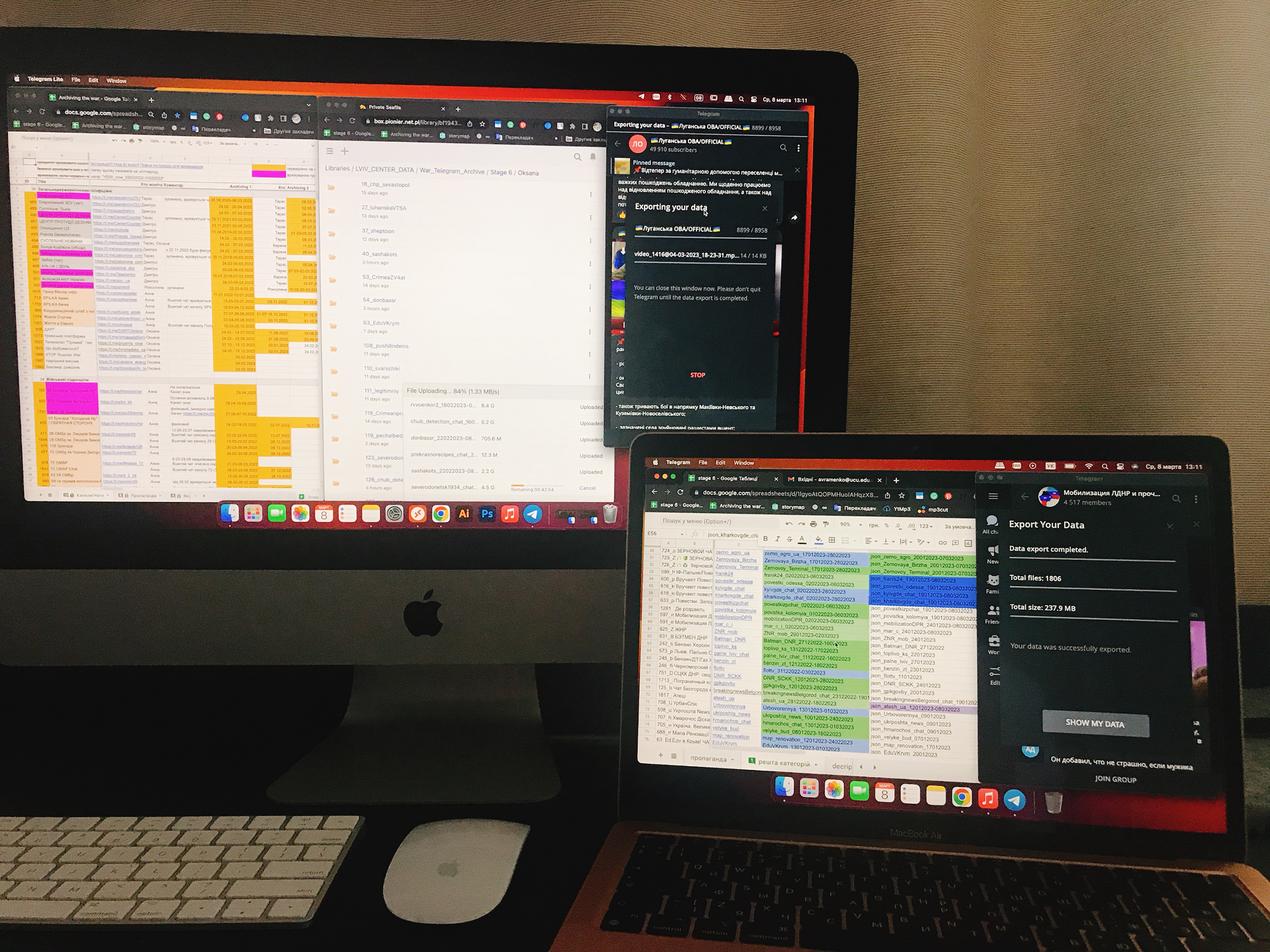
Group 2 analysed Telegram practices of grassroots sabotage groups in Russia’s war against Ukraine, choosing to focus on the concept of sabotage as resistance in the context of the war. They explore the representation and practices of sabotage actors through digital ethnographic data collection and qualitative content analysis of three pre-selected channels across two stages: the initial phase following the full-scale invasion (after 24.02.2022) and the established phase (after the liberation of Kherson). Using Google Sheets, the group documented their observation by recording only interpretations and selected phrases from TG Archive data, to minimise and essentially avoid sensitive data sharing with third party platforms, which forms the core of a collaborative paper. They require continuous access to the TG Archive and plan to present results at international conferences.
Key challenges included the archive’s data limits (only until June 2023), leading the group to focus on early group establishment and key dates in the early stages of the war. Ethical constraints on exporting data were addressed through rich-text coding while avoiding sensitive details. The limits of the translation tool that is embedded in the TG Archive and does not share the data with third party platforms were mitigated via double and triple coding, discussing metaphorical language (e.g., „going for a walk“ as a form of resistance/protest), and regular exchange meetings.
As the war is ongoing, the group anonymizes channel and group titles to avoid harming participants in occupied Ukrainian territories and in Russia involved in partisan activities. To prevent adversarial learning, for example through making strategic information on sabotage organization potentially available to Russian security services, the project team chose to describe groups in an abstract manner and their practices in general terms. Central questions in this research project included how sabotage actors describe their own actions, and the issue of research extractivism if/when getting in contact with investigated groups. Currently, the group is finalising their literature review and structuring analysis results.
Group 3 (Everyday War Witnessing: Witnessing the Outbreak of the War through Urban Chats)
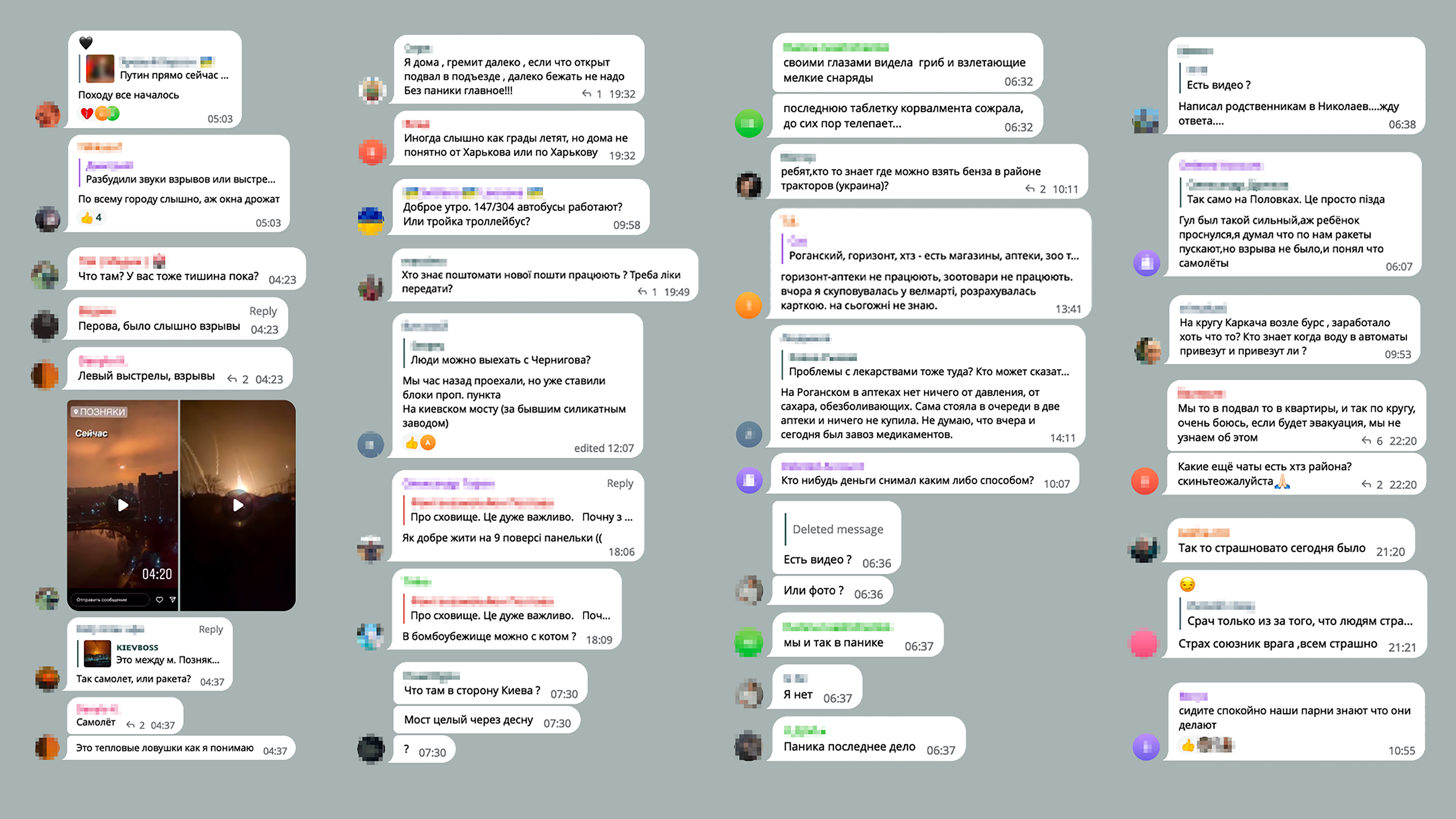
Group 3 examined how the outbreak of the full-scale invasion became witnessable through Telegram, focusing on urban chats from 24 February 2022. The group employs a methodology combining distant reading, by focusing on words that appear most common with close reading of the context for topic identification, followed by merging selected quotes and visualising them through colour-coded topics. The current aim of this research group is to test this methodology—checking for important missing elements—and to visualise topics of each chat separately.
Using the TG Archive as the data source for the project, messages, publication times, and chat names were collected from the archive and used for collaborative analysis, such as Google Collaboratory. Challenges include the subjectivity of defining topics, and decisions about visualisation methods. A data-related question the group faces is whether chat names should be published in the final work.
Outlook and Future for Working with the TG Archive
The data sprint session concluded with an outlook about future steps for working with the TG Archive. A central topic was developing clear citation guidelines, such as mentioning the Archive name, message ID, channel/chat ID, timestamp and guidelines on how to seed the archive, the ethical handling of anonymised data, and proper visualisation practices. Questions regarding the further development of the TG Archive revolved around quotes creation and management for collaborative work with CSV export and assigned tags, as well as the creation of a thematic collections registry on the website of the TG Archive that follows a transparent categorisation logic.
Open ethical challenges addressed the technical feasibility of obtaining consent from channel administrators or participants due to the scale and urgency of data collection. Debates of the group discussion centered on obtaining consent after the fact, such as contacting channel administrators, which is potentially dependent on channel status following the “situational ethics” approach as advocated by the Association of Internet Researchers. Moreover, the usage of third party services, including LLMs, presents another ethical tension, as the current user agreement prohibits the usage of such services, although local models that don’t share data might be ethically feasible. Additional questions included best practices for user agreements to mitigate data breaches and further consultation with other civil archiving initiatives such as the Syrian Archive.
DAY 2, 01.04.2026
Justice through Digital Data
The second day started off with a public session in the afternoon of 1 April, beginning with the roundtable “Digital Justice and Accountability”, moderated by Johanna Hiebl (European University Viadrina). The roundtable started off with practitioner perspectives of Jenna Dolecek (OSINT for Ukraine) and Maryna Slobodyanuk (Truth Hounds), both of whom are involved in documenting and investigating war crimes during the Russian full-scale invasion of Ukraine. Their presentations were followed by Kaja Kowalczewska (Digital Justice Center, University of Wrocław/Queen’s University Belfast) who researches the role of civil society organisations in accountability processes, in particular on how digital data collected by CSOs can be responsibly transferred into prosecutorial and investigative contexts.
Jenna Dolecek spoke from the perspective of rapid-response verification, noting that physical investigators typically arrive only after an attack has taken place, which means that digital evidence often precedes and shapes what is later examined on the ground. Yet despite this, none of the cases she presented have so far appeared in court. Rather than framing this as a failure, she approached it as a shared learning process across the field. Maryna Slobodyanuk observed that while the war is in many ways being recorded automatically, a significant gap persists between documentation and justice: the evidentiary requirements of court proceedings are stringent, the Ukrainian legal system is still adapting to the realities of digital evidence, and the data itself remains fragile and fragmented. She also flagged the ethical risks of relying on data derived from hacked or otherwise non-public sources as legal evidence, as well as the persistent practical challenge of accessing war crime scenes. Kaja Kowalczewska brought in a research perspective, arguing that digitalisation has prompted a democratisation of accountability processes by granting access to non-state actors who lack the institutional knowledge and resources of traditional investigative bodies. She emphasised that the key measure of success is not the volume of material collected, but whether the system as a whole can responsibly navigate that material into prosecutorial contexts.
In the subsequent discussion, Kowalczewska stressed “the importance of coordination more than lack of civil journalism/data,” highlighting success stories of coordination architecture. The conversation also addressed the challenges of fake materials requiring extensive verification time, with AI framed not as black and white but as a tool supporting active human analysis. Questions from the audience raised the role that local communities can and should play in data-based investigations, pointing to an ongoing tension of visibility between centralised expertise and grassroots knowledge.
Capturing Cultural Resistance as Less Documented War Witnessing
The public conference programme concluded with a film screening of “A Home for Rita” (directed by Yulia Appen, 2025). The documentary film follows a Roma family that had to flee the Russian occupation in spring 2022, focusing in particular on the direct experiences of Roma women during the war, their stories and their playful imagination. Set in the city of Zaporizhzhia, just 40 kilometres from the frontline, the narrative centers around the housing problem for displaced Roma people, and their search for a home and a sense of belonging. At the same time, the movie documents the reflections of the Roma people on Ukraine and their own complex identity during the full-scale invasion and in the context of the resistance to Russian aggression.
The screening was followed by a Q&A with director Yulia Appen and Sashko Protyah from Freefilmers, moderated by Prof. Dr. Miglė Bareikytė. The director Appen answered questions from the audience, describing the process of establishing contact with the Roma families, as well as the ethical implications of her position as an external individual producing a documentary film about a marginalized community, her approach of continuously giving back to the community and especially supporting the family in relocating.
A word of thanks from the organizers
The format of the online conference and data sprint around the Telegram Archive of the War once again provided a space to carry out hands-on data research and to discuss the intersection of different methodological approaches and ethical challenges, drawing on specific thematic and temporal contexts. Beyond the specific findings of each working group and roundtable contribution, this year’s programme highlighted the tension between the extensive documentation of the war, digital data-based witnessing and ongoing injustices through the ongoing attack on Ukraine. Participants emphasized that open-source digitally derived evidence from the TG Archive cannot stand alone, but requires cross-referencing and also effective coordination and collaboration efforts to ensure that those involved do not duplicate their work. In times of ongoing war in Ukraine and thus in Europe, where Russia’s continued bombardment makes travel to and from Ukraine — and thus collaborative research in a shared physical space — extremely difficult, this online format has proven a meaningful way to sustain research engagement with issues that are urgent for participants from both academia and different realms of practice. As organisers, we want to thank everyone who joined this year’s conference and data sprint for their continued collaboration, openness, and mutual support.
On behalf of the CRC Media of Cooperation and the project teams “War Sensing” (European University Viadrina, Frankfurt (Oder) with Prof. Dr. Miglė Bareikytė, Johanna Hiebl and Gregor Wörl, the Telegram Archive of the War (Center for Urban History, Lviv) with Oksana Avramenko and Maryana Mazurak and School of Communications/Conflict Institute (Dublin City University) with Prof. Dr. Tanya Lokot