Neuigkeiten
SFB beteiligt sich an bundesweiter Aktion
Zahlreiche Hochschulen und Forschungsinstitutionen verkünden gemeinschaftlich, ihre Aktivitäten auf der Plattform X einzustellen. Die Universität Siegen schließt sich der Aktion an. Auch der SFB folgt dem Aufruf und friert seinen Account auf der Plattform X ein.
➞ Stellungnahme der Universität Siegen
➞ gemeinsame Pressemitteilung von insgesamt 63 Hochschulen und Forschungseinrichtungen
Der SFB bleibt auf seinen anderen Plattformen aktiv – Follow us!
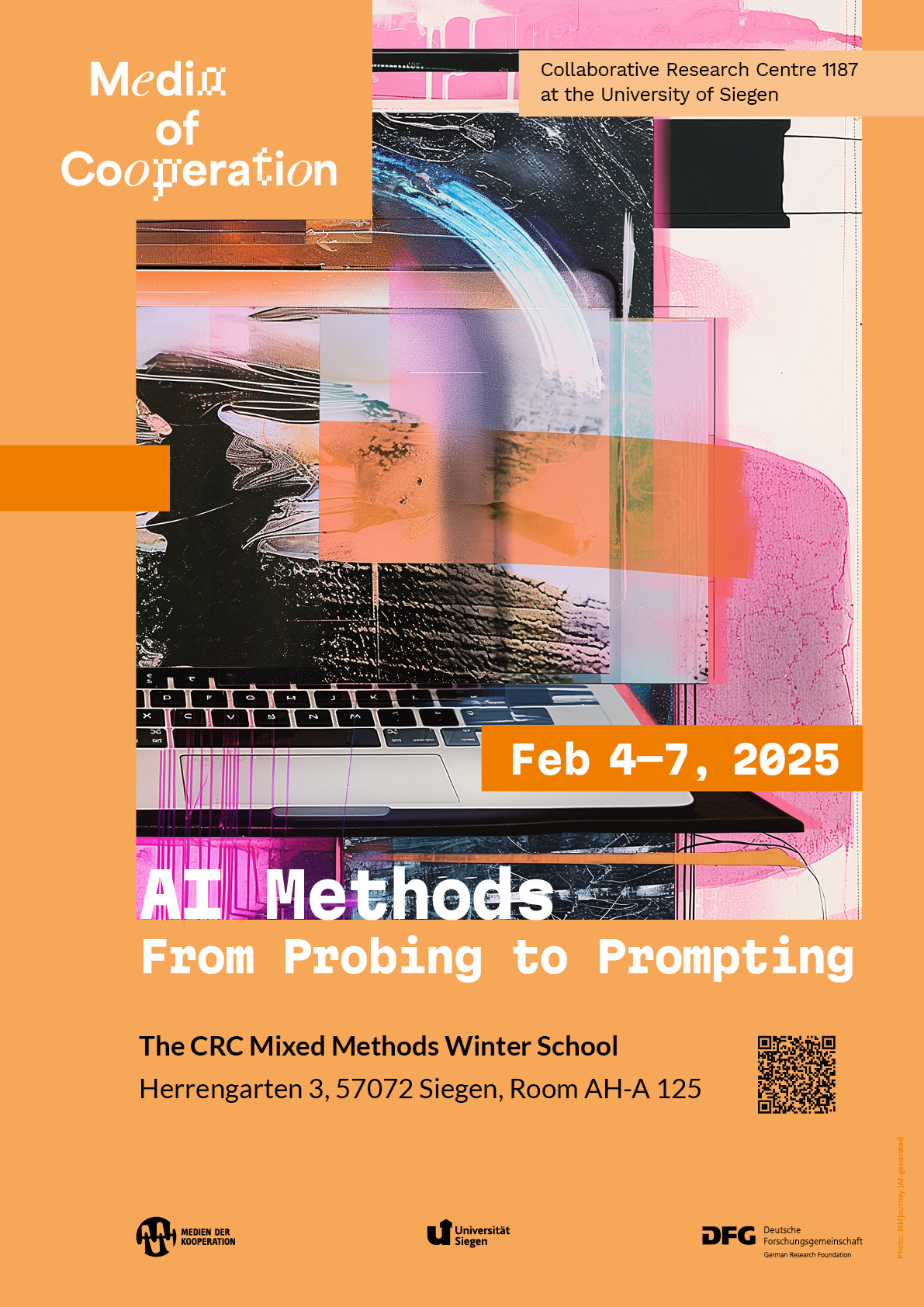
AI Methods: From Probing to Prompting, 4-7 February, 2025
The Collaborative Research Center 1187 “Media of Cooperation” organizes the one-week winter school at the University of Siegen and invites graduate students, postdoc researchers, and media studies scholars interested in the intersections of AI methods, digital visual methodologies, visual social media, and platforms. The Winter School aims to explore questions centering on the implications of AI methods for new forms of sense-making and human-machine co-creation. Please register via the registration form until December 15 2025.
About the Winter School
As artificial intelligence (AI) technologies rapidly evolve, the ways in which we perceive and process information are fundamentally changing. The shift from computational vision, recognition, and classification to generative AI lies at the core of today’s technological landscape, fueling societal debates across different areas—from open-source intelligence and election security to propaganda, art, activism, and storytelling.
Computer vision, a sophisticated agent of pattern recognition, emerged with the rise of machine learning, sparking critical debates around the fairness of image labelling and the deep-seated biases in training data. Today, models like Midjourney, Stable Diffusion, DALL-E, and more recently, Grok are not just recognizing—they are generating patterns, synthesizing multimodal data from websites, social media, and other online sources to produce oddly familiar and yet captivating results. This shift introduces significant ethical questions: How can we critically repurpose the outputs of AI models that are always rooted in platform infrastructures? Which methodological challenges and creative possibilities arise when the boundaries between context and scale become indistinct? Are patterns and biases all there is? And how about scaling down?
The one-week winter school at the University of Siegen organized by the Collaborative Research Center “Media of Cooperation” invites participants to explore these questions centering on the implications of AI methods for new forms of sense-making and human-machine co-creation. The winter school is practice-based and brings together conceptual inputs, workshops, and sprinted group projects around two collaborative methods: probing and prompting.
Probing involves repurposing AI systems to explore their underlying mechanisms. It is a method of critical interrogation—for example, using specific collections of images as inputs to reveal how contemporary computer vision models process these inputs and generate descriptions. Probing not only serves to problematize the hidden architectures of AI but also allows us to critically assess their different ‘ways of knowing’—how can alternative computer vision features such as web detection or text-in-image recognition help us contextualize and interpret visual data?
On the other hand, prompting refers to the practice of engaging GenAI models through input commands to generate multimodal content. Prompting emphasizes the participatory aspect of AI, framing it as a tool for human-machine co-creation, but it also shows the models’ limitations and inherent tensions. AI-generated creations captivate us, yet they also pose the risk of hallucination or what philosopher Harry Frankfurt might call “bullshit”— statements the models confidently present as facts, regardless of their detachment from reality.
The first day of the Winter School will be hybrid. Project group work will be taking place on site.
Program highlights
Participants will have the opportunity to explore and attune these methods to different research scenarios including tracing the spread of propaganda memes/deepfakes, analyzing AI-generated images, and ‘jailbreaking’ or prompting against platforms’ content policy restrictions. A blend of research practice and critical reflection, the winter school features
a keynote by Jill Walker Rettberg (University of Bergen) on “Qualitiative methods for analysing generative AI: Experiences with machine vision and AI storytelling”
two hands-on workshops on mixed techniques for probing and prompting facilitated by Carlo de Gaetano (Amsterdam University of Applied Sciences), Andrea Benedetti (Density Design, Politecnico di Milano), Elena Pilipets (University of Siegen), and Marloes Geboers (University of Amsterdam)
two project tracks intended to combine AI methods with qualitative approaches and ethical data storytelling.
Track 1 “Fabricating the People: Probing AI Detection for Audio-Visual Content in Turkish TikTok” led by Lena Teigeler and Duygu Karatas (both University of Siegen)
Track 2 “Jail(break)ing: Synthetic Imaginaries of ‘sensitive’ AI” led by Elena Pilipets (University of Siegen) and Marloes Geboers (University of Amsterdam)
Track I: Fabricating the People: Probing AI Detection for Audio-Visual Content in Turkish TikTok
Lena Teigeler & Duygu Karatas
Several brutal femicides in Türkiye in 2024 led to a wave of outrage, showing in protests both on the streets and on social media. The protesters demand the protection of women against male violence, measures against offenders and criticize the government under Recep Tayyip Erdoğan for not standing up for women’s rights, as demonstrated, for example, by Türkiye’s withdrawal from the Istanbul Convention in 2021. One of the cases leading to the protest was allegedly connected to the Turkish “manosphere” and online “incel” community. The manosphere is an informal online network of blogs, forums, and social media communities focused on men’s issues, often promoting views on masculinity, gender roles, and relationships. At the core of these groups often lie misogynistic, and anti-feminist views. Many groups foster toxic attitudes toward women and marginalized groups. Incels, short for „involuntary celibates,“ are one subgroup belonging to the broader manosphere, formed by men who feel unable to form romantic or sexual relationships despite wanting them, often blaming society or women for their frustrations.
The project investigates how the cases of femicide are discussed and negotiated in Turkish TikTok by protesters and within the manosphere and explores how these videos make use of generative AI. The use of AI in video creation can range from entire scene generation, over the creation of sounds or deepfaking, to editing and stylisation. The project takes a sample of TikToks associated with the recent wave of femicides as the starting point and makes use of AI methods for two purposes: 1) To detect the usage of generative AI within a sample of TikToks with the help of image labeling. This can range from fully-generated images, videos or sound, to the usage of tools and techniques used within the creation and editing process. We compare different models for detection purposes. 2) With the help of Web Detection, we trace the spread of videos and images across platform borders and content elements that are assembled or synthesized within TikToks.
The aim of the project is to create a cartography of AI based methods for the investigation of audio-visual content. It is part of the DFG-funded research project “Fabricating the People – negotiation of claims to representation in Turkish social media in the context of generative AI”.
Track II: Track 2 Jail(break)ing: Synthetic Imaginaries of ’sensitive‘ AI
Elena Pilipets & Marloes Geboers
The rapid evolution of AI technology is pushing the boundaries of ethical AI use. Newer models like Grok-2 diverge from traditional, more restrained approaches, raising concerns about biases, moderation, and societal impact. This track explores how three generative AI models—X’s Grok-2, Open AI’s GPT4o, and Microsoft’s Copilot—reimagine controversial content according to—or pushing against—the platforms‘ content policy restrictions. To better understand each model’s response to sensitive prompts, we use a derivative approach: starting with images as inputs, we generate stories around them that guide the creation of new, story-based image outputs. In the process, we employ iterative prompting that blends “jailbreaking”—eliciting responses the model would typically avoid—with “jailing,” or reinforcing platform-imposed constraints. Jail(break)ing, then, exposes the skewed imaginaries inscribed in the models‘ capacity to synthesize compliant outputs: The more iterations it takes to generate a new image the stronger the latent spaces of generative models come to the fore that lay bare the platforms‘ data-informed structures of reasoning.
Addressing the performative nature of automated perception, the track, facilitated by Elena Pilipets and Marloes Geboers, examines six image formations collected from social media, which then were used as prompts to explore six issues: war, memes, art, protest, porn, synthetics. In line with feminist approaches, we attend specifically to the hierarchies of power and (in)visibility perpetuated by GenAI, asking: Which synthetic imaginaries emerge from various issue contexts and what do these imaginaries reveal about the model’s ways of seeing? To which extent can we repurpose generative AI as a storytelling and tagging device? How do different models classify sensitive and ambiguous images (along the trajectories of content, aesthetics, and stance)?
Facilitators will combine situated digital methods with experimental data visualization techniques tapping into the generative capacities of different AI models. The fabrication and collective interpretation of data with particular attention to the transitions between inputs and outputs will guide our exploration throughout. Participants will learn how to:
- Conduct “keyword-in-context” analysis of AI-generated stories to identify patterns or “formulas” within issue-specific imaginaries (where, who/what, and how).
- Perform network analysis of AI-generated tags, where input keywords are tags for the original images and output keywords are tags for AI-regenerated images.
- Design prompts to generate canvases that synthesize vernaculars of different transformer models.
The project builds on our earlier work, developing ethnographic approaches to explore cross-model assemblages of algorithmic processes, training datasets, and latent spaces.
Registration
Please register via the form above until December 15. Your registration will be confirmed by December 20, 2024. Participation is limited to 20 people.
Venue
University of Siegen
Campus Herrengarten
Herrengarten 3
room: AH-A 125
57072 Siegen
Contact: Elena Pilipets
Der SFB und die Universität Siegen nimmt Abschied von Prof. Dr. Volkmar Pipek.
Am 6. Januar 2024 verstarb nach langer, schwerer Krankheit im Alter von 56 Jahren Prof. Dr. Volkmar Pipek. Prof. Pipek war von 2006 bis 2013 zunächst als Juniorprofessor im Fach Wirtschaftsinformatik der Fakultät III an der Universität Siegen tätig bevor er zum 1. Februar 2013 zum Universitätsprofessor für „Computer-Supported Cooperative Work and Social Media” berufen wurde. Mit ihm verliert der SFB und die Universität einen international renommierten Forscher und guten Freund.
Einen ausführlichen Nachruf und eine Gedenkseite für Prof. Pipek finden Sie hier
Unser tief empfundenes Mitgefühl gilt seiner Familie und Freund*innen.
In der neusten Publikation “Kontrapunkte setzen – Digitale Politische Bildung mit ContraPoints” in unserer Working Paper Series (No. 35, Dez) setzt sich Julia Bee mit den Potenzialen kreativer Format Politischer Bildung in digitalen Kontexten auseinander. Im Zentrum stehen videoessayistische Gegenformaten von Stiftungen, Institutionen und Vlogger:innen, die darauf abzielen, rechte Metapolitiken zu entlarven und zu erkennen. Sie produzieren Bildungsformate, die nicht nur inhaltlich und informativ, sondern auch ästhetisch und affektiv anknüpfen.
Stiftungen, Institutionen und Vlogger:innen haben in den letzten Jahren angesichts des Rechtsrucks auf Plattformen neue Formate der Politischen Bildung geschaffen. Diese wollen präventiv und intervenierend in rechte Diskurse, Trolling, Fake News und Co. eingreifen. Am Beispiel des Youtube-Kanals ContraPoints untersucht Bee die Formatspezifik der politischen Bildung, die im Anschluss an Donna Haraway als situiertes Wissen verstanden wird.
Julia Bee ist Professorin für Medienästhetik an der Universität Siegen. In ihrer Forschung kombiniert sie ästhetische Phänomene mit Medienphilosophie und Praxistheorie. Dekoloniale und Gender Medien Theorie sind dabei zentral. Derzeitige Forschungsgegenstände bilden dokumentarische Filme, TV-Serien, Vlogs, Installationen, Literatur sowie mobile Medienpraktiken wie Fahrradfahren. Sie ist Teilprojektleiterin des ab Januar 2024 neu geförderten Projekts B09 Fahrradmedien: Kooperative Medien der Mobilität.
Die Publikation „Kontrapunkte setzen – Digitale Politische Bildung mit ContraPoints” wird im Rahmen der Working Paper Series des SFB 1187 „Medien der Kooperation“ veröffentlicht. Die Working Paper Serie versammelt aktuelle Beiträge aus dem Umfeld der inter- und transdisziplinären Medienforschung und bietet die Möglichkeit einer schnellen Veröffentlichung und ersten Verbreitung von am SFB laufenden oder ihm nahestehenden Forschungsarbeiten. Ziel der Reihe ist es, die SFB-Forschung einer breiteren Forschungsgemeinschaft zugänglich zu machen. Alle Working Papers sind über die Website zugänglich oder können in gedruckter Form bei info[æt]sfb1187.uni-siegen.de bestellt werden.
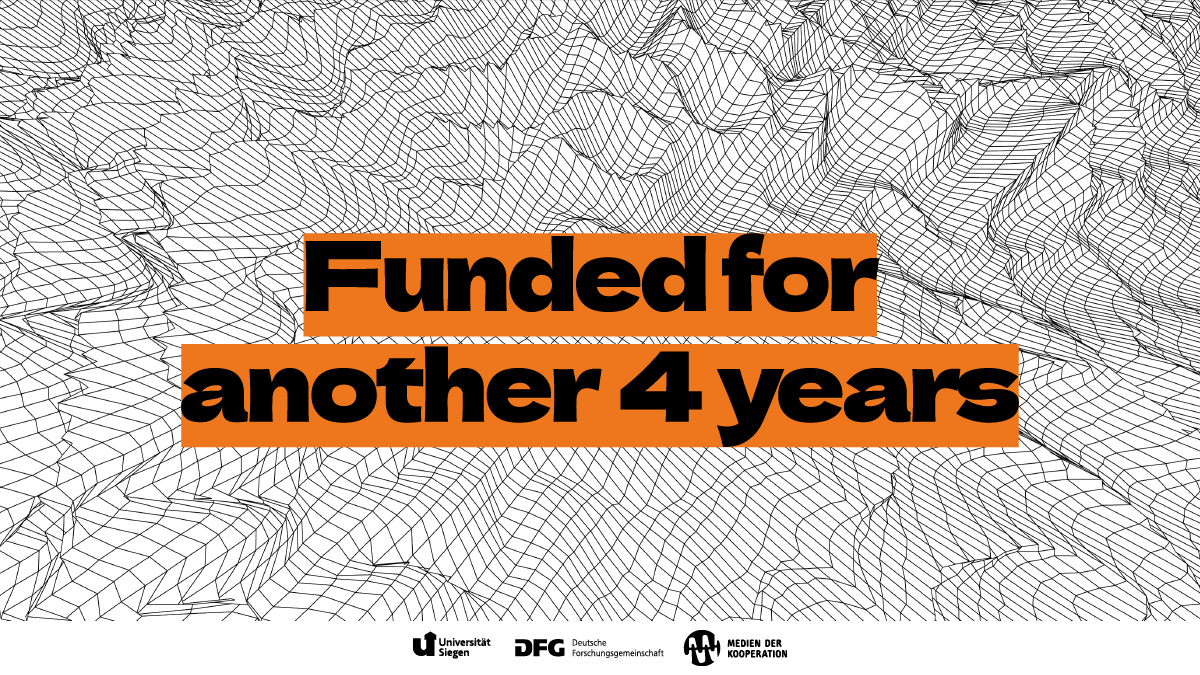
Die DFG hat entschieden: Unser SFB 1187 „Medien der Kooperation“ wird für weitere 4 Jahre gefördert! Wir freuen uns über die Entscheidung der DFG und danken unserem großartigen Team an Forschenden für all die Arbeit, die in den SFB gesteckt wurde, die Bewerbung, die Vor-Ort-Begutachtung, die Teambildung und das erstaunliche Forschungsprogramm. Das war eine kollektive Leistung!
Wir freuen uns auch, die neuen Projekte und Teilprojektleitenden willkommen zu heißen und gemeinsam weitere Jahre der Forschung zu Medien der Kooperation gestalten zu können, insbesondere mit einem neuen Fokus auf sensorische Medien, Künstliche Intelligenz und sensorische Praxeologie.
Lasst uns die kollektive Arbeit an Medien der Kooperation fortführen!
Hier geht es zur Pressemitteilung der Universität Siegen.
Hier gehts zur DFG Pressemitteilung.
Der SFB 1187 stellt Videomitschnitte vergangener und kommender Veranstaltungen zur Verfügung.
Unter dem neuen Menüreiter ‚Media‚-Seite können ab sofort Videomitschnitte vergangener Tagungen angeschaut werden. Dazu gehören unter anderem einzelne Vorträge und Panels der letztjährigen „Off the Grid“ Geomedia Conference 2021, Beiträge vergangener SFB-Jahrestagungen und anderer internationaler Tagungen. Außerdem geben kurze Projektvideos Einblicke in die Forschungsarbeiten der Doktorand:innen unseres Integrierten Graduiertenkollegs (MGK). Videomitschnitte kommender Veranstaltungen werden zukünftig auf der „Media“-Seite veröffentlicht.
The CRC “Media of Cooperation” condemns Russia’s war of aggression against Ukraine.
We are deeply concerned for and stand in solidarity with the people of Ukraine, fellow academics, our colleagues, students, their friends and families. Further, we express our solidarity and respect for all people in and beyond Russia who are resisting and are being subjected to severe repressive measures by the regime.
“The Russian attack on Ukraine is profoundly shocking and our thoughts are with all the people affected by it. They have our solidarity and support. The university and the academic communities offer a series of support services in which we as researchers can participate”, says Prof. Dr. Carolin Gerlitz, deputy speaker of the CRC.
In line with the statement of the German Society for Media Studies (Gesellschaft für Medienwissenschaft e. V.), the CRC is convinced that universities and research are and must remain characterized by international exchange and cooperation. Therefore, support cannot be subject to any national exclusions.
The board of the German Society for Media Studies shares a list of aid and support programs, compiled by the society’s Commission for Good Work in Research (Kommission für gute Arbeit in der Wissenschaft), supports the working group “AK Ukraine und Flucht” as well as the statement of the “AG Gender / Queer Studies und Medienwissenschaft”.
Below we share links to above mentioned initiatives as well as links to statements and support by other institutions.
University Siegen
Deutsche Forschungsgemeinschaft (DFG)
Overview of all statements an information released by the DFG
Information for researchers No. 17 (3 March 2022): “Geflüchtete Forschende: DFG weitet Unterstützung aus” and further information and support for “Geflüchtete Forschende” (DE) and “Refugee Researchers: DFG Expands Support” and further information and support for “Refugee Researchers” (EN)
Statement “Alliance of Science Organisations in Germany: solidarity with partners in Ukraine – consequences for science and the humanities” of the Alliance of Science Organisations in Germany
German Society for Media Studies (Gesellschaft für Medienwissenschaft e. V.)
Working group “AK Ukraine und Flucht”, an initiative established out of the society’s Commission for Good Work in Research (Kommission für gute Arbeit in der Wissenschaft). More info on the initiative can be found here (in: DE / EN / UK / RU). For support, joining and sharing of information: akukraineflucht[æt]gfmedienwissenschaft.de and Email list: ak-flucht-und-ukraine[æt]lists.riseup.net
FG DeKolonial e.V.
How and why did people come to deny the materiality of the digital? What can we learn by recovering it? What if we rethink digital materialities as ongoing cooperative accomplishments?
From December 1–3 2021 historians, media theorists and information scholars come together for the online conference “Digital Matters” to examine socio-material constituents of digital systems and artifacts. Tackling the presupposition of digital immateriality as a misconception but at the same time as a productive site for interdisciplinary scholarly inquiry into media and data practices, the conference counters the idea of disembodied algorithms floating rhetorically in an ethereal cloud of big data. With a keynote lecture by Jonathan Sterne (McGill University) titled “Some Species of Materiality”, six moderated sessions and twelve international speakers, the conference promises a deep dive into digital matters and (im)materialities.
Conceptualized as an online conference with hybrid elements, most speakers will partake online with the organizers and several others coming together onsite in Siegen.
The conference is organized by Thomas Haigh (University of Wisconsin-Milwaukee & Siegen University), Valérie Schafer (University of Luxembourg), Axel Volmar (Siegen University) and Sebastian Giessmann (Siegen University). The event is part of the CRC projects A01 and A02.
For more information see:
https://www.mediacoop.uni-siegen.de/en/events/conference-digital-matters-a01/
https://www.socialstudiesof.info/digitalmatters/
How does digitization relate to assistance? A mishap sparked a profound study on contemporary redistribution of assistance at Deutsche Bahn.
When sociology professor Jörg Potthast lost his phone and wallet on a train in 2015, he found himself in the stressful situation of not being able to block his credit card. Without a phone of his own he had to rely on the train conducter’s kindness and contact his bank over a borrowed one. To make matters worse the connection was insufficient. This unfortunate event prompted the author to take a closer look at the lost and found services of the Deutsche Bahn.
Noticing a shift towards digitization within the “lost and found” services of the deutsche Bahn, the author explores the effects that come with digital practices. Leaving the train, the publication “Lost and found: transforming assistance at digital Deutsche Bahn” further contemplates the general digital practices of the individual consumer, when seeking assistance.
The publication intends to seek for a politics of pity – which have been largely absent from the current appraisals of digital sociality – in exploring the ambiguous patterns in the practice of assistance.
Jörg Potthast is a principal investigator at the Collaborative Research Center (SFB 1187) „Media of Cooperation“ in Siegen, leading the project A04 – Normal Interruptions of Service. Structure and Change of Public Infrastructures, which explores the sociological aspects of public transport.
His paper is published as part of the Working Paper Series of the SFB 1187 (No. 19, July 2021) which promotes inter- and transdisciplinary media research and provides an avenue for rapid publication and dissemination of ongoing research located at or associated with the CRC. The purpose of the series is to circulate in-progress research to the wider research community beyond the CRC. All Working Papers are accessible via the website or can be ordered in print by sending an email to: karina.kirsten[æt]uni-siegen.de
Der SFB 1187 „Medien der Kooperation“ wird von der Deutschen Forschungsgemeinschaft für weitere 3,5 Jahre bis Dezember 2023 gefördert. Der Beginn der zweiten Förderphase fällt mitten in die anhaltende Ausnahmesituation der COVID-19-Pandemie, der sich der SFB am 27. und 28. Oktober 2020 wissenschaftlich annimmt: „Pandemic Cooperation: Media and Society in Times of Corona“ lautet der Titel der diesjährigen Jahrestagung, in der Wissenschaftler*innen aus mehr als zehn Ländern in sechs thematischen Panels zusammenkommen, um die anhaltenden Auswirkungen der Pandemie auf durch digitale Medien vermittelte Kooperationsverhältnisse zu analysieren. Zwei Keynote Vorträge von Sarah Pink und Arjun Appadurai/Paula Kift runden das Programm der erstmals vollständig virtuell stattfindenden Jahrestagung ab.
2 / 3