News
A Special-themed collection with the journal Platforms & Society
Out now! Special-themed collection “Ambient Amplification: Memecry Across Platforms,” with Platforms & Society, edited by Elena Pilipets and Marloes Geboers and including 10 individual articles
→ read the editorial introduction
What comes into focus when we approach memes through the affective interplay of user practices and algorithmic systems? The editorial introduction to Volume One situates the collection’s ten methodological and conceptual reflections around a series of shifts that “foreground the background” of contemporary platform cultures: from viral events toward surrounding adaptations and remixes; from metrics to affinity-based algorithmic approximation; from memes as content to vibe-based riffing on affective orientations; and from visibility to ambiguity resistant to quantification.
Please find links to the individual articles below. Happy reading, and stay tuned for the forthcoming call for contributions to Volume Two!
All contributions:
- Elena Pilipets and Marloes Geboers Ambient Amplification: Memecry Across Platforms
- Susanna Paasonen Affect and memes: Ambiguity abounds
- Stijn Peeters and Tom Willaert ‘Dark metrics’ and the mainstreaming of political extremism on Dutch-speaking Telegram
- Nicola Righetti and Richard Rogers Coordinated inauthentic behaviour on Facebook? A typology of manufactured attention
- Sal Hagen, Daniël de Zeeuw, and Tommaso Venturini Digital rhythmanalysis: Studying memetic and affective rhythms on the post-viral Web
- Marcus Bösch and Tom Divon Dancing in uniform: Thirst trap propaganda in military image wars on TikTok
- Boris Noordenbos and Marc Tuters The counter-hegemonic hegemon: A cross-platform analysis of a Kremlin-backed strategic narrative
- Marloes Geboers, Elena Pilipets, Idil Galip and Julia Bee Amplification, communities, platforms: Reclaiming space with Idil Galip and Julia Bee
- Jing Zeng, Qinghao Guan, Ariadna Matamoros-Fernández, and Xiran Liu How do multi-modal large language models understand non-English visual hate?
- Fraser Crichton and Guillén Torres (Re)Generating Hate
- Elena Pilipets and Marloes Geboers Synthetic imaginaries of “sensitive” AI: On ambient amplification and jail(break)ing as method
The SFB cordially invites you to the oral examination in the doctoral examination proceedings of Hoa Mai Trần. The dissertation defense will take place on Tuesday, 20 October 2026, from 10:00 a.m. to 12:00 p.m. in room AR-E 4112 (OASE Learning Workshop) at Adolf-Reichwein-Str. 2, 57068 Siegen, Germany.
During the defense, Hoa Mai Trần will present and academically defend the findings of her dissertation before the examination committee. The title of her dissertation is: “The Virtual Self in the In-Between: An Ethnographic Study of Childhood and Children’s Modes of Existence in Digital Play.”
Where does “the child” begin in digital play, and where does it end? Drawing on three years of ethnographic fieldwork with three families in Germany, Hoa Mai Trần examines children’s experiences while playing digital games. The educational science study explores how the boundaries between the “self” and the “not-self” shift during play. At its core is the research question: How is children’s hybrid being-in-the-world brought forth through digital play?
The central thesis of the dissertation is that children can be present and exist beyond the physical boundaries of their flesh-and-blood bodies. Between feeling, becoming, and dying, an in-between space unfolds within play, revealing children’s hybrid, living modes of existence. Children’s play becomes a meaningful, tangible, and dynamic (in-between) reality. The phenomena of boundary dissolution, mutually generated by the child and the game, enable temporary or reactivatable ways of unfolding the self and the world, depending on the particular play situation, and contribute to the emergence of the virtual self. The virtual self is not a digital representation of the child within the game, but rather the idea brought forth through play—one that can be digitally materialized and personalized to varying degrees, expressing the possibility of being or becoming something or someone. Digital games are inhabitable spaces of childhood that have individual, social, educational policy-related, and economic significance for children and society.
The dissertation project is part of Subproject B05: “(Early) Childhood and Smartphones.” The examination will be conducted in German and will be chaired by Prof. Dr. Jutta Wiesemann (first examiner), Prof. Dr. Jochen Lange (second examiner), and Prof. Dr. Chantal Munsch (member of the examination committee).
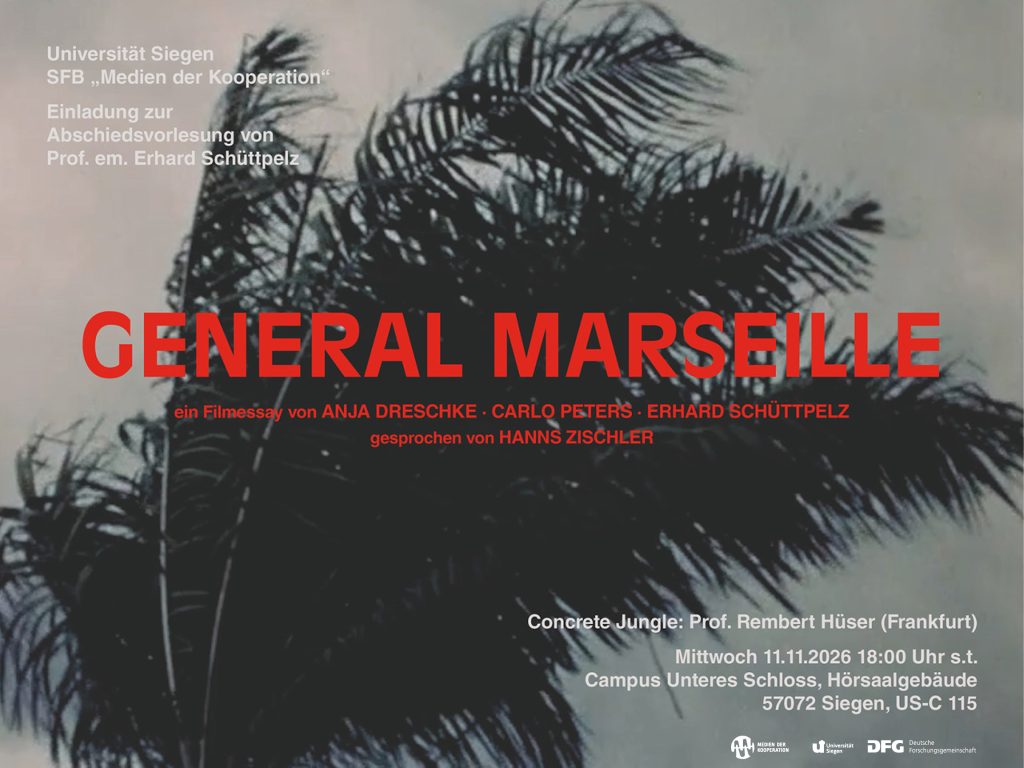
The SFB cordially invites you to the farewell lecture of Prof. em. Erhard Schüttpelz, who retired in October 2025. He was a founder and one of the defining scholars of the SFB. In his farewell lecture, Erhard Schüttpelz will present and discuss his film essay “General Marseille,” which he produced together with Anja Dreschke and Carlo Peters. Prof. Rembert Hüser will subsequently deliver the laudation, after which the SFB invites all guests to a reception.
Venue
University of Siegen
Campus Unteres Schloss
US-C 115
About Erhard Schüttpelz
Erhard Schüttpelz, born in 1961 in Haldern (now Rees), studied in Hanover, Exeter, Bonn, Cologne, and Oxford (St. John’s) and received his doctorate from the University of Bonn in 1994. In 1994/95, he was a Feodor Lynen Fellow of the Alexander von Humboldt Foundation at Columbia University, New York. From 1996 to 1998, he was a postdoctoral researcher at the DFG Research Training Group Theory of Literature and Communication at the University of Constance; from 1998 to 2003, he served as a research associate in preparation for, and subsequently within, the Collaborative Research Centre Media and Cultural Communication at the Universities of Cologne, Bonn, and Aachen.
He completed his habilitation in 2003 at the University of Constance, where he served as the scientific coordinator of the research unit Cultural Theory and Theory of the Political Imaginary from 2003 to 2005, funded by Albrecht Koschorke’s Leibniz Prize. In 2005, he was a Fellow at the IFK (Vienna). Since 2005, he has been Professor of Media Theory at the University of Siegen, serving as a principal investigator of the DFG Research Training Group Locating Media and the Collaborative Research Centre Media of Cooperation. From 2012 to 2016, he was an elected member of the DFG Review Board 103, and from 2018 to 2022, a member of the University Council of the University of Siegen. In addition, he held fellowships in Weimar, Constance, Berlin (FU), Münster, and at the Center for Advanced Studies – Erlangen.
His interests are philological and cultural in nature. They initially led him from structuralist literary theory to the language theory of rhetorical figures—driven by a deep sympathy for impossible syntheses that could bridge the divide between continental and analytic philosophy, for boundary crossers between disciplines, for the history of the humanities modeled on Science and Technology Studies, and for figures of transition, boundary objects, tricksters, disruptions, and images. He found his academic home in the newly emerging discipline of German media studies—of which he remarks that it is »a field I could neither have studied nor invented better myself to pursue my interest in opportunities for cooperation«.
His films and books include a film with the working title Gaabi Cirey! featuring the voice of Hanns Zischler (with Anja Dreschke and Carlo Peters), the film A Kind of World War (with Anselm Franke, 2021), online at: https://www.hkw.de/de/app/mediathek/video/84649 and the books Eine Art Weltkrieg / A Kind of World War (with Anselm Franke, Berlin, Haus der Kulturen der Welt, 2021), Die Moderne im Spiegel des Primitiven. Weltliteratur und Ethnologie 1870-1960 (Munich 2005), Deutland (Berlin 2023), and Medium, Medium: Elemente einer Anthropologie (Berlin 2025). A 2002 conference at the Warburg-Haus resulted in the volume he co-edited with Cora Bender and Thomas Hensel, »Schlangenritual«. Der Transfer der Wissensformen vom Tsu’ti’kive der Hopi bis zu Aby Warburgs Kreuzlinger Vortrag (Berlin 2007).
In connection with this honor, Erhard Schüttpelz will deliver a celebratory lecture in the reading room of the Warburg-Haus, scheduled for the second half of 2026. The date will be announced along with the invitation from the Aby Warburg Foundation.
Mediengeographie: Handbuch für Wissenschaft und Studium (Media Geographies: Handbook für Research and Study)
by Tristan Thielmann (Universität Siegen, SFB) and Max Kanderske (SFB)
The field of media geography is situated at the intersection of media studies and human geography. The aim of this handbook is to trace the development of media geography and to provide a comprehensive overview of the current field of research—ranging from the geography of books to the geography of film and video games, and on to the geography of the Internet, smartphones, and AI.
About the book
The Internet of Things, Big Data, drone media, artificial intelligence, mobile GIS, and sensorized life: geodata are increasingly shaping our everyday lives and academic discourse. Published by Nomos, this handbook provides a comprehensive overview of current research questions emerging at the intersection of geography and media. On the one hand, it offers subject-oriented overview articles; on the other, it brings together programmatic contributions that have proven influential and forward-looking for the field. Contributors include Bruno Latour, Tim Ingold, Karen Caplan, Sarah Pink, Mark Andrejevic, James Ash, and Jessica McLean. An overview is provided in the introduction, which is available via academia.edu.
The work of Collaborative Research Centre 1187 “Media of Cooperation” is reflected in several contributions to the handbook: As head of project P04 “Precision Farming: Co-operative Practices of Virtual Fencing”, Tristan Thielmann examines the field of digital animal geographies; Sebastian Gießmann, head of project A01 “Digital-Networked Media between Specialization and Universalization”, traces the historical development of internet geography; and Max Kanderske, research associate in project A03 “Navigation in Online/Offline Spaces”, provides an introduction to the practices and discourses of digital real-time geography.
Further information can be found in the interview with the editors.
University members will soon have access to the digital edition of the handbook via inlibra.
About the authors
Tristan Thielmann is Professor of Science, Technology and Media Studies at the University of Siegen and Deputy Spokesperson of CRC 1187 “Media of Cooperation.” He is also the principal investigator of the projects A03 – Navigation in Online/Offline Spaces and P04 – Precision Farming: Co-operative Practices of Virtual Fencing. His research focuses on media geographies, media and technology history, navigation studies, and cultural cartographies. His areas of interest also include ethnomethodologies and technomethodologies, as well as the study of media and technologies in spatial and social contexts.
Max Kanderske is a research associate in project A03 “Navigation in Online/Offline Spaces” at the Siegen CRC “Media of Cooperation.” Beyond navigation studies, his research interests include sensor-mediated environments and digital game spaces. He is also co-editor of the Game Studies journal “Spiel|Formen.”
Beyond Informed Consent: Consumer Data Preferences and the Case for Enforcement-Oriented Transparency
by Prof. Dr. Maximilian Becker & Catalina Goanta (University Siegen, SFB)
How are digitalization and artificial intelligence changing the structures of private law? In this working paper, Maximilian Becker examines the legal challenges posed by digital technologies from the perspective of civil law. The paper analyzes how data-driven systems, algorithmic decision-making processes, and new digital business models are influencing existing structures of private law and explores the extent to which current law can meet the demands of the digital transformation.
→ Link Working Paper
About the Working Paper
Digital markets have fundamentally altered the conditions under which consumers engage with data-driven platforms, yet regulatory frameworks, particularly in the EU, continue to rely on consent-based models that presuppose a level of technological literacy and informed agency that most users do not possess. Drawing on existing empirical evidence from five studies across the US, UK, and EU, this paper departs from the empirical argument that consumer preferences regarding personal data are highly unstable and shaped by framing and trust rather than genuine, well-formed values.
Consumers systematically overestimate the privacy protections offered by paid services, accept personalization without understanding its commercial scope, and disregard privacy notices regardless of their clarity. This argument exposes the structural failure of transparency-as-disclosure as a regulatory strategy: informing consumers better does not fix markets distorted by asymmetric information and complex, layered business models.
Rather than doubling down on consumer-facing transparency obligations, this paper proposes a shift toward enforcement-oriented business-model transparency, under which platforms would be required to disclose aspects such as data flows, monetization strategies, but also algorithmic processes to regulatory authorities and civil society. The Digital Services Act and the General Data Protection Regulation already point somewhat in this direction. Building on this logic, the paper proposes further machine-readable transparency as a complement to existing information obligations.
About the Authors
Prof. Dr. Maximilian Becker is a professor of civil law, intellectual property law, and media law at the University of Siegen. His research focuses on civil law with connections to medical law, data law, and information technology law, as well as on IT law, media law, and competition law. He studied German and European business law at the University of Siegen and earned his doctorate there in 2012 with a dissertation on “Absurd Contracts.” After serving as an assistant professor at the University of Siegen and as a professor of data protection law and IT law at Leibniz University Hannover, he has been a professor at the University of Siegen since 2021. In addition, he is a subproject leader for the project A07 – ‘The Personal Data Industry’ at SFB 1187 Media of Cooperation (University of Siegen).
Catalina Goanta is an Associate Professor in Private Law and Technology and Principal Investigator of the ERC Starting Grant HUMANads, focused on understanding the impact of content monetization on social media and on reinterpreting private law fairness in the context of platform governance. Between 2016-2021 she was Assistant Professor at the Faculty of Law at Maastricht University, and during February 2018 – February 2019, she was a Niels Stensen fellow and visited the University of St. Gallen (The Institute of Work and Employment) and Harvard University (The Berkman Center for Internet and Society). She has been a mercator fellow at the SFB since 2025.
About the Working Paper Series
The Working Paper Series of SFB 1187 “Media of Cooperation” brings together current contributions from the field of interdisciplinary and transdisciplinary media research. The SFB Working Paper Series offers the opportunity for pre-publication and rapid dissemination of research work currently being carried out at the SFB or related to it. The aim of the series is to make SFB research accessible to a broader research community. Publication in the Working Paper Series does not preclude the publication of revised versions of the same contribution in other journals. Contributions from postdocs and established researchers are welcome. The series is intended as a publication forum for the researchers represented in the SFB, their projects, and their ongoing research. Contributions are published in open access and in a limited print edition. If you would like to publish an article in the Working Paper Series, please submit your topic proposal in the form of an abstract (max. 300 words) together with a short CV (max. 50 words). For manuscript submission, please refer to our styleguide.
Funded by the German Research Foundation (DFG) – Project number 262513311 – SFB 1187. Editorial responsibility: Karina Kirsten, University of Siegen & SFB 1187 Media of Cooperation.
The SFB cordially invites you to the defense of Niklas Strüver’s doctoral thesis.
Monday, July 27, 2026, at 11:00 a.m. in Room AH-A 217/18.
During the defense, the findings of his dissertation will be presented to the examination committee and academically defended. The title of his dissertation is “Speaking on behalf of the periphery: Third-party relationships in Amazon’s Alexa ecosystem” and it examines the developmental dynamics of the voice assistant Alexa from the perspectives of infrastructure and platform theory. Drawing on the four articles presented, the dissertation explores how Alexa functions as an infrastructure and platform for third-party providers in business and academia, and what sociotechnical power imbalances arise in the process. This analysis allows for an examination of the social relationships that Amazon, as the manufacturer, enters into with complementary providers on the periphery of the platform. Through various empirical approaches, it is possible, despite the usual secrecy maintained by large corporations, to gain insight into the development of technologies that are present in the everyday lives of many people.
It will be conducted in German and supervised by the two examiners, Dagmar Hoffmann and Armin Beverungen.
Niklas Strüver (M.A.) ist wissenschaftlicher Mitarbeiter im Projekt B06 („Un/erbetene Beobachtung in Interaktion“) und Doktorand am SFB 1187 „Medien der Kooperation“. Er studierte Soziologie mit einem Schwerpunkt auf Techniksoziologie an der RWTH Aachen und schloss dort den Master of Arts ab. Seine Forschungsschwerpunkte liegen u.a. in den Bereichen Techniksoziologie, Science and Technology Studies sowie Platform Studies.
The 2026 annual conference of the Collaborative Research Center 1187 “Media of Cooperation” explores the politics of cooperative sensing and sense-making in a time marked by geopolitical and climate catastrophes, anti-democratic backlashes and the rise of authoritarian regimes—all of which are phenomena closely intertwined with increasing datafication, generative AI developments, and the growing power of Big Tech.
→ Check out the program and register now
Around the world, we find ourselves confronted with these complex entanglements, whose environmental, political and societal costs are distributed unevenly. While digital technologies enable new forms of cooperation, their energy consumption also contributes to environmental disasters. At the same time, it is precisely these digital technologies and infrastructures that are increasingly becoming sites of violence, from algorithmic discrimination to gendered and racialized forms of harassment and disinformation.
Against this backdrop, the annual conference examines how cooperation is being reshaped in today’s sociotechnical environments. It explores how various alliances—between states and Big Tech companies on the one hand, and between researchers, activists, artists, and communities on the other—negotiate the possibilities and limits of public action and perception. How do media and data practices contribute to new forms of control and how are they challenged via digital protests or anti-tech initiatives? And how can cooperative practices and protests also enable resistance and democratic engagement?
Bringing together scholars, activists, artists, filmmakers and journalists, the conference invites participants to inquire into the politics of media, data, and sensory practices, and to explore the role of cooperative forms of sensing and sense-making.
The conference is organized around three key thematic areas:
Area 1: Digital Power and Techfascism
In this section, we examine emerging alliances between governments, technology corporations, and far-right digital cultures. It focuses on current formations of violence and power: the cooperation between governments and Big Tech on the one hand, and the rise of the global far-right enabled by deregulated social networks on the other. Topics include digital violence, disinformation campaigns, the affective politics of online communities, techfascisms, and debates around digital sovereignty.
Area 2: Sensory Conflicts and Mediated Wars
This area explores how contemporary conflicts, from wars to geopolitical tensions, are experienced, mediated, and interpreted through digital technologies. It addresses major geopolitical and media-technological shifts, including the digitally mediated forms of witnessing wars and conflicts, as well as the fundamental expropriations of land, water, and resources underpinning digital media, which become visible through practices of extractivism, and the sensory confusion produced by disinformation and generative AI.
Area 3: Resistance, Cooperation and Democratic Practices
Alongside critical diagnoses discussed in the other two areas, this part of the program highlights practices of resistance and democratic engagement from activist research and digital anti-facist initiatives. The third section therefore explores interventions in the radicalization and fascistization of societies, how scholars and universities can act together with civil society to counter anti-democratic processes in which Big Tech and other corporations are actively implicated.
As part of the annual conference, Prof. Dr. Erhard Schüttpelz will deliver his farewell lecture, which will include a laudatory address by Prof. Dr. Rembert Hüser. The farewell ceremony will be held in German.
Venue
University of Siegen
Campus Unteres Schloss
US-S 001 / 002
Obergraben 25
57072 Siegen
We are delighted to announce the programme for the forthcoming Autumn School, Synthetic Social Media: Studying Platform-Embedded AI, taking place at the University of Siegen, 22–25 September.
The programme is organised around three themes: AI Slop / Slopification (Day 1), Chatbot / Appification (Day 2), and Persona / Affective Infrastructure (Day 3), featuring presentations by Stijn Peeters, Marloes Geboers, Salvatore Romano, Carine Roos, Giorgia Arbuti, Natalia Stanusch, Tanja Sihvonen, Jimmy Mäkelä, Natalia Sánchez-Querubín, Nuppu Pelevina, Lilli Sihvonen, Elena Pilipets, and Marcus Bösch.
The three themes are brought into conversation through keynotes by Gabriele De Seta, Esther Weltevrede, Sara Messelaar Hammerschmidt, and Carolin Gerlitz, followed by collaborative method-mapping workshops in breakout groups supported by data designers Ángeles Briones and Riccardo Ventura.
Reflecting on synthetic/human-machine co-created data, participants will brainstorm ways to combine different methodological pathways, analytical techniques, and research tools to study platform-embedded AI through qualitative inquiry and critical technical practice. The workshops integrate hands-on data exploration and visual mapping on Miro boards, using methodological prototyping as a mode of inquiry. Each workshop is tailored to the day’s theme, exploring questions of field access/data collection, research tool inscriptions, sense-making/sensing, methodological frictions, and the ethical challenges posed by synthetic data and AI-mediated environments. The specific affordances of the media phenomena at hand are central. Our main interest is to explore how these affordances inform the method(s).
The Autumn School concludes (on Day 4) with a collective reflection on the outcomes of the method mapping workshops, bringing together the insights and questions that emerged over the course of the programme.
Venue
Universität Siegen | Campus Herrengarten
AH-A 217/18 | Herrengarten 3 | 57072 Siegen
In an interview with the Institute for Network Cultures, Sebastian Gießmann, PI of A01: History of Digitally Networked Media between Specialization and Universalization, answers questions about his newly published book on credit cards and discusses the theory of digital payments.
→ You can read the interview here (in German)
1 / 19