News
The SFB cordially invites you to the oral examination in the doctoral examination proceedings of Hoa Mai Trần. The dissertation defense will take place on Tuesday, 20 October 2026, from 10:00 a.m. to 12:00 p.m. in room AR-E 4112 (OASE Learning Workshop) at Adolf-Reichwein-Str. 2, 57068 Siegen, Germany.
During the defense, Hoa Mai Trần will present and academically defend the findings of her dissertation before the examination committee. The title of her dissertation is: “The Virtual Self in the In-Between: An Ethnographic Study of Childhood and Children’s Modes of Existence in Digital Play.”
Where does “the child” begin in digital play, and where does it end? Drawing on three years of ethnographic fieldwork with three families in Germany, Hoa Mai Trần examines children’s experiences while playing digital games. The educational science study explores how the boundaries between the “self” and the “not-self” shift during play. At its core is the research question: How is children’s hybrid being-in-the-world brought forth through digital play?
The central thesis of the dissertation is that children can be present and exist beyond the physical boundaries of their flesh-and-blood bodies. Between feeling, becoming, and dying, an in-between space unfolds within play, revealing children’s hybrid, living modes of existence. Children’s play becomes a meaningful, tangible, and dynamic (in-between) reality. The phenomena of boundary dissolution, mutually generated by the child and the game, enable temporary or reactivatable ways of unfolding the self and the world, depending on the particular play situation, and contribute to the emergence of the virtual self. The virtual self is not a digital representation of the child within the game, but rather the idea brought forth through play—one that can be digitally materialized and personalized to varying degrees, expressing the possibility of being or becoming something or someone. Digital games are inhabitable spaces of childhood that have individual, social, educational policy-related, and economic significance for children and society.
The dissertation project is part of Subproject B05: “(Early) Childhood and Smartphones.” The examination will be conducted in German and will be chaired by Prof. Dr. Jutta Wiesemann (first examiner), Prof. Dr. Jochen Lange (second examiner), and Prof. Dr. Chantal Munsch (member of the examination committee).
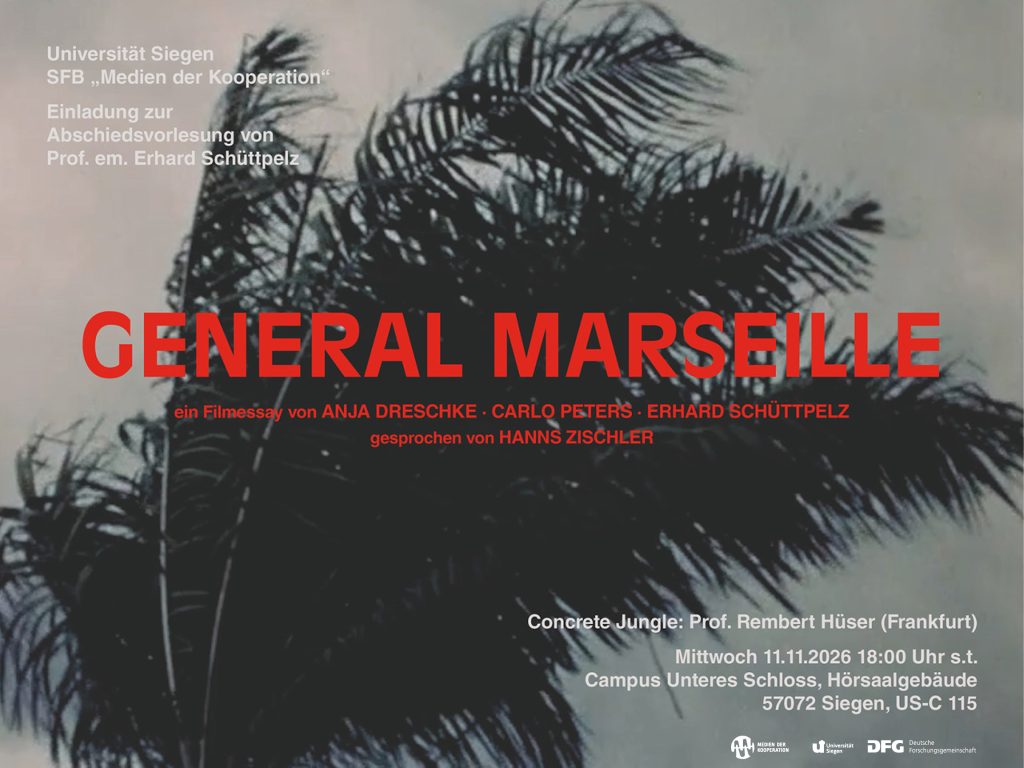
The SFB cordially invites you to the farewell lecture of Prof. em. Erhard Schüttpelz, who retired in October 2025. He was a founder and one of the defining scholars of the SFB. In his farewell lecture, Erhard Schüttpelz will present and discuss his film essay “General Marseille,” which he produced together with Anja Dreschke and Carlo Peters. Prof. Rembert Hüser will subsequently deliver the laudation, after which the SFB invites all guests to a reception.
Venue
University of Siegen
Campus Unteres Schloss
US-C 115
About Erhard Schüttpelz
Erhard Schüttpelz, born in 1961 in Haldern (now Rees), studied in Hanover, Exeter, Bonn, Cologne, and Oxford (St. John’s) and received his doctorate from the University of Bonn in 1994. In 1994/95, he was a Feodor Lynen Fellow of the Alexander von Humboldt Foundation at Columbia University, New York. From 1996 to 1998, he was a postdoctoral researcher at the DFG Research Training Group Theory of Literature and Communication at the University of Constance; from 1998 to 2003, he served as a research associate in preparation for, and subsequently within, the Collaborative Research Centre Media and Cultural Communication at the Universities of Cologne, Bonn, and Aachen.
He completed his habilitation in 2003 at the University of Constance, where he served as the scientific coordinator of the research unit Cultural Theory and Theory of the Political Imaginary from 2003 to 2005, funded by Albrecht Koschorke’s Leibniz Prize. In 2005, he was a Fellow at the IFK (Vienna). Since 2005, he has been Professor of Media Theory at the University of Siegen, serving as a principal investigator of the DFG Research Training Group Locating Media and the Collaborative Research Centre Media of Cooperation. From 2012 to 2016, he was an elected member of the DFG Review Board 103, and from 2018 to 2022, a member of the University Council of the University of Siegen. In addition, he held fellowships in Weimar, Constance, Berlin (FU), Münster, and at the Center for Advanced Studies – Erlangen.
His interests are philological and cultural in nature. They initially led him from structuralist literary theory to the language theory of rhetorical figures—driven by a deep sympathy for impossible syntheses that could bridge the divide between continental and analytic philosophy, for boundary crossers between disciplines, for the history of the humanities modeled on Science and Technology Studies, and for figures of transition, boundary objects, tricksters, disruptions, and images. He found his academic home in the newly emerging discipline of German media studies—of which he remarks that it is »a field I could neither have studied nor invented better myself to pursue my interest in opportunities for cooperation«.
His films and books include a film with the working title Gaabi Cirey! featuring the voice of Hanns Zischler (with Anja Dreschke and Carlo Peters), the film A Kind of World War (with Anselm Franke, 2021), online at: https://www.hkw.de/de/app/mediathek/video/84649 and the books Eine Art Weltkrieg / A Kind of World War (with Anselm Franke, Berlin, Haus der Kulturen der Welt, 2021), Die Moderne im Spiegel des Primitiven. Weltliteratur und Ethnologie 1870-1960 (Munich 2005), Deutland (Berlin 2023), and Medium, Medium: Elemente einer Anthropologie (Berlin 2025). A 2002 conference at the Warburg-Haus resulted in the volume he co-edited with Cora Bender and Thomas Hensel, »Schlangenritual«. Der Transfer der Wissensformen vom Tsu’ti’kive der Hopi bis zu Aby Warburgs Kreuzlinger Vortrag (Berlin 2007).
In connection with this honor, Erhard Schüttpelz will deliver a celebratory lecture in the reading room of the Warburg-Haus, scheduled for the second half of 2026. The date will be announced along with the invitation from the Aby Warburg Foundation.
The SFB cordially invites you to the defense of Niklas Strüver’s doctoral thesis.
Monday, July 27, 2026, at 11:00 a.m. in Room AH-A 217/18.
During the defense, the findings of his dissertation will be presented to the examination committee and academically defended. The title of his dissertation is “Speaking on behalf of the periphery: Third-party relationships in Amazon’s Alexa ecosystem” and it examines the developmental dynamics of the voice assistant Alexa from the perspectives of infrastructure and platform theory. Drawing on the four articles presented, the dissertation explores how Alexa functions as an infrastructure and platform for third-party providers in business and academia, and what sociotechnical power imbalances arise in the process. This analysis allows for an examination of the social relationships that Amazon, as the manufacturer, enters into with complementary providers on the periphery of the platform. Through various empirical approaches, it is possible, despite the usual secrecy maintained by large corporations, to gain insight into the development of technologies that are present in the everyday lives of many people.
It will be conducted in German and supervised by the two examiners, Dagmar Hoffmann and Armin Beverungen.
Niklas Strüver (M.A.) ist wissenschaftlicher Mitarbeiter im Projekt B06 („Un/erbetene Beobachtung in Interaktion“) und Doktorand am SFB 1187 „Medien der Kooperation“. Er studierte Soziologie mit einem Schwerpunkt auf Techniksoziologie an der RWTH Aachen und schloss dort den Master of Arts ab. Seine Forschungsschwerpunkte liegen u.a. in den Bereichen Techniksoziologie, Science and Technology Studies sowie Platform Studies.
The 2026 annual conference of the Collaborative Research Center 1187 “Media of Cooperation” explores the politics of cooperative sensing and sense-making in a time marked by geopolitical and climate catastrophes, anti-democratic backlashes and the rise of authoritarian regimes—all of which are phenomena closely intertwined with increasing datafication, generative AI developments, and the growing power of Big Tech.
→ Check out the program and register now
Around the world, we find ourselves confronted with these complex entanglements, whose environmental, political and societal costs are distributed unevenly. While digital technologies enable new forms of cooperation, their energy consumption also contributes to environmental disasters. At the same time, it is precisely these digital technologies and infrastructures that are increasingly becoming sites of violence, from algorithmic discrimination to gendered and racialized forms of harassment and disinformation.
Against this backdrop, the annual conference examines how cooperation is being reshaped in today’s sociotechnical environments. It explores how various alliances—between states and Big Tech companies on the one hand, and between researchers, activists, artists, and communities on the other—negotiate the possibilities and limits of public action and perception. How do media and data practices contribute to new forms of control and how are they challenged via digital protests or anti-tech initiatives? And how can cooperative practices and protests also enable resistance and democratic engagement?
Bringing together scholars, activists, artists, filmmakers and journalists, the conference invites participants to inquire into the politics of media, data, and sensory practices, and to explore the role of cooperative forms of sensing and sense-making.
The conference is organized around three key thematic areas:
Area 1: Digital Power and Techfascism
In this section, we examine emerging alliances between governments, technology corporations, and far-right digital cultures. It focuses on current formations of violence and power: the cooperation between governments and Big Tech on the one hand, and the rise of the global far-right enabled by deregulated social networks on the other. Topics include digital violence, disinformation campaigns, the affective politics of online communities, techfascisms, and debates around digital sovereignty.
Area 2: Sensory Conflicts and Mediated Wars
This area explores how contemporary conflicts, from wars to geopolitical tensions, are experienced, mediated, and interpreted through digital technologies. It addresses major geopolitical and media-technological shifts, including the digitally mediated forms of witnessing wars and conflicts, as well as the fundamental expropriations of land, water, and resources underpinning digital media, which become visible through practices of extractivism, and the sensory confusion produced by disinformation and generative AI.
Area 3: Resistance, Cooperation and Democratic Practices
Alongside critical diagnoses discussed in the other two areas, this part of the program highlights practices of resistance and democratic engagement from activist research and digital anti-facist initiatives. The third section therefore explores interventions in the radicalization and fascistization of societies, how scholars and universities can act together with civil society to counter anti-democratic processes in which Big Tech and other corporations are actively implicated.
As part of the annual conference, Prof. Dr. Erhard Schüttpelz will deliver his farewell lecture, which will include a laudatory address by Prof. Dr. Rembert Hüser. The farewell ceremony will be held in German.
Venue
University of Siegen
Campus Unteres Schloss
US-S 001 / 002
Obergraben 25
57072 Siegen
We are delighted to announce the programme for the forthcoming Autumn School, Synthetic Social Media: Studying Platform-Embedded AI, taking place at the University of Siegen, 22–25 September.
The programme is organised around three themes: AI Slop / Slopification (Day 1), Chatbot / Appification (Day 2), and Persona / Affective Infrastructure (Day 3), featuring presentations by Stijn Peeters, Marloes Geboers, Salvatore Romano, Carine Roos, Giorgia Arbuti, Natalia Stanusch, Tanja Sihvonen, Jimmy Mäkelä, Natalia Sánchez-Querubín, Nuppu Pelevina, Lilli Sihvonen, Elena Pilipets, and Marcus Bösch.
The three themes are brought into conversation through keynotes by Gabriele De Seta, Esther Weltevrede, Sara Messelaar Hammerschmidt, and Carolin Gerlitz, followed by collaborative method-mapping workshops in breakout groups supported by data designers Ángeles Briones and Riccardo Ventura.
Reflecting on synthetic/human-machine co-created data, participants will brainstorm ways to combine different methodological pathways, analytical techniques, and research tools to study platform-embedded AI through qualitative inquiry and critical technical practice. The workshops integrate hands-on data exploration and visual mapping on Miro boards, using methodological prototyping as a mode of inquiry. Each workshop is tailored to the day’s theme, exploring questions of field access/data collection, research tool inscriptions, sense-making/sensing, methodological frictions, and the ethical challenges posed by synthetic data and AI-mediated environments. The specific affordances of the media phenomena at hand are central. Our main interest is to explore how these affordances inform the method(s).
The Autumn School concludes (on Day 4) with a collective reflection on the outcomes of the method mapping workshops, bringing together the insights and questions that emerged over the course of the programme.
Venue
Universität Siegen | Campus Herrengarten
AH-A 217/18 | Herrengarten 3 | 57072 Siegen
About Bicycle Media
Mobility is a cooperative process shaped by diverse media, social, and infrastructural practices. Cycling, too, is conditioned by the interplay of diverse technologies, infrastructures, bodies, images, and public spheres. At the same time, bicycle mobility is neither neutral nor equally accessible to everyone: it is shaped by social power relations and diverse experiential worlds.
Against this backdrop, the annual conference of the research project “Bicycle Media—Cooperative Practices of Mobility” (SFB 1187 “Media of Cooperation”) examines the bicycle itself as a medium of public sphere and participation: as a form of mobility that connects people, places, perspectives, and knowledge, thereby enabling a specific appropriation of space. The conference takes as its starting point an expanded concept of media that encompasses not only audiovisual and digital formats but also understands (care) practices such as repair, activism, or collective cycling as forms of mediation.
Our perspective on cycling is shaped by media. Conversely, cycling also shapes media spaces. In this context, the papers presented at the annual conference examine the bicycle (and cycling) as a medium of embodied experience and perception, particularly in relation to public discourses, affects, bodies, and infrastructures. The conference will discuss diversity-sensitive and intersectional perspectives on bicycle mobility, for example with regard to mobility conflicts, gender and class relations, as well as unequal conditions of access and representations.
Nation/Culture/Infrastructure: A Grey Room Intervention
Tuesday, April 21st, 10:00 (PT) / 13:00 (ET) / 19:00 (CET) on Zoom
The editors of Grey Room announce an hour-long webinar on infrastructure as a site of political sovereignty and media-technical force, featuring Rosalind C. Morris (Columbia), Erhard Schüttpelz (PI of P02, Siegen), Julia Velkova (Linköping), and Lisa Parks (Santa Barbara), moderated by Bernard Geoghegan (editor, Grey Room).
The conversation will reflect on twenty-first century infrastructural imperialisms, from the conflicts in Ukraine and Iran to China’s “Belt and Road Initiative,” in light of Marcel Mauss’s 1920s meditations on infrastructure and the nation (published in issue 102 of Grey Room with commentaries by Morris and Schüttpelz). The conversation will also broach emerging questions of methodology and political critique, with particular reference to Schüttpelz’s seminal essay “The Media-Anthropological Turn of Cultural Techniques” (translated in issue 102) and the infrastructural ethnography of Velkova and Parks, “Reimagining Media Historiographies and Satellite Technologies in Bulgaria” (published in issue 103).
For links to the webinar and optional readings, sign up here →


Studying Media as an Ongoing Accomplishment
We are excited to invite you to this summer’s Lecture Series on “Cooperative Methodologies – Studying Sensory Media and AI”. Inspired by Simon Garfinkel’s notion of “ongoing accomplishment”, we invited eight guest speakers to explore research methods and situations methodologically.
About the lecture series
The lecture series “Cooperative Methodologies – Studying Sensory Media and AI” addresses methodological problems that emerge from studying media as an “ongoing accomplishment” (Garfinkel). The central premise is that methods cannot be treated as external instruments applied to pre-given objects. Rather, research situations are constituted through the entanglement of media and tools, technical and human sensing, and research practices. Methodological reflection thus focuses on the conditions under which knowledge is cooperatively produced and problematised.
A key challenge is the multiple situatedness of digital and sensor-based media. Practices are locally embedded yet generate and connect multiple situations through infrastructural distribution, real-time synchronization, and scalability. Micro-situations must therefore be analyzed in relation to infrastructures of sensing and sense-making, data publics and stakeholder constellations, and the interplay of human perception with technical sensor systems. This requires methodological designs that combine approaches capable of tracing cross-scale relations and controversies.
Furthermore, the lecture series is concerned with the methodological status of digital tools and AI systems within research practice. Tools for collecting, sharing, analysing, and visualising data inscribe their own ordering capacities into research. With sensor data and AI outputs, these effects intensify: classifications, recommendations, and model biases shape what can be observed, archived, and interpreted. The series situates these dynamics within debates on performativity, inscriptions, bias, and interface methods, while emphasizing that they emerge in entangled sensory research practices involving human and non-human agencies.
Finally, the lecture series inquires into how methodological choices distribute attention and agency: they determine which experiences count as data, which forms of sensing become legible, and which publics are addressed and which are excluded. Accordingly, the series approaches methods as political arrangements that govern participation in knowledge-making – asking whose voices enter datasets and models, whose interpretations shape analytic pipelines, and whose concerns remain unaccounted for. Cooperative methodology may require making conflicts over categories, metrics, and evidentiary standards explicit, accountable, and revisable.
Lectures & Speakers
We invited eight international guest speakers from media studies, social science, economics, informatics, linguistics, science and technology studies as well as art and activism. They come from the Netherlands, Finland, Iran, USA, Germany and Great Britain.
Lecture Series
“Cooperative Methodologies”
Summer 2026
#1 Ideal Subjects. The Abstract People of AI
Wed, 15.04.26| 2-4 pm c.t.
Olga Goriunova
#2 The Ethics of AI-supported Research Methodologies
Wed, 29.04.26| 2-4 pm c.t.
Simon Hirsbrunner
#3 Co-Designing Care & Technology: Methodological Insights from Community-Care Research
Wed, 13.05.26| 2-4 pm c.t.
Dennis Kirschsieper & Claudia Müller
#4 Situated, Distributed, Messy: Meme Research in Synthetic Social Media
Wed, 27.05.26| 2-4 pm c.t.
Elena Pilipets
#5 Ethnomethodological Conversation Analysis and the Analysis of Technologized Interaction at Work with Functional Diversity & Mixed Abilities
Wed, 10.06.26| 2-4 pm c.t.
Maija Hirvonnen
#6 Counter-Choreographies of Data: Activism Between Platform and Ground
Wed, 10.06.26| 2-3.45 pm
Azadeh Ganjeh
#7 Machineries of Similarity and Difference: AIDS From Its Research Infrastructures
Wed, 10.06.26| 4-5.30 pm
David Ribes
#8 Staying with the Trouble of Personal Data: Data Subject Rights as Method in Conditions of Limited Access
Wed, 08.07.26| 2-4 pm c.t.
Yarden Skop & Maria Boole
Event Details
- Dates: April 15 – July 8, 2026
- Location: University of Siegen, Herrengarten 3, Room: AH-A 217/18
- Streaming: via Webex
- Time: Wednesdays, 2:15 AM – 3:45 PM CET
How to Register
All events take place in hybrid form (on-site and via Webex). No registration is required if you would like to attend on-site. To attend the lecture online via Webex, please register here →
Contact
Thank you, and we hope to see you there!
Media Climate Justice: At the intersection of media and cultural studies and activism
17.-19. April 2026, Quartiershalle in der Ko Fabrik, Bochum
The MEDIA EXTRACTIVISM Spring School explores, at the intersection of media and cultural studies and activism, how “raw materials” are extracted, used, constructed, imagined, and negotiated in discourse. In doing so, it examines the complex interweaving of materiality, media representation, imagination, and the social attribution of meaning. The goal is to connect academic perspectives with climate policy action, thereby providing new impetus for a critical analysis of media-driven extraction that critically expands the public understanding of sustainability and, in light of the urgency to act, finds ways to address the climate catastrophe.
The Spring School MEDIA EXTRACTIVISM explores, at the intersection of media and cultural studies and activism, how “raw materials” are extracted, used, constructed, imagined, and discursively negotiated. In doing so, it reflects on the complex interweaving of materiality, media representation, imagination, and the societal attribution of meaning.
- What images, narratives, and frames shape public perceptions of raw materials, energy sources, or sustainable alternatives?
- How do journalistic, social, and artistic formats portray the fragility and urgency of resources, as well as their creative power of healing and care?
- Which extractive regimes do algorithmic and cloud-based systems generate or perpetuate?
- How do we narrate the water, land use, and energy conflicts associated with AI and cloud computing?
- Where can we mobilize and practice resistance against extractive violence in our everyday lives?
The Spring School invites scholars, activists, and journalists to explore theoretical and empirical approaches to resources as phenomena of media culture. Within the framework of the Spring School, we aim not only to analyze discourses and representations but also to conceive new performative and participatory communication formats. The goal is to connect scholarly perspectives with climate policy action, thereby providing new impetus for a critical analysis of media-driven extraction that critically expands the public understanding of sustainability and, in light of the urgency to act, finds ways to address the climate catastrophe.
We look forward to lectures and workshops with Migration Audio Archive, Jakob Claus, Gerko Egert, Azadeh Ganjeh, Matthias Grotkopp, Mariette Kesting, Frederike Lange, Petra Löffler, Julia Nitschke, Maike Reinerth, Rémi Willemin, and others.
Studierende, Lehrende und ihre Seminargruppen sind – etwa im Rahmen von Exkursionen – herzlich willkommen, an unserer Media Climate Justice Spring School no. 3 in Bochum teilzunehmen. Infos und Anmeldung unter: mail@mediaclimatejustice.org

1 / 5