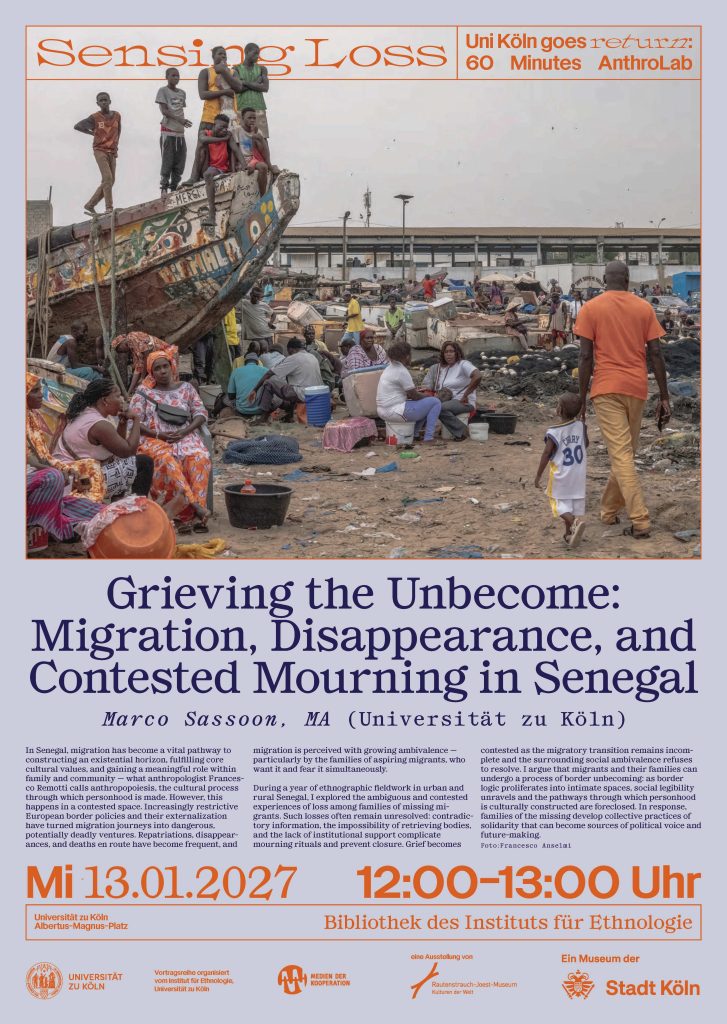
Sensing Loss – Uni Köln goes r e t u r n: 60 Minutes AnthroLab.
Grieving the unbecome: migration, disappearance, and contested mourning in Senegal
Marco Sassoon, MA (Uni Köln)
- Wednesday 12-1pm @ the department library, Department of Social and Cultural Anthropology, Uni Köln –
In Senegal, migration has become a vital pathway to constructing an existential horizon, fulfilling core cultural values, and gaining a meaningful role within family and community — what anthropologist Francesco Remotti calls anthropopoiesis, the cultural process through which personhood is made. However, this happens in a contested space. Increasingly restrictive European border policies and their externalization have turned migration journeys into dangerous, potentially deadly ventures. Repatriations, disappearances, and deaths en route have become frequent, and migration is perceived with growing ambivalence — particularly by the families of aspiring migrants, who want it and fear it simultaneously.
During a year of ethnographic fieldwork in urban and rural Senegal, I explored the ambiguous and contested experiences of loss among families of missing migrants. Such losses often remain unresolved: contradictory information, the impossibility of retrieving bodies, and the lack of institutional support complicate mourning rituals and prevent closure. Grief becomes contested as the migratory transition remains incomplete and the surrounding social ambivalence refuses to resolve. I argue that migrants and their families can undergo a process of border unbecoming: as border logic proliferates into intimate spaces, social legibility unravels and the pathways through which personhood is culturally constructed are foreclosed. In response, families of the missing develop collective practices of solidarity that can become sources of political voice and future-making.
————
The lecture series Sensing Loss connects anthropological thinking across university and museum spaces. Social and cultural anthropologists at all career stages discuss their ongoing research to explore how people sense and make sense of loss. Sensing Loss asks how loss is experienced, embodied and spatialized – and how displacement, dispossession and past injustices can become sources for new future-making practices. Experiences of loss, their confrontation, and the ways in which people try to come to terms with them – and find ways to r e t u r n – are as diverse as the situations in which people experience colonialism, violence or marginalization.
The public lectures discuss how grief, loss and remembrance can become resources for articulating claims on the present, and for shaping new connections between people and places, past and future. In resonance with the exhibition r e t u r n at the RJM, the lectures engage with diverse moments and forms of grief, nostalgia and memory work, as well as with joint departures into new futures.
Veranstaltungsort
Köln
