News

“The Connectivity of Things: Network Cultures since 1832”
Sebastian Gießmann (University of Siegen)
Translated by Steven Lindberg
Die Verbundenheit der Dinge was first published by Kulturverlag Kadmos Berlin in 2014 (2nd ed. 2016). Sebastian Gießmann was awarded the renowned translation prize for humanities and social science scholars by Geisteswissenschaften International in 2020. The result of Sebastian Gießmann’s completely revised translation has now been published by MIT Press under the title The Connectivity of Things: Network Cultures since 1832.
A media history of the material and infrastructural features of networking practices, a German classic translated for the first time into English.
Nets hold, connect, and catch. They ensnare, bind, and entangle. Our social networks owe their name to a conceivably strange and ambivalent object. But how did the net get into the network? And how can it reasonably represent the connectedness of people, things, institutions, signs, infrastructures, and even nature? The Connectivity of Things by Sebastian Giessmann, the first media history that addresses the overwhelming diversity of networks, attempts to answer all these questions and more.
Reconstructing the decisive moments in which networking turned into a veritable cultural technique, Giessmann takes readers below the street to the Parisian sewers and to the Suez Canal, into the telephone exchanges of Northeast America, and on to the London Underground. His brilliant history explains why social networks were discovered late, how the rapid rise of mathematical network theory was able to take place, how improbable the invention of the internet was, and even what diagrams and conspiracy theories have to do with it all. A primer on networking as a cultural technique, this translated German classic explains everything one ever could wish to know about networks.
Praise
“From fishing nets to the London Tube map, telephones to network protocols, this fascinating book mines diverse historical episodes to highlight the changing materiality, culture, and practices of networks.”
JoAnne Yates, Sloan Distinguished Professor of Management, Emerita, MIT Sloan School of Management
“Behold the much-anticipated history and theory of networks. Giessmann has penned a deeply philosophical and beautifully written media history of how the modern world became so intricately, and perilously, webbed. A triumph!”
Benjamin Peters, Hazel Rogers Associate Professor of Media Studies, University of Tulsa; coeditor of Your Computer is on Fire; author of How Not to Network a Nation
“The Connectivity of Things is as expansive and capacious as a network, drawing together technologies and social forms, spatiality and temporality, language and images—an essential text for network historians.”
Nicole Starosielski, Professor, University of California, Berkeley; author of The Undersea Network and Media Hot and Cold
Sebastian Giessmann is Senior Lecturer at the Department for Media Studies at the University of Siegen. He is Principal Investigator of the DFG-funded research project“ „A01 – Digital Network Technologies between Specialization and Generalization“ at the Collaborative Research Centre 1187 –“Media of Cooperation”.
MIT Press is one of the largest and most distinguished university presses in the world and a leading publisher of books and journals at the intersection of science, technology, art, social science, and design. MIT Press books and journals are known for their intellectual daring, scholarly standards, interdisciplinary focus, and distinctive design.
“Gender and Technology at Work: From Workplace Studies to Social Justice in Design”
Ellen Balka (Simon Fraser University, British Columbia)
Ina Wagner (University of Siegen)
Anne Weibert (University of Siegen)
Volker Wulf (University of Siegen)
The book Gender and Technology at Work: From Workplace Studies to Social Justice in Design was published by Cambridge University Press in April 2024.
The book Gender and Technology at Work: From Workplace Studies to Social Justice in Design, auhtored by our member Volker Wulf (project B04) and his co-authors Ellen Balka, Ina Wagner and Anne Weibert brings together the vast research literature about gender and technology to help designers understand what a gender perspective and a focus on intersectionality can contribute to designing information technology systems and artifacts, and to assist organizations as they work to develop work cultures that are supportive of women and marginalized genders and people. Drawing on empirical and analytical studies of women’s work and technology in many parts of the world, the book addresses how to make invisible aspects of work visible; how to recognize women’s skills without falling into the trap of gender stereotyping; how to engage in improving working conditions; and how to defend care of life situations and needs against a managerial logic.
It addresses challenges for design, including many overlooked and undervalued aspects, such as the complexities involved in human–machine interactions, as well as the need to create safe spaces for research subjects.
- Explores how work in relation to technology is mediated in complex ways by ethnic, cultural, and class backgrounds as well as issues of sexuality
- Presents views about how to build pathways to gender equality in design, addressing wider structural issues that need to be addressed when working towards design justice
- Takes an interdisciplinary approach, including literature from the social sciences, ergonomics, health sciences, computer science, and design disciplines
Reviews & endorsements
“This expansive volume conveys how decades of feminist scholarship on women, work, and technology can inform artifact and system design in ways that promote social justice. It is enriched by the collaboration of a multidisciplinary, multinational team of authors who weave their own stories and those of other feminist technologists into the narrative.”
Carol J. Haddad, Professor Emerita of Technology Studies, Eastern Michigan University
“A captivating deep dive into the intersection of gender, technology, and workplace culture. The authors masterfully integrate extensive research, providing essential guidance for designing user-centric IT systems and promoting inclusive workplaces. A pivotal guide for creating a more equitable tech world.”
Nicola Marsden, Professor of Social Informatics, Heilbronn University, Author of Retaining Women in Tech: Shifting the Paradigm
“This book provides a very welcome and sensitive appraisal of the gender-technology relationship in an ever faster-paced era of change in both domains. It is conceptually comprehensive and politically engaged, restoring authority and agency to those conventionally overlooked and marginalised in technological design processes. A must-read for all those interested in the challenges of achieving social justice in technology design.”
Juliet Webster, Work and Equality Research, London
“Balka, Wagner, Weibert & Wulf’s expertise and established commitment to participatory design (PD) and computer-supported cooperative work (CSCW) provides a rich history of feminist scholarship in gender and technology studies that has shaped this field. Interspersed with interviews from eleven feminist pioneers in PD, CSCW, HCI and STS, they offer provocations, ethical-political perspectives and inspiration for burgeoning intersectional and interdisciplinary research and practice in gender, work and system design, data feminism, critical data studies, and data justice and design justice.”
Leslie Regan Shade, Faculty of Information, University of Toronto
Volker Wulf is Professor at the Institute for Information Systems and New Media at the University of Siegen and is pricipal investigator of the CRC 1187 “Media of Cooperation” project “B04 – Digital Publics and Social Transformation in the Maghreb”. Ellen Balka is a Professor in the School of Communication at Simon Fraser University. Ina Wagner is affiliated to the University of Siegen, Germany after retiring as professor at the Vienna University of Technology, Vienna. Anne Weibert is a research associate at the Institute for Information Systems and New Media at the University of Siegen.
Cambridge University Press is the publishing division of the University of Cambridge, one of the world’s leading research institutions and winner of 81 Nobel Prizes. Cambridge University Press is committed by its charter to disseminate knowledge as widely as possible across the globe. They are publishing academic-level research, reference and higher education textbooks across a wide range of disciplines under the Cambridge University Press imprint.
Power Dynamics and Inequalities within Wikipedia”
Hannah Schmedes (Ruhr University Bochum)
In June 2024, our SFB member Hannah Schmedes (B09) published an article worth reading in the journal FKW // Zeitschrift für Geschlechterforschung und visuelle Kultur 74 (2024) entitled “-1.153 Characters. Towards A Queerfeminist Infrastructural Critique of Wikipedia”, in which she explores the concealed biases, power dynamics, and inequalities within Wikipedia’s infrastructural framework.
Hannah Schmedes is a PhD candidate at the Institute for Media Studies at the Ruhr University Bochum. She is a researcher in the project “B09 – Bicycle Media. Cooperative Media of Mobility” in the DFG-funded CRC 1187 “Media of Cooperation”.
FKW // Zeitschrift für Geschlechterforschung und visuelle Kultur analyzes visual representations and discourses in their social and gender-political significance. FKW thus combines art and cultural theory, image and media studies, gender-specific, political and methodological issues to create a critical cultural history of the visual. Questions about constructions in the field of visual culture, about mechanisms of inclusion and exclusion, symptomatic subject designs and unreflected objectifications are at the forefront of the critical interest in representation. From a perspective that understands knowledge and understanding as dynamic processes that are always changing, FKW sees itself as a platform for constructive debate and discussion that aims to provide food for thought and critically accompany ways of rethinking.
Convergence 30 (1) Special Issue on „Critical Technical Practice(s) in Digital Research“
Daniela van Geenen (University of Siegen)
Karin van Es (University Utrecht)
Jonathan Gray (King’s College London)
Our CRC-Member Daniela van Geenen (A03), together with Karin van Es and Jonathan Gray, edited the special issue “Critical Technical Practice(s) in Digital Research”, which has now been published in Convergence: The International Journal of Research into New Media Technologies 30 (1).
Save the date: the editors will (soft) launch the issue at the CRC research forum on 10 July, 2 to 4 pm CEST with some short presentations. You can join the event either online or in Siegen! Contact Daniela van Geenen.
Links to the articles and the living literature collection (Zotero group) can be found here.
In this special issue, the authors turn to ideas of and approaches to critical technical practices (CTPs) as entry points to doing critique and doing things critically in digitally mediated cultures and societies. They explore the pluralisation of ‘critical technical practice’, starting from its early formulations in the context of AI research and development (Agre, 1997a, 1997b) to the many ways in which it has resonated and been taken up by different publications, projects, groups, and communities of practice, and what it has come to mean. Agre defined CTP as a situational, practical, and constructive way of working: ‘a technical practice for which critical reflection upon the practice is part of the practice itself’ (1997a: XII). Communities of practice in which the notion has been adopted, adapted, and put to use range from human–computer interaction (HCI) to media art and pedagogy, from science and technology studies (STS) and computer-supported cooperative work (CSCW) to digital humanities, media studies and data studies. This special issue serves as an invitation to (re)consider what it means to use this notion drawing on a wider body of work, including beyond Agre. In this introduction, they review and discuss CTPs according to (1) Agre, (2) indexed research, and (3) contributors to this special issue. They conclude with some questions and considerations for those interested in working with this notion.
The issue is at the same time timely and timeless, featuring contributions by Tatjana Seitz (A01) & Sam Hind; Michael Dieter; Jean-Marie John-Mathews, Robin De Mourat, Donato Ricci and Maxime Crépel; Anders Koed Madsen; Winnie Soon and Pablo Velasco; Mathieu Jacomy and Anders Munk; Jessica Ogden, Edward Summers and Shawn Walker; Urszula Pawlicka-Deger; Simon Hirsbrunner, Michael Tebbe and Claudia Müller-Birn; Bernhard Rieder, Eric Borra and Stijn Peters; Carolin Gerlitz (A03 & Speaker of the CRC 1187), Fernando van der Vlist and Jason Chao; Daniel Chavez Heras; and Sabine Niederer and Natalia Sanchez Querubin.
Daniela van Geenen is a lecturer in Data Journalism and Visualization at the University of Applied Sciences Utrecht and is also a Ph.D. candidate at the DFG CRC 1187 “Media of Cooperation” and member of the project “A03 – Navigation in Online/Offline Spaces” at the University of Siegen Karin van Es is associate professor Media & Culture Studies and project lead Humanities at Data School at Utrecht University. Jonathan Gray is Reader in Critical Infrastructure Studies at the Department of Digital Humanities, King’s College London.
Convergence is an international peer-reviewed academic journal which was set up in 1995 to address the creative, social, political and pedagogical issues raised by the advent of new media technologies. As an international research journal, it provides a forum both for monitoring and exploring developments in the field and for encouraging, publishing and promoting vital innovative research. Adopting an inter-disciplinary approach and published six times a year, Convergence has developed this area into an entirely new research field.
In der neusten Publikation “Kontrapunkte setzen – Digitale Politische Bildung mit ContraPoints” in unserer Working Paper Series (No. 35, Dez) setzt sich Julia Bee mit den Potenzialen kreativer Format Politischer Bildung in digitalen Kontexten auseinander. Im Zentrum stehen videoessayistische Gegenformaten von Stiftungen, Institutionen und Vlogger:innen, die darauf abzielen, rechte Metapolitiken zu entlarven und zu erkennen. Sie produzieren Bildungsformate, die nicht nur inhaltlich und informativ, sondern auch ästhetisch und affektiv anknüpfen.
Stiftungen, Institutionen und Vlogger:innen haben in den letzten Jahren angesichts des Rechtsrucks auf Plattformen neue Formate der Politischen Bildung geschaffen. Diese wollen präventiv und intervenierend in rechte Diskurse, Trolling, Fake News und Co. eingreifen. Am Beispiel des Youtube-Kanals ContraPoints untersucht Bee die Formatspezifik der politischen Bildung, die im Anschluss an Donna Haraway als situiertes Wissen verstanden wird.
Julia Bee ist Professorin für Medienästhetik an der Universität Siegen. In ihrer Forschung kombiniert sie ästhetische Phänomene mit Medienphilosophie und Praxistheorie. Dekoloniale und Gender Medien Theorie sind dabei zentral. Derzeitige Forschungsgegenstände bilden dokumentarische Filme, TV-Serien, Vlogs, Installationen, Literatur sowie mobile Medienpraktiken wie Fahrradfahren. Sie ist Teilprojektleiterin des ab Januar 2024 neu geförderten Projekts B09 Fahrradmedien: Kooperative Medien der Mobilität.
Die Publikation „Kontrapunkte setzen – Digitale Politische Bildung mit ContraPoints” wird im Rahmen der Working Paper Series des SFB 1187 „Medien der Kooperation“ veröffentlicht. Die Working Paper Serie versammelt aktuelle Beiträge aus dem Umfeld der inter- und transdisziplinären Medienforschung und bietet die Möglichkeit einer schnellen Veröffentlichung und ersten Verbreitung von am SFB laufenden oder ihm nahestehenden Forschungsarbeiten. Ziel der Reihe ist es, die SFB-Forschung einer breiteren Forschungsgemeinschaft zugänglich zu machen. Alle Working Papers sind über die Website zugänglich oder können in gedruckter Form bei info[æt]sfb1187.uni-siegen.de bestellt werden.
The new publication, “Co-Teaching Post-digital Ethnography” of our Working Paper Series (No. 34, Oct), is out now. The authors, Simone Pfeifer and Suzana Jovicic, deal with teaching complex theories and methodological approaches. They reflect on the co-teaching methods used in a master class on post-digital ethnographies. This work also aims to present implementation examples in teaching and co-teaching constellations using teaching exercises.
Simone Pfeifer is a social and cultural anthropologist focusing on visual anthropology, digital and media anthropology. She is a postdoctoral researcher in the Graduiertenkolleg, and her research focuses on Muslims’ everyday lives and digital media practices in Germany. Previously, she was a research assistant at the Institute of Anthropology and African Studies at JGU Mainz in the research project “Jihadism on the Internet: The shaping of images and videos, their appropriation and dissemination” and at the graduate college “Locating Media” at the University of Siegen.
Suzana Jovicic is a lecturer and ESPRIT (FWF) Fellow at the Department of Social and Cultural Anthropology, University of Vienna. She specialises in digital, design and psychological anthropology, as well as in participatory and interdisciplinary research. She is a co-convenor of the European Network for Psychological Anthropology and a co-founder of the Digital Ethnography Initiative. Website: https://ksa.univie.ac.at/institut/mitarbeiterinnen/post-docs/jovicic-suzana.
The paper “Co-Teaching Post-digital Ethnography” is published as part of the Working Paper Series of the CRC 1187, which promotes inter- and transdisciplinary media research and provides an avenue for rapid publication and dissemination of ongoing research located at or associated with the CRC. The series aims to circulate in-progress research to the wider community beyond the CRC. All Working Papers are accessible via the website or can be ordered in print by email to: info[æt]sfb1187.uni-siegen.de.
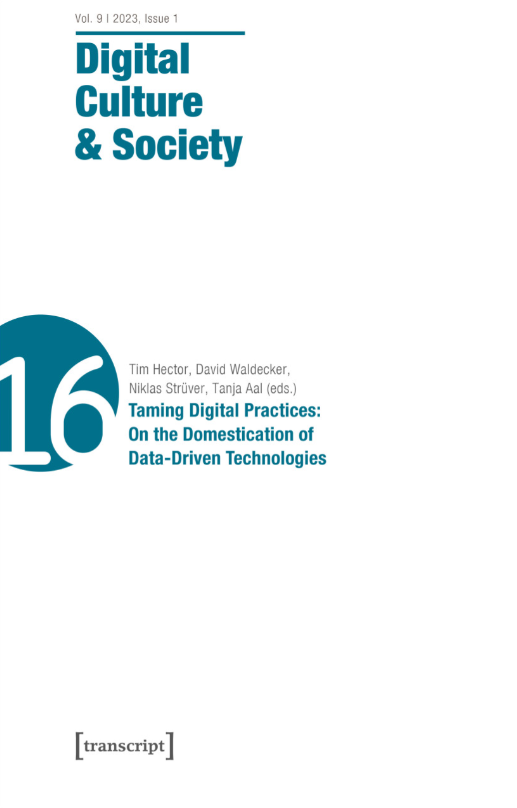
Whether it’s a dog, a cat, or a smart speaker, all of them require some time to settle into households. Modern mundane life is brimming with a variety of new data-driven technologies: digitally connected media such as vacuum robots, smart speakers, drones, and kitchen appliances are supposed to augment the practices they are involved in. As people integrate these technologies into their lives through a process of domestication, they adapt to them and are influenced by their presence. The thematic issue “Taming Digital Practices. On the Domestication of Data-Driven Technologies” of Digital Culture & Society, edited by Tim Hector, David Waldecker, Niklas Strüver, and Tanja Aal combines domestication research with empirical analysis of current digital and interconnected media, focusing on the process of taming with an emphasis on practices. In doing so, the issue brings together interdisciplinary perspectives, including media studies, sociology, anthropology, and human-computer interaction, among them a number of contributions from the CRC Media of Cooperation.
Edited by Tim Hector, David Waldecker, Niklas Strüver of the subproject B06 “Un-/desired Observation in Interaction: “Intelligent Personal Assistants” (IPA)“ (IPA)” and Tanja Aal of the subprojetc A05 “The Cooperative Creation of User Autonomy in the Context of the Ageing Society”.
In the latest publication “Unboxing Spain’s Colonial Past in the Rif – Situating memory work and transborder publics in a Domestic Basement Archive in Madrid” of our Working Paper Series, the author Carla Tiefenbacher analyzes the archival practices of the inhabitants of the northern moroccan city of Al Hoceima. To fully understand the practices surrounding the operation and coercion of colonialism in Spain and northern Morocco, she explores ongoing trans-mediterranean and spanish memory activism by considering collecting practices with the help of the experiences of the inhabitants collected over several changes of power and the preserved objects.
As part of the subproject “Digital Publics and Social Transformations in the Maghreb,” Carla Tiefenbacher currently writes her master’s thesis on archival practices and memory infrastructures among the last Spanish colonizers in northern Morocco. She is currently completing the interdisciplinary course “Culture and Environment in Africa” at the University of Cologne. She holds a B.A. in Liberal Arts and Sciences from the University of Freiburg and is a trained mediator and grief counselor.
The paper “Unboxing Spain’s Colonial Past in the Rif – Situating memory work and transborder publics in a Domestic Basement Archive in Madrid” is published as part of the Working Paper Series of the CRC 1187, which promotes inter- and transdisciplinary media research and provides an avenue for rapid publication and dissemination of ongoing research located at or associated with the CRC. The purpose of the series is to circulate in-progress research to the wider research community beyond the CRC. All Working Papers are accessible via the website or can be ordered in print by sending an email to: info[æt]sfb1187.uni-siegen.de.
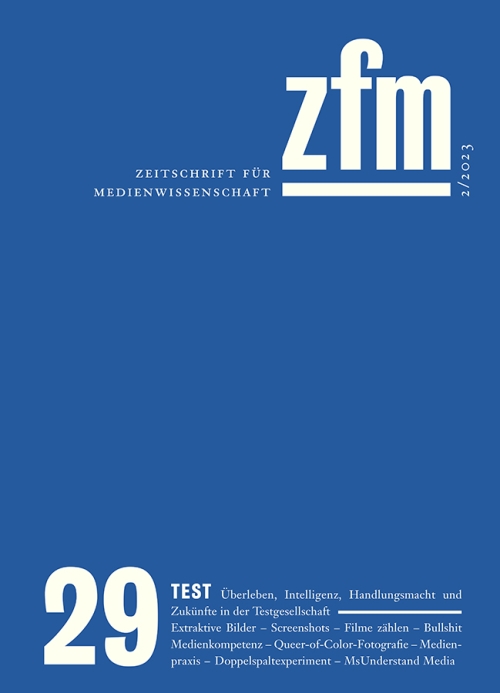
Carolin Gerlitz, Sprecherin des SFB und Teilprojektleiterin von A03, P03 und MGK, und Sebastian Gießmann, Teilprojektleiter von A01, zeichnen für das aktuelle Heft der Zeitschrift für Medienwissenschaft zum Thema TEST verantwortlich. Sie fragen, wie sich Medien und Tests wechselseitig konstituieren. Besondere Aufmerksamkeit erfahren dabei Politiken des Testens. Gerlitz und Gießmann schlagen vor, Tests als offene Situationen zu verstehen, in denen mit teils etablierten, teils sich erst während des Testens etablierenden Maßstäben soziotechnische Bewertungen erfolgen und Entscheidungen getroffen werden. Für einen medienkulturwissenschaftlichen Begriff des Tests gilt: In den Mikroentscheidungen des verteilten und verteilenden Testens steht das Soziale selbst auf der Probe. Die in diesem Heft versammelten Beiträge verdeutlichen: kein Test ohne Medien – kein Medium ohne Test.
Mit Beiträgen von David Bucheli, Gabriele Schabacher, Sophie Spallinger, Stefan Rieger, Daniela Holzer, Christoph Borbach, Noortje Marres und Philippe Sormani.
Das Heft erscheint im Open Acess.
Konzeption und Beiträge werden am Mittwoch, den 29. November im Rahmen des SFB Forschungsforums vorgestellt.
3 / 5