Events-Archive
Annual Conference of the project B09 “Bicycle Media: Cooperative Media of Mobility”
Mobility is a cooperative process shaped by a variety of media, social, and infrastructural practices. Cycling, too, is conditioned by the interplay of diverse technologies, infrastructures, bodies, images, and public spheres. At the same time, bicycle mobility is neither neutral nor equally accessible to all: it is shaped by social power relations and diverse experiential worlds.
Against this backdrop, the annual conference of the research project “Bicycle Media – Cooperative Practices of Mobility” (SFB 1187 “Media of Cooperation”) examines the bicycle itself as a medium of public sphere and participation: as a form of mobility that connects people, places, perspectives, and knowledge, thereby enabling a specific appropriation of space. The conference takes as its starting point an expanded concept of media that encompasses not only audiovisual and digital formats but also understands (care) practices such as repair, activism, or collective cycling as forms of mediation.
Our perspective on cycling is shaped by the media. Conversely, cycling also shapes media spaces. In this context, the papers presented at the annual conference examine the bicycle (and cycling) as a medium of embodied experience and perception, particularly in relation to public discourses, emotions, bodies, and infrastructure. The conference will discuss diversity-sensitive and intersectional perspectives on bicycle mobility, for example with regard to mobility conflicts, gender and class relations, as well as unequal conditions of access and representations.
We cordially invite you to participate and join the discussion.
Venue
Kortumstraße 90
44787 Bochum
Links
 Projekt
 Program
17.09.26
Day 1
Begrüßung & Einführung: Fahrrad als Medium
Mittagspause
Panel 1: Medien/Diskurse: Media Discourses on Refugee Women Learning to Ride Bikes; Polizeimeldungen über getötete Radfahrer*innen; Saddlesisters. Fahrradfeminismus im Spannungsfeld von Road Rage und Wiki Rage
Aram Lee; Marlene Sattler; Xenia Waporidis & Hannah Schmedes
Pause
Panel 2: Körper- und Affektwelten des Radfahrens: Sweat Mode on – Die Ambiguität kollektiven Schwitzens als strukturierende Dimension von Praxis, Körpern und Artefakten im Indoor-Cycling; Milieuspezifische Lebenswelten des Radfahrens. Einblick in Forschungsdaten einer Cultural-Probes-Studie; Radfahren im Spektrum. Sichtbarkeit, Affekt und Bewegung
Christopher Kirschner; Caro Baaske; Herbert Schwaab
Pause
Panel 3: Mobilitätskonflikte: Fahrradmobilität, Klassenkonflikte und der Backlash der Mobilitätswende; "Violences routières". Konflikte zwischen Rad- und Fußverkehr in Paris
Thomas Klinger, Sören Groth & Joschua Kuckherm; Gabriele Schabacher
Gemeinsames Abendessen
Filmscreening: "Bici-bles" - Fahrradaktivismus als Medium der Kollektivierung und Kollaboration
Sarah Sander
18.09.26
Day 2
Ankunft & Kaffeepause
Panel 3: Urbane Räume: Fatshaming, Bequemlichkeit und Technikdeterminismus. E-Bike-Disruption in Amsterdam; Städtische Fahrradkulturen im Wandel - Eine kreislaufwirtschaftliche Perspektive auf Reparatur, Konsum und Distinktion; „50 Tage – 50 Stadtteile“. Stadtteilerkundungen mit dem Fahrrad
Markus Stauff; Maximilian Hoor; Katharina Sakowski
Kaffeepause
Panel 4: Sichtbarkeiten: Ausdauer streamen. Plattformisierung und die Medialität des Fahrradfahrens am Race AcrossAmerica 2026; O Acidente - Fahrrad, Vulnerabilität und (post-)koloniale Verkehrsplanung
Julia Willms; Maximilian Rünker
Mittagessen
Gemeinsame Fahrradtour
Contact
Projekt B09
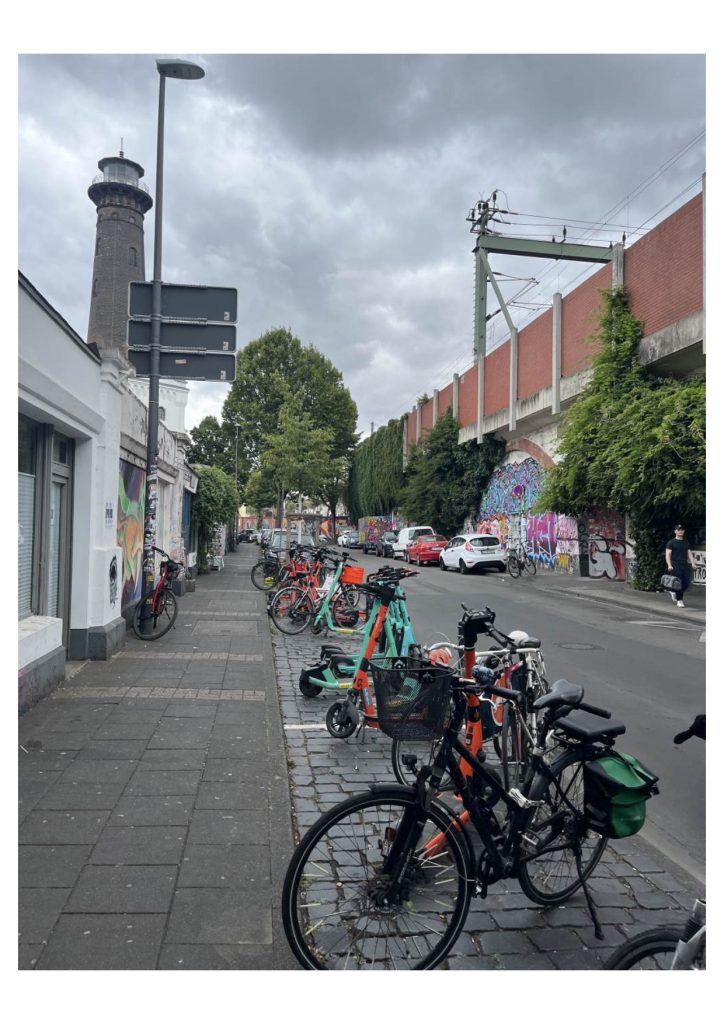
Shared bikes, e-scooters, and app-based mobility services have become a familiar feature of urban life. Frequently promoted as seamless, sustainable, and accessible modes of transportation, such services are increasingly leaving their mark in how people navigate and move through cities. So-called shared micromobility is also a disruptive presence in the street, as it creates new frictions, obstacles, and risks which destabilise habitual ways of traversing the city. Finally, as shared micromobility involves the creation of new infrastructures, it raises fundamental questions about public space, technological economy, data governance, accessibility, and civic participation, which cut across underlying transformations and everyday experiences of city life.
This workshop invites participants from diverse backgrounds – including users and non-users of shared mobility services, residents, policymakers, mobility planners, activists, researchers, and industry representatives – to collectively explore the role of shared micromobility in the city of Cologne. The workshop will use creative methods to observe, narrate, and analyse encounters with shared mobility systems in the lived environment of the street. Through situated mobility experiences, collaborative observation of micromobility situations, discussion, and mapping exercises, we seek to make visible the infrastructures, actors, technologies and practices of (e)valuation that shape contemporary urban mobility.
The workshop will be guided by a series of questions: How seamless – or seamful – and/or possibly disruptive are experiences of shared micromobility in practice? What infrastructures, data flows, forms of labour, and governance arrangements are involved in making these services (not) work? Whose needs, perspectives, and interests are reflected in current mobility systems, and whose are overlooked? How do digital platforms and mobility applications organise – and disorganise – access to urban space, mobility choices, privacy, and participation? And how should questions of sustainability be understood—not only in environmental terms, but also in relation to social justice, accessibility, and democratic accountability?
By exploring these questions from multiple perspectives and standpoints, the workshop aims to foster a collective inquiry into the promises, frictions, and consequences of shared micromobility. The aim, then, is to expand the frame on what is considered relevant to understanding and addressing the impacts and risks of the roll-out micromobility infrastructures. By creatively documenting encounters with micromobility on the level of the neighbourhood, we can articulate digital transformations and disruptions of our surroundings and their problems in a collectivising way.
Artist-led collaborative diagramming and narrative sculpting activities will guide the analysis of our shared observations of micromobility encounters. This shared process of narrative sculpting will inform a publicly accessible report on the seams and frictions of shared mobility in Cologne Ehrenfeld.
The workshop is organized by the project A03: Navigation in Online/Offline Spaces within the Collaborative Research Centre Media of Cooperation at the University of Siegen, which investigates how mobile media, platforms, and digital infrastructures are reshaping navigation of and movement through urban environments. The main organisers of the workshop are: Carolin Gerlitz, Daniela van Geenen, Max Kanderske (Universität Siegen/University of Siegen) & Noortje Marres (CIM Warwick, https://warwick.ac.uk/fac/cross_fac/cim/), Artist-Researchers: Yasmine Boudiaf (Ambient Information Systems, London), & Mukul Patel
Venue
Venloer Straße 429
50825 Köln
Program
17.09.2026
Day 1
Introduction
On the move in Ehrenfeld
Lunch
Plenary session: reconvene and introduce the diagramming method
Break-out slot
Artists will then guide each group to transform their diagram into a narrative sculpture
Plenary session: narrating encounters
Wrapping up
18.09.2026
Day 2
Revisit the narrative sculpture and create interpretative structure / grid
Lunch
Where to move from here
Closing remarks, booze & bites
Contact
Topics can be submitted to the board meetings via the status representatives two weeks before the meeting at the latest. Invitations go out two weeks before the meeting. Funding applications must be submitted at least two weeks in advance via the coordination (Dominik Schrey), including an explanation, cost estimate, detailed cost overview, and programme.
Applications must be submitted at least two weeks in advance via the coordination (Dominik Schrey), including an explanation and additional documents. For further information, please refer to the following templates. Please note that the templates are only available in German. For english versions please contact Dominik Schrey:
- Application for association
- Application for funding of a publication
- Application for funding of an event
The board meetings include reports, public topics, and various which are open to all SFB members. Personal and financial matters won’t be public and will be discussed after the public part. Webex links for online participation will be sent out on the previous Friday. Attendance on-site is possible.
Digital protocols will be provided via sciebo.
Venue
Contact
“Games and play are at once material and imaginary. They are real – but they trouble commonsense notions of reality; they offer multiple realities of fantasy, performance and intense experience” (Giddings 2014, S. 3).
In der Fortsetzung des Gesprächs- und Filmformats „Kameraethnographie trifft Seth Giddings“ explorieren wir unterschiedliche Spielräume in digitalen Kindheiten anhand aktueller Filme aus unserem Projekt, die wir entlang von Seth Giddings‘ „Gameworlds” (2014) diskutieren. Wir fragen, auf welche Weisen Vorstellungskraft zwischen Körpern, Dingen, Medien und Spielsystemen hervorgebracht wird und wie im Spiel Medientechnologien, Sounds, Spielzeuge und Rhythmen etc. alternative Raum-Zeitlichkeiten erzeugen.
Wir diskutieren den mikroethologischen Ansatz von Giddings mit seinem Schwerpunkt auf (digitaler) Materialität entlang gelebter Spielerfahrungen von Kindern. Wir vergleichen diesen mit dem mikroethnographischen Ansatz und der Kamera-Ethnographie als methodologische Grundlagen im Projekt mit der Frage: Wie wird Imagination von Kindern im Spiel beobachtbar?
Literatur:
Giddings, Seth (2014): Gameworlds. Virtual Media and Children’s Everyday Play. London, New York: Bloomsbury Academic
Wer teilnehmen möchte, sendet bitte eine Mail an hoa.mai.tran@uni-siegen.de, um den Webex-Link und den Text im Vorfeld zu erhalten.
Venue
Contact
The SFB cordially invites you to the oral examination for Niklas Strüver’s doctoral dissertation.
Monday, July 27, 2026, at 11:00 a.m. in Room AH-A 217/18.
During the defense, the findings of his dissertation will be presented to the examination committee and academically defended. The title of his dissertation is “Speaking on behalf of the periphery: Third-party relationships in Amazon’s Alexa ecosystem” and it examines the developmental dynamics of the voice assistant Alexa from the perspectives of infrastructure and platform theory. Drawing on the four articles presented, the dissertation explores how Alexa functions as an infrastructure and platform for third-party providers in business and academia, and what sociotechnical power imbalances arise in the process. This analysis allows for an examination of the social relationships that Amazon, as the manufacturer, enters into with complementary providers on the periphery of the platform. Through various empirical approaches, it is possible, despite the usual secrecy maintained by large corporations, to gain insight into the development of technologies that are present in the everyday lives of many people.
It will be conducted in German and supervised by the two examiners, Dagmar Hoffmann and Armin Beverungen.
Venue
Herrengarten
AH-A 217/218
Siegen
Contact
Schedule
|
Time |
Thursday, 23 July 2026 |
|
09:00 – 09:50 |
Daniela van Geenen |
|
09:50 – 10:00 |
Coffee break |
|
10:00 – 10:50 |
Ksenia Rybak |
|
10:50 – 11:00 |
Coffee break |
|
11:00 – 11:50 |
Damaris Lehmann |
|
11:50 – 12:00 |
Coffee break |
|
12:00 – 12:50 |
Hina Firdaus |
|
12:50 – 14:00 |
Lunch break: Food Court (Mensa US) |
|
14:00 – 14:50 |
Athena Grandis |
|
14:50 – 15:00 |
Coffee break |
|
15:00 – 15:50 |
Clara Cardoso |
|
15:50 – 16:00 |
Coffee break |
|
16:00 – 16:50 |
Anne Schreiber |
|
16:50 – 17:00 |
Coffee break |
|
17:00 – 17:50 |
Akib Shariar Khan |
|
18:30 |
Joint Dinner (venue t.b.a.) |
|
Time |
Friday, 24 July 2026 |
|
09:00 – 09:50 |
Johanna Hiebl |
|
09:50 – 10:00 |
Coffee break |
|
10:00 – 10:50 |
Michael Brilka |
|
10:50 – 11:00 |
Coffee break |
|
11:00 – 11:50 |
Vesna Schierbaum |
|
11:50 – 12:00 |
Coffee break |
|
12:00 – 12:50 |
Anna Kalinina |
|
12:50 – 14:00 |
Lunch break: Food Court (Mensa US) |
|
14:00 – 14:50 |
Final discussions |
Venue
Campus Herrengarten
AH-A 217/18
Herrengarten 3
57072 Siegen
Links
Programm Contact
The conference is preceded by a small ‘pre-conference’ on Wednesday afternoon, 15 July, following the research forum, entitled: “Navigating an Archive.”
Keynote
Waverly Duck, who will be traveling to Siegen from UC Santa Barbara, will give the keynote lecture:
“Negroes Gone Wrong”: Pauli Murray, Passing, and the Interactional Practices of Race, Gender, Sexuality, and Power in Garfinkel’s 1940 “Color Trouble”
The keynote will take place in Herrengarten, AHA 217/218, on 16 July, from 17:15–18:45h.
The rest of the program can be found below.

Venue
Campus Herrengarten
Herrengarten 3
AH-A 217/18
57072 Siegen
Links
Program Program
16.7.2026
Social Inequalities, Membership Categorization, and Interactional Asymmetries: EMCA Analyses and Ethnographic Challenges
Opening and Introductory Remarks
Clemens Eisenmann (University of Konstanz/Siegen) & Lorenza Mondada (U of Basel)
Subaltern tasks: what they reveal about the organisation of collective action
Lorenza Mondada (University of Basel)
Lunch (Mensa)
Productive asymmetries: Of manuscripts, “members,” and methods; Asymmetries in "Human–Machine" Encounters: Walking, Talking, and Commonality
Philippe Sormani (ZhdK Zürich); Jakub Mlynar (HES-SO Valais-Wallis)
Coffee break
Preliminary Considerations on a Conversation Analytic Approach to Intersectionality
Kevin Whitehead (UC Santa Barbara)
“Negroes Gone Wrong”: Pauli Murray, Passing, and the Interactional Practices of Race, Gender, Sexuality, and Power in Garfinkel’s 1940 “Color Trouble”
Waverly Duck (UC Santa Barbara)
Concluding discussion
Anne W. Rawls (Bentley University)
Dinner (Brasserie Ristorante e Piazza, Unteres Schloß 1, 57072 Siegen)
Contact
Venue
Campus Herrengarten
Herrengarten 3
AH-A 217/18
57072 Siegen
Program
15.7.26
Pre-conference Workshop: Navigating an Archive
Archival practices:reconstructing concealed and fragmented histories
Lorenza Mondada (University of Basel)
Researching the ELIZA materials in Garfinkel’s archive: the achievement of historicity in archival practices
Minan Lou (University of Konstanz)
Archival practices in, of, and as the Garfinkel archive
Clemens Eisenmann (University of Konstanz/Siegen), Jakub Mlynar (HES-SO Valais-Wallis), Anne W. Rawls (Bentley University), and Philippe Sormani (ZhdK Zürich)
Dinner
Contact
14:15 – 15:00 Dr. Clemens Eisenmann: “Sociology of Perception”
15:00 – 15:45 Dr. Philippe Sormani: “Relocating ‘AI’: a Praxeological Approach”
More information coming soon.
Venue
Campus Herrengarten
AH-A 217/18 and Webex
Herrengarten 3
57072 Siegen
Contact
Dr. Dominik Schrey
dominik.schrey[æt]uni-siegen.de
Telefon: +49 (0)271 740 4664
The GDPR promises us that we can receive our personal data from anyone who collected it upon request. Research has already shown this does not really work as envisioned in law.
This lecture asks to dig deeper into the topic, by approaching data subject rights, in particular Article 15 GDPR, as a methodological device for studying digital infrastructures under conditions of limited access. Access rights are first a legal protection and empowerment measure, but we examine how they can be used to trace tracking practices, data flows and processes of identity formation in online advertising ecosystems. In the course of this research we bridge media studies and digital methods with legal studies. The data collection process is first an encounter with the infrastructures that exist to inform users, but also an encounter of the user with fragments of themselves.
From a legal perspective, we analyse how data protection law conceptualises different forms of identity and how identities are legally attributed to a data subject. At the same time, we interrogate the limits of this framework: while the GDPR presupposes that personal data can be linked to an identified or identifiable natural person, contemporary data practices routinely challenge these distinctions. Identities emerge from combinations of data points that individually fall below the threshold of “personal data,” yet collectively constitute a recognisable profile. The legal figure of the data subject is thus both a normative construct and an unstable one, continuously deconstructed and reassembled by digital infrastructures.
Yarden Skop & Maria Boole (University of Paderborn & Siegen / Project A07 @ SFB 1187 Media of Cooperation)
Venue
Campus Herrengarten
AH-A 217/18 and Webex
Herrengarten 3
57072 Siegen
Contact
Topics can be submitted to the board meetings via the status representatives two weeks before the meeting at the latest. Invitations go out two weeks before the meeting. Funding applications must be submitted at least two weeks in advance via the coordination (Dominik Schrey), including an explanation, cost estimate, detailed cost overview, and programme.
Applications must be submitted at least two weeks in advance via the coordination (Dominik Schrey), including an explanation and additional documents. For further information, please refer to the following templates. Please note that the templates are only available in German. For english versions please contact Dominik Schrey:
- Application for association
- Application for funding of a publication
- Application for funding of an event
The board meetings include reports, public topics, and various which are open to all SFB members. Personal and financial matters won’t be public and will be discussed after the public part. Webex links for online participation will be sent out on the previous Friday. Attendance on-site is possible.
Digital protocols will be provided via sciebo.
Venue
Campus Herrengarten
AH-A 228
Herrengarten 3
57072 Siegen
Contact
Writing Retreat des internen SFB-Graduiertenkollegs inkl. Workshop und Einzelcoachings durch Dr. Anselm Spindler (trainofthought.de).
Venue
Campus Herrengarten
Contact
14:15 – 15:45: “Counter-Choreographies of Data: Activism Between Platform and Ground”
This lecture examines how methodological choices distribute attention, agency, and legibility within knowledge production, focusing on digital platforms as contested sites where data is shaped by algorithmic infrastructures, political pressure, and regimes of visibility. Social media posts are approached not as neutral evidence, but as partial and mediated traces of activism.
Drawing on personal research practice, the lecture traces digital content back to its on-site realities—embodied experiences, spatial conditions, and forms of risk that remain off-screen. Through performative reactivation, these traces are re-situated to produce counter-narratives that disrupt the manipulated datasets of authoritarian regimes, transforming research into a site for witnessing, resistance, and collective memory.
The concept of “counter-choreographies of data” frames this methodology as a political intervention that foregrounds the uncounted, blinded, and misrepresented. Positioning research as activism, the lecture argues for cooperative methodologies that make conflicts over categories, metrics, and evidence explicit, accountable, and revisable.
Azadeh Ganjeh (Hochschule für Künste im Sozialen Ottersberg / Mercator Fellow @ SFB 1187 Media of Cooperation)
Azadeh Ganjeh is a Performance Artist and scholar specializing in the intersection of socio-political contexts and the realm of Performance Art and performative culture. Her research, rooted in the observance and analysis of public interventions, protests, performance events and Theatres, reveals the intricate link between performance art and socio-political movements. Since 2004, with her collective, Rebel-IST-hah!, her artistic practice has focused on aesthetic strategies and dramaturgical interventions to create an inclusive space of appearance and activism through the Performing Arts. As an activist and performance artist, her research project focuses on the aesthetics of the performative presence of the body in the public space as resistance. She traces these performances through a focus on non-Eurocentric historiography of civil resistance in the Global South and climate activism in sacrifice zones, which occurs through Performing Arts. Due to the state’s opposition to her secular approach, advocacy for academic freedom, and her active role as a feminist artist and activist, she encountered political restraints and threats from the authorities of the Islamic Republic of Iran, and since 2022, found herself compelled to seek exile in Germany as a Scholar at Risk.
16:00 – 17:30: “Machineries of Similarity and Difference: AIDS From Its Research Infrastructures”
What kinds of practical and epistemic work are required to draw together different kinds of data, people, and evidence? This talk examines ‘interoperability’ by tracing the history of three AIDS cohort studies that, over three decades, were gradually merged into a single research network. Today, with a double-click, researchers can combine data collected from gay and bisexual men in the 1980s with materials gathered from women in the North of the US beginning in the 1990s and in the South of the US in the 2010s—data that remain scientifically comparable. Yet today’s apparent ease reveals next to nothing about the political protests and scientific disputes that made such comparability possible. The interoperability of these AIDS research data rests on decades of negotiation over how blood, data, and human participants could be rendered equivalent.
David Ribes (University of Washington)
David Ribes is professor in the Department of Human Centered Design and Engineering (HCDE) and director of the Science, Technology and Society Studies (STSS) program at the University of Washington, Seattle. He is a sociologist of science and technology who focuses on the development and sustainability of research infrastructures; their relation to long-term changes in the conduct of science; and, transformations in objects of research. David is a regular contributor to the fields of Science and Technology Studies (STS) and Information Studies. His methods are ethnographic, archival-historical and comparative. See davidribes.com or dataecologi.es for more.
Venue
Campus Herrengarten
AH-A 217/18 and Webex
Herrengarten 3
57072 Siegen
Contact
14:15 – 15:00 Dr. Tim Hector: Language and Norms at Digital Interfaces. Adaptation, Friction, and Creativity in Situated Interaction with Digital Technologies
15:00 – 15:45 Dr. Astrid Vogelpohl: Hybrid Spaces – Hybrid Selves
Early Childhood and Smartphone
Venue
Campus Herrengarten
AH-A 217/18 and Webex
Herrengarten 3
57072 Siegen
Contact
Dr. Dominik Schrey
dominik.schrey[æt]uni-siegen.de
Telefon: +49 (0)271 740 4664
Ethnomethodological Conversation Analysis and the Analysis of Technologized Interaction at Work with Functional Diversity & Mixed Abilities
Prof. Maija Hirvonen (Tampere University)
My talk explores theoretical and methodological positions in the ethnomethodological and conversation-analytical studies (EMCA) of dis/ability in technologized workplace interaction. The talk features research questions and sample analyses from a major European research and innovation project, NewWorkTech, which has collected naturalistic video-recorded data with six different dis/ability groups and from workplaces in six different countries.
EMCA aims at describing systems of situated human conduct and practices of social and technologized interaction from the members’ perspective. Today, this perspective is typically accomplished by an analytical process of interpreting naturally occurring video data in such way that researchers seek to understand the observable conduct and practices as one of the participants. With the emphasis on multimodality and, increasingly, multisensoriality, the analysis of interaction involves a detailed observation of the spatial, visual and other nonverbal modalities as resources of the system.
With regard to dis/ability and functional diversity, such as blindness or neurodivergence, EMCA studies must question the premises of acquiring a ”members’ perspective” in (inter)action which is (yet) not known to or experienced by the researcher. My talk intends to pave some ways for the methodological development in order to analyse (technologized) interaction cooperatively from the perspective of functional diversity and mixed ability – concepts which do not put ontological priority to any one sense or way of being in the world.
Venue
Campus Herrengarten
AH-A 217/18 and Webex
Herrengarten 3
57072 Siegen