Sensing Loss – Uni Köln goes r e t u r n: 60 Minutes AnthroLab.
Donnerstags 16:30-17:30Uhr
Prof. Dr. Birgit Meyer (Utrecht): „Undemonise!“ Verlust und Wiederaneignung spiritueller Artefakte der Eʋe in Ghana und Togo
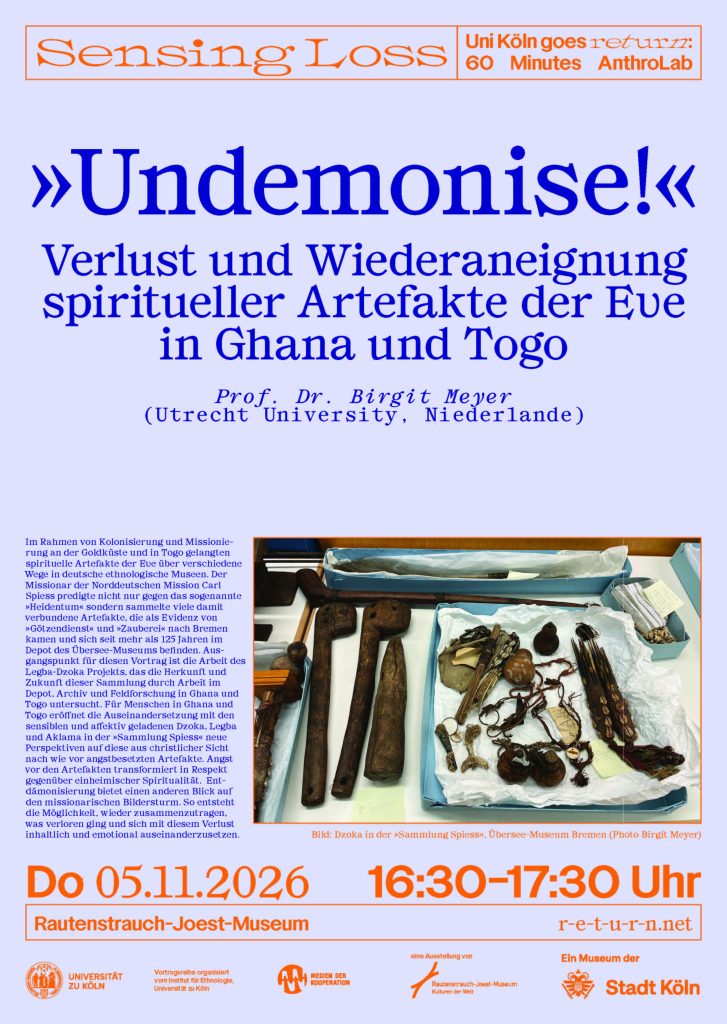
As part of the colonization and missionary activities on the Gold Coast and in Togo, spiritual artifacts of the Eʋe found their way into German ethnological museums through various channels. Carl Spiess, a missionary with the North German Mission, not only preached against so-called “paganism” but also collected many related artifacts, which were brought to Bremen as evidence of “idolatry” and “sorcery” and have been stored in the Übersee-Museum’s depot for more than 125 years. The starting point for this lecture is the work of the Legba-Dzoka Project, which investigates the origins and future of this collection through work in the storage facility, the archives, and field research in Ghana and Togo. For people in Ghana and Togo, engaging with the sensitive and emotionally charged Dzoka, Legba, and Aklama objects in the “Spiess Collection” opens up new perspectives on these artifacts, which, from a Christian viewpoint, continue to be associated with fear. Fear of the artifacts is transformed into respect for indigenous spirituality. De-demonization offers a different perspective on the missionary iconoclasm. This creates the opportunity to reassemble what was lost and to come to terms with this loss, both in terms of content and emotion.
————
Die Diskussionsreihe Sensing Loss bringt ethnologische Forschungen aus der Universität ins Museum. Sozial- und Kulturanthropolog:innen aller Karrierestufen berichten aus ihren aktuellen Forschungen, wie Menschen Verlust erfahren und Verlusterfahrungen bearbeiten. Sensing Loss fragt, wie Verlust begegnet, verkörpert und verräumlicht wird – und wie aus Vertreibung, Enteignung und vergangenem Unrecht neue Zukünfte gewonnen werden können. Erfahrungen des Verlusts (loss), ihre Konfrontation und Aufarbeitung [r e t u r n] sind dabei so vielfältig wie die Situationen, in denen Menschen Kolonialismus, Marginalisierung oder Gewalt begegnen. Die öffentlichen Vorträge diskutieren Formen des Sensing, über die Menschen Verlust gewahr werden, und Sense Making, d.h. die Frage, wie Menschen Verlusterfahrungen eine Bedeutung verleihen. Trauer, Verlust und Erinnerung können zur Quelle werden, Ansprüche an die Gegenwart zu artikulieren und zwischen Menschen und Orten, Vergangenheit und Zukunft neue Verbindungen zu erarbeiten. Im Sinne der Ausstellung r e t u r n beschäftigen sich die Vorträge mit ganz unterschiedlichen Momenten und Formen der Trauer, der Nostalgie, der Erinnerungsarbeit und des gemeinsamen Aufbruchs.
————
The lecture series Sensing Loss connects anthropological thinking across university and museum spaces. Social and cultural anthropologists at all career stages discuss their ongoing research to explore how people sense and make sense of loss. Sensing Loss asks how loss is experienced, embodied and spatialized – and how displacement, dispossession and past injustices can become sources for new future-making practices. Experiences of loss, their confrontation, and the ways in which people try to come to terms with them – and find ways to r e t u r n – are as diverse as the situations in which people experience colonialism, violence or marginalization.
The public lectures discuss how grief, loss and remembrance can become resources for articulating claims on the present, and for shaping new connections between people and places, past and future. In resonance with the exhibition r e t u r n at the RJM, the lectures engage with diverse moments and forms of grief, nostalgia and memory work, as well as with joint departures into new futures.
Venue
Köln
