Sensing Loss – Uni Köln goes r e t u r n: 60 Minutes AnthroLab.
Between Houses: Sensing Losses and Making Home in the Life of an Ethiopian Migrant Domestic Worker
Saleh Said Adem, MA (Uni Köln)
- Wednesday 12-1pm @ the department library, Department of Social and Cultural Anthropology, Uni Köln –
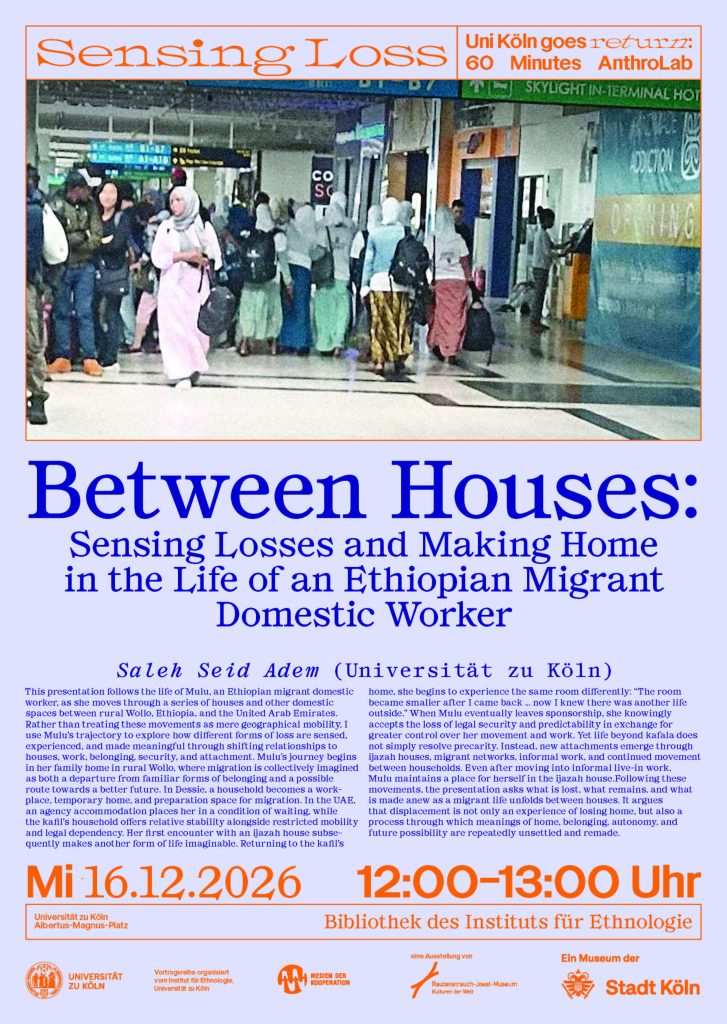
This presentation follows the life of Mulu, an Ethiopian migrant domestic worker, as she moves through a series of houses and other domestic spaces between rural Wollo, Ethiopia, and the United Arab Emirates. Rather than treating these movements as mere geographical mobility, I use Mulu’s trajectory to explore how different forms of loss are sensed, experienced, and made meaningful through shifting relationships to houses, work, belonging, security, and attachment. Mulu’s journey begins in her family home in rural Wollo, where migration is collectively imagined as both a departure from familiar forms of belonging and a possible route towards a better future. In Dessie, a household becomes a workplace, temporary home, and preparation space for migration. In the UAE, an agency accommodation places her in a condition of waiting, while the kafil’s household offers relative stability alongside restricted mobility and legal dependency. Her first encounter with an ijazah house subsequently makes another form of life imaginable. Returning to the kafil’s home, she begins to experience the same room differently: “The room became smaller after I came back … now I knew there was another life outside.”When Mulu eventually leaves sponsorship, she knowingly accepts the loss of legal security and predictability in exchange for greater control over her movement and work. Yet life beyond kafala does not simply resolve precarity. Instead, new attachments emerge through ijazah houses, migrant networks, informal work, and continued movement between households. Even after moving into informal live-in work, Mulu maintains a place for herself in the ijazah house.Following these movements, the presentation asks what is lost, what remains, and what is made anew as a migrant life unfolds between houses. It argues that displacement is not only an experience of losing home, but also a process through which meanings of home, belonging, autonomy, and future possibility are repeatedly unsettled and remade.
————
The lecture series Sensing Loss connects anthropological thinking across university and museum spaces. Social and cultural anthropologists at all career stages discuss their ongoing research to explore how people sense and make sense of loss. Sensing Loss asks how loss is experienced, embodied and spatialized – and how displacement, dispossession and past injustices can become sources for new future-making practices. Experiences of loss, their confrontation, and the ways in which people try to come to terms with them – and find ways to r e t u r n – are as diverse as the situations in which people experience colonialism, violence or marginalization.
The public lectures discuss how grief, loss and remembrance can become resources for articulating claims on the present, and for shaping new connections between people and places, past and future. In resonance with the exhibition r e t u r n at the RJM, the lectures engage with diverse moments and forms of grief, nostalgia and memory work, as well as with joint departures into new futures.
Venue
Köln
