P04 - Precision Farming: Co-operative Practices of Virtual Fencing


The project investigates sensor-based co-operative media and data practices of precision agriculture and closed-loop sensing for the containment of animals. It thus makes a praxeological contribution to the media, technological and agricultural history of border practices in addition to the empirical analysis of their implementation.


CRC 1187-Project-P04-2024.JPG
© CRC 1187 “Media of Cooperation”


News


Executive Summary

The subproject “Precision Farming: Co-operative Practices of Virtual Fencing” investigates collaborative processes of semi-autonomization in the field of precision farming based on sensor technologies from the perspective of media theory, media history, and media praxeology. Against the backdrop of current sociopolitical and ecological challenges in the agricultural sector, the subproject uses the example of digital herding to evaluate the question of how cooperative media practices of heterogeneous actors produce virtual geographic boundaries. For this purpose, an analysis of co-operation is employed to examine terrain-modeling boundary practices, their use-specific mediatic forms of interaction, and their implementation in the form of closed-loop sensing. The project therefore allows a reflection of the mediatic conditions and scope for action of a practice specific to agriculture that consolidates media-historical developments and has, so to speak, a sustainable effect on future developments in the field of agriculture and animal husbandry. A full understanding of the thematic field within media studies concerned with boundary objects and boundary practices that is intimately connected to this requires media-theoretical reflection, empirical-qualitative research in the field, and the historical-praxeological evaluation of its development. These share the aim of making current media and data practices of sensor-based digital fencing comprehensible as an emergent further development of previously analog techniques of terrain modeling as well as of media and boundary practices of fencing. For this purpose, the characteristics of virtual fencing identified as essential are subjected to a historical analysis that also takes the agricultural, praxeological, and socio-technical implications of mobile fencing into consideration.

In order to reflect the practice of mobile fencing in its geographical and socio-technical conditionality from the perspective of media studies, selected virtual fencing systems are empirically examined. The analysis covers the different contexts of emergence and use of current applications, including those of a socioeconomic nature, and shows which specific technologies and situative practices are associated with each of them. In addition, this study explores the practices of fencing, the media technologies of sensing, and the socio-technical practices of agricultural automation in order to distinguish the historical lines of development of virtual fencing.  Moreover, the approaches grounded in media theory and media praxeology adopted by this study make it possible to additionally consider discarded concepts, tensions, and failed designs of cooperative sensing practices. This allows an understanding of how boundary objects are already contoured or discarded as such in the preliminary or early phase of technology developments.


Media-theoretical, praxeological and socio-technical analysis of the "boundary infrastructure" of Precision Livestock Farming, consisting of electronic animal collars, GPS, LoraWAN and cloud infrastructures as well as mobile cartographic media applications.

Thesis: The difference between physical geography, human geography and vital geography is dissolved by Virtual Fencing.

Against the backdrop of current socio-political and ecological challenges in the agricultural sector, P04 uses the example of digital herding to analyze

  • how geographical boundaries are created through the co-operative media practices of heterogeneous actors,
  • how practices of fencing, from barbed wire to electric fences to Virtual Fencing, have historically developed and collided.
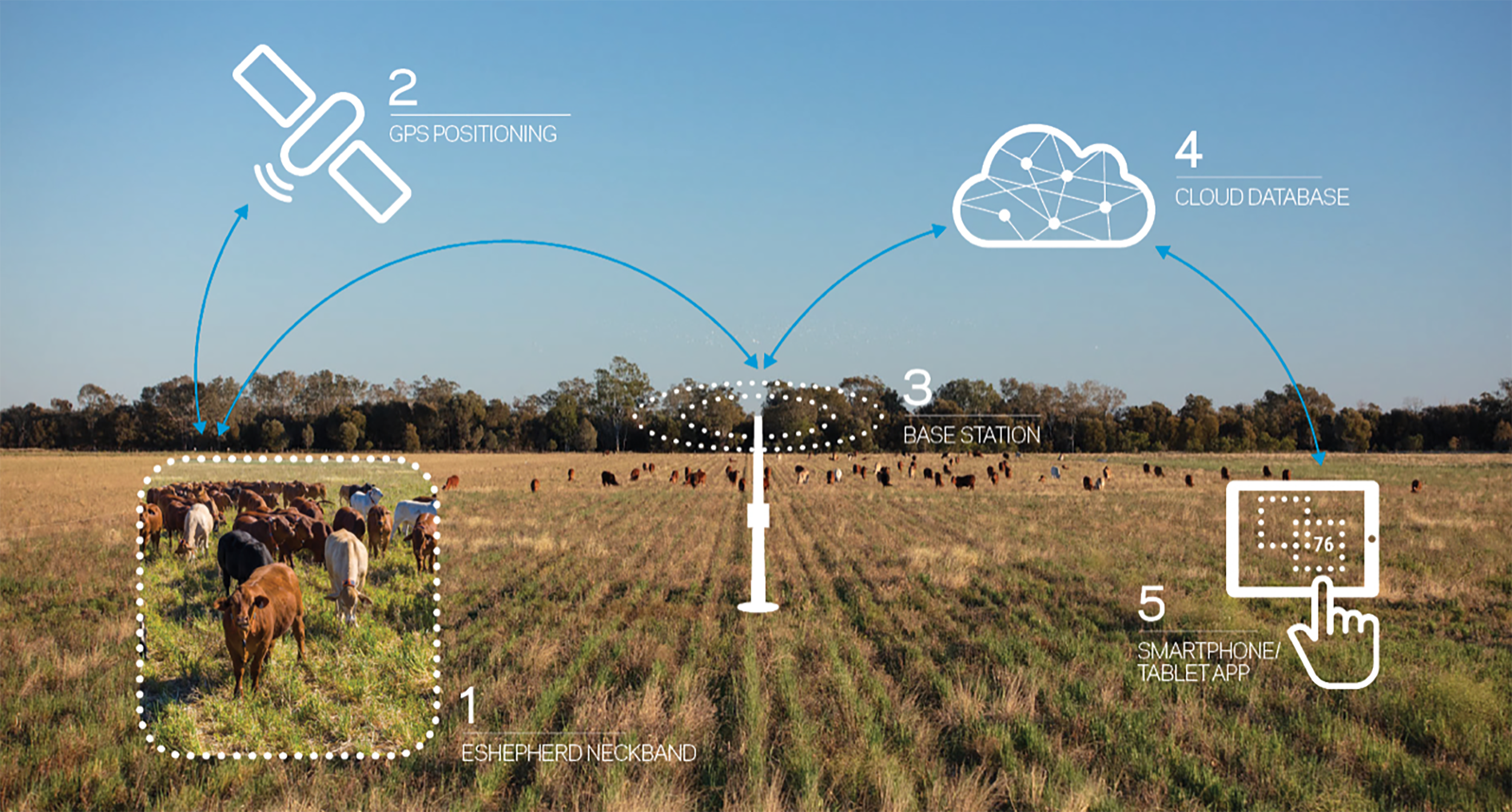
Prinzip von Virtual Fencing mit der App eShepherd (© am.gallagher.com)
Principle of Virtual Fencing with the app eShepherd
(© am.gallagher.com)

The project aims to interweave historical praxeology and empirical analysis of recent sensor data practices using case studies of border modeling.

The project is methodologically oriented towards the further development of ANT and boundary object analysis.

The contemporary and historical analyses require a mix of methods from

  • Co-operation analysis
  • Field research and participant observation
  • Affordance and interface analysis
  • Image studies analyses
  • Media archaeology of closed-loop sensing
  • Archive research, oral history, re-enactment of agricultural automation
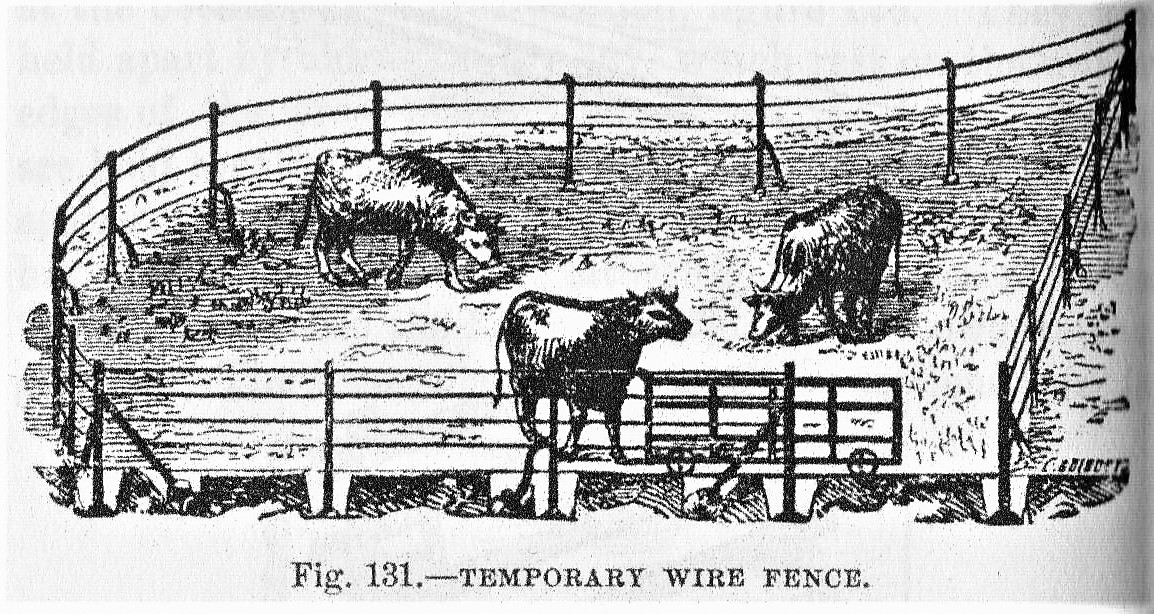
Temporary Wire Fence (© Fences, Gates and Bridges 1887)
Temporary Wire Fence
(© Fences, Gates and Bridges 1887)

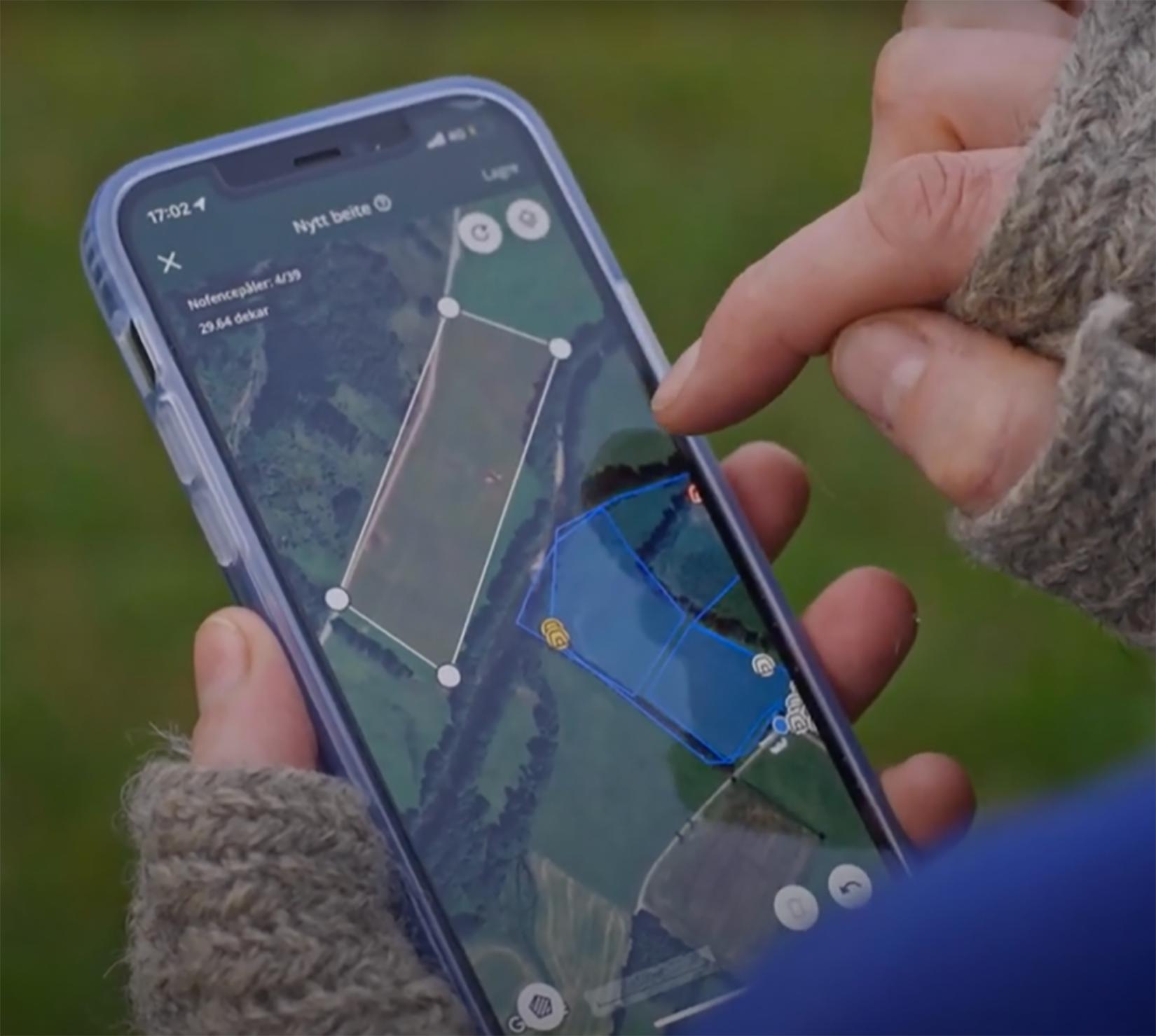
Mit dem Finger Tiere hüten (© Nofence AS: Innføring i Nofenceappen)
Interaction with app-based virtual fencing technology
(© Nofence AS: Innføring i Nofenceappen)


WP1 analyzes current sensor data practices in Precision Farming based on the three focal points of infrastructuring and intervention; interface and interaction; and sensing ecologies.

WP2 examines the history of fencing practices, taking into account the heterogeneity of historical cultural techniques. To this end, historical trajectories of a shared history of media, technology and agriculture will be traced.

Thus, WP2 will trace the history of agricultural technology as a socio-technical co-operative development of progressive automation, miniaturization, precision and smartness (including its counter-movements).

Based on the entanglement of physical, virtual and vital geographies analyzed in WP1 and reconstructed in WP2, WP3 will analytically redefine the co-operation and boundaries between bio- and geodiverse actors.


Publications

2025

Borbach, Christoph, Wendy Hui Kyong Chun, and Tristan Thielmann. 2025. “Making everything ac-count-able. The digital twinning paradigm”. New Media & Society 27 (8): 4369–4384. https://doi.org/10.1177/14614448251338289.
Borbach, Christoph, Wendy Hui Kyong Chun, and Tristan Thielmann, eds. 2025. “Special Issue „Digital Twinning"”. New Media & Society 27 (8).
Borbach, Christoph, Timo Kaerlein, Robert Stock, and Sabine Wirth. 2025. “Akustische Interfaces. Eine Lagebestimmung”. In Akustische Interfaces. Interdisziplinäre Perspektiven auf Schnittstellen von Technologien, Sounds und Menschen, edited by Christoph Borbach, Timo Kaerlein, Robert Stock, and Sabine Wirth, 1–33. Wiesbaden: SpringerVieweg. https://doi.org/10.1007/978-3-658-47635-9_1.
Borbach, Christoph, Timo Kaerlein, Robert Stock, and Sabine Wirth, eds. 2025. Akustische Interfaces. Interdisziplinäre Perspektiven auf Schnittstellen von Technologien, Sounds und Menschen. Wiesbaden: SpringerVieweg. https://doi.org/10.1007/978-3-658-47635-9.
Borbach, Christoph, and Max Kanderske. 2025. “Do not consent! Theorizing media as counter-practice”. Dialogues on Digital Society 1 (2): 220–225. https://doi.org/10.1177/29768640251342610.
Borbach, Christoph, and Max Kanderske. 2025. “Playful Resistance: The Politics of Sensor Counter-Practices in Urban Technospheres”. Mediapolis. A Journal of Cities and Culture 10 (3). https://www.mediapolisjournal.com/2025/11/playful-resistance.
Borbach, Christoph, and Benjamin Lindquist. 2025. “Körper, Stimmen, Prothesen. Eine Geschichte sprechender Interfaces als Assistenztechnologien”. In Akustische Interfaces. Interdisziplinäre Perspektiven auf Schnittstellen von Technologien, Sounds und Menschen, edited by Christoph Borbach, Timo Kaerlein, Robert Stock, and Sabine Wirth, 145–166. Berlin u.a.: Springer VS. https://doi.org/10.1007/978-3-658-47635-9_7.
Borbach, Christoph, and Tristan Thielmann, eds. 2025. “Special Issue „Digital Sovereignty"”. communication +1 11 (2).
Couture, Stéphane, Sophie Toupin, and Christoph Borbach. 2025. “Sovereign AI, the fragmented internet, data crawlers, and the opacity of consent forms: A dialogue on digital sovereignty”. communication +1 11 (2). https://doi.org/10.7275/cpo.3555.
Thielmann, Tristan, and Christoph Borbach. 2025. “The Digital Leviathan: Medializing Sovereignty for Critical AI and Data Studies”. communication +1 11 (2). https://doi.org/10.7275/cpo.3521.

2024

Borbach, Christoph. 2024. Delay. Mediengeschichten der Verzögerung, 1850–1950. Bielefeld: Transcript. https://doi.org/10.14361/9783839452349.
Borbach, Christoph, and Max Kanderske. 2024. “Counter-practices: Understanding sensor datafication through subversive action”. Dialogues on Digital Society. https://doi.org/10.1177/2976864024130597.

2023

Borbach, Christoph. 2023. “Medien- als Testgeschichte. Radarentwicklung in den Bell Labs und bei Western Electric”. Zeitschrift für Medienwissenschaft 15 (2): 73–85. https://doi.org/10.25969/mediarep/20063.
Borbach, Christoph, and Tristan Thielmann. 2023. “Chains of Co-operation in the 1940s: Working on the Air Situation Picture”. In Materiality of Cooperation, edited by Sebastian Gießmann, Tobias Röhl, and Ronja Trischler, 91–130. Wiesbaden: Springer.

2022

Friedrich, Kathrin. 2022. “Hüten per Fingerzeig. Mediale Zugewandtheit im Precision Livestock Farming”. In Automatisierte Zuwendung – Affektive Medien | Sensible Medien | Fürsorgende Medien, edited by Bernd Bösel, 27–36. AugenBlick. Konstanzer Hefte zur Medienwissenschaft 85.
Thielmann, Tristan. 2022. “Environmental conditioning: Mobile geomedia and their lines of becoming in the air, on land, and on water”. New Media & Society 24 (11): 2438–2467.

2021

Friedrich, Kathrin. 2021. “Im virtuellen Zaun – Umgebungen adaptiver Medien”. In Techno-ästhetische Perspektivierungen des Milieus, edited by Rebekka Ladewig and Angelika Seppi, 243–249. Leipzig: Spector Books.
Friedrich, Kathrin, and A. S. Aurora Hoel. 2021. “Operational analysis: A method for observing and analyzing digital media operations”. New Media & Society 25 (1). 10.1177/1461444821998645.

2019

Borbach, Chistoph, and Tristan Thielmann. 2019. “Über das Denken in Ko-Operationsketten. Arbeiten am Luftlagebild”. In Materialität der Kooperation, edited by Sebastian Gießmann, Tobias Röhl, and Ronja Trischler, 115–167. Wiesbaden: Springer VS. https://doi.org/10.1007/978-3-658-20805-9_5.
Borbach, Christoph. 2019. “Navigating (through) Sound. Auditory Interfaces in Maritime Navigation Practice, 1900–1930”. Interface Critique 2: 17–33. https://doi.org/10.11588/ic.2019.2.67261.
Borbach, Christoph. 2019. “Reduced to the Max. Medienminiaturisierung als Erfolgsgeschichte am Beispiel der GPS-Empfänger”. In Kleine Medien. Kulturtheoretische Lektüren, edited by Oliver Ruf and Uta Schaffers, 35–57. Würzburg: Königshausen & Neumann.
Thielmann, Tristan. 2019. “Sensormedien: Eine medien- und praxistheoretische Annäherung”. Working Paper Series Media of Cooperation 9. http://dx.doi.org/10.25819/ubsi/31.