You can find past events in our archive!
Selected lectures and events are available as recordings in our media library!



Topics can be submitted to the board meetings via the status representatives two weeks before the meeting at the latest. Invitations go out two weeks before the meeting. Funding applications must be submitted at least two weeks in advance via the coordination (Kevin Onland), including an explanation, cost estimate, detailed cost overview, and programme. The board meetings include reports, public topics, and various which are open to all SFB members. Personal and financial matters won’t be public and will be discussed after the public part. Webex links for online participation will be sent out on the previous Friday. Attendance on-site is possible. Digital protocols will be provided via the intranet/sciebo.
2:15 – 3:00
Kristof van Laerhoven und Shadan Sadhegian (P05)
Social Interaction in Semi-Automated Road Traffic
3:00 – 3:45
Tahereh Aboofazeli (MGK)
A multimodal collective auto-ethnography by female carpet weavers in Iran
Topics can be submitted to the board meetings via the status representatives two weeks before the meeting at the latest. Invitations go out two weeks before the meeting. Funding applications must be submitted at least two weeks in advance via the coordination (Kevin Onland), including an explanation, cost estimate, detailed cost overview, and programme. The board meetings include reports, public topics, and various which are open to all SFB members. Personal and financial matters won’t be public and will be discussed after the public part. Webex links for online participation will be sent out on the previous Friday. Attendance on-site is possible. Digital protocols will be provided via the intranet/sciebo.
 Kontakt
The 3rd phase (2024-2027) of the SFB 1187 Media of Cooperation focuses on sensor media’s scaling performance. The CRC’s research program covers the entire spectrum of this scaling performance, from the level of the body and micro-interaction to distributed situations of sensor data, transnational surveillance, and global data infrastructures.
“Scales of Cooperation” discusses the CRC’s cross-scale understanding of cooperation, starting from micro-situational cooperation practices to the cooperation of transnational infrastructures with their data and data practices. The SFB aims to develop a media theory of this cooperatively composed scaling performance, leading to a final conference and publication of the CRC in 2027.
To this end, the SFB will launch a first lecture series in the summer semester of 2024, which will examine different scalings of the claim to sovereignty of various actors from the local to the global level—starting from individual media situations to the political-regulatory level of the European Union and beyond.
Digitale Politik und postdigitale Souveränität: Zwischen Technokratie, Öffentlichkeit und medialer Kontrolle?
15.05.24 | 4.15-5.45 PM | Hybrid
Lecture by Prof. Dr. Stephan Packard (Universität zu Köln)
The Double Alignment Problem – On the Transfer of Sovereignty between Humans and AI
28.05.24 | 4.15-5.45 PM | Hybrid
Lecture by Prof. Dr. Roberto Simanowski
Regulating Sovereignty in Cyberspace
29.05.24 | 4.15-5.45 PM | Hybrid
Lecture by Prof. Dr. Yik Chan Chin (Beijing Normal University)
The Semi-Souvereign Fifth Estate
12.06.24 | 4.15-5.45 PM | Hybrid
Lecture by Prof. Dr. William Dutton (Michigan State University)
Digitale Politik und postdigitale Souveränität: Zwischen Technokratie, Öffentlichkeit und medialer Kontrolle?
15.05.24 | 4.15-5.45 PM | Hybrid
Lecture by Prof. Dr. Stephan Packard (Universität zu Köln)
The Double Alignment Problem – On the Transfer of Sovereignty between Humans and AI
28.05.24 | 4.15-5.45 PM | Hybrid
Lecture by Prof. Dr. Roberto Simanowski
Regulating Sovereignty in Cyberspace
29.05.24 | 4.15-5.45 PM | Hybrid
Lecture by Prof. Dr. Yik Chan Chin (Beijing Normal University)
The Semi-Souvereign Fifth Estate
12.06.24 | 4.15-5.45 PM | Hybrid
Lecture by Prof. Dr. William Dutton (Michigan State University)
Digitale Politik und postdigitale Souveränität: Zwischen Technokratie, Öffentlichkeit und medialer Kontrolle?
15.05.24 | 4.15-5.45 PM | Hybrid
Lecture by Prof. Dr. Stephan Packard (Universität zu Köln)
The Double Alignment Problem – On the Transfer of Sovereignty between Humans and AI
28.05.24 | 4.15-5.45 PM | Hybrid
Lecture by Prof. Dr. Roberto Simanowski
Regulating Sovereignty in Cyberspace
29.05.24 | 4.15-5.45 PM | Hybrid
Lecture by Prof. Dr. Yik Chan Chin (Beijing Normal University)
The Semi-Souvereign Fifth Estate
12.06.24 | 4.15-5.45 PM | Hybrid
Lecture by Prof. Dr. William Dutton (Michigan State University)
2:15pm – 3:00pm
Kathrin Friedrich, Tristan Thielmann und Christoph Borbach (P04)
Precision Farming: Ko-Operative Praktiken des Virtual Fencing
3:00pm – 3:45pm
tba
Digitale Politik und postdigitale Souveränität: Zwischen Technokratie, Öffentlichkeit und medialer Kontrolle?
15.05.24 | 4.15-5.45 PM | Hybrid
Lecture by Prof. Dr. Stephan Packard (Universität zu Köln)
The Double Alignment Problem – On the Transfer of Sovereignty between Humans and AI
28.05.24 | 4.15-5.45 PM | Hybrid
Lecture by Prof. Dr. Roberto Simanowski
Regulating Sovereignty in Cyberspace
29.05.24 | 4.15-5.45 PM | Hybrid
Lecture by Prof. Dr. Yik Chan Chin (Beijing Normal University)
The Semi-Souvereign Fifth Estate
12.06.24 | 4.15-5.45 PM | Hybrid
Lecture by Prof. Dr. William Dutton (Michigan State University)
Topic: Our digital present: new forms of cooperation
The DFG Collaborative Research Centre “Media of Cooperation” explores our digital living environments.
2:15pm – 3:00
Marcus Burkhardt, Max Becker und Yarden Skop (A07)
Industrie der Personendaten
3:00pm – 3:45pm
Miglè Bareikyte (P06)
War Sensing
Digitale Politik und postdigitale Souveränität: Zwischen Technokratie, Öffentlichkeit und medialer Kontrolle?
15.05.24 | 4.15-5.45 PM | Hybrid
Lecture by Prof. Dr. Stephan Packard (Universität zu Köln)
The Double Alignment Problem – On the Transfer of Sovereignty between Humans and AI
28.05.24 | 4.15-5.45 PM | Hybrid
Lecture by Prof. Dr. Roberto Simanowski
Regulating Sovereignty in Cyberspace
29.05.24 | 4.15-5.45 PM | Hybrid
Lecture by Prof. Dr. Yik Chan Chin (Beijing Normal University)
The Semi-Souvereign Fifth Estate
12.06.24 | 4.15-5.45 PM | Hybrid
Lecture by Prof. Dr. William Dutton (Michigan State University)

June 27, 2024 14:00-19:00 / June 28, 2024 9:00-13:00
In advance: individual telephone conversation to discuss reference to your own project and materials.
The aim of this master class is to experience the experimental approach of camera ethnography and to try out arranging research (with reference to Wittgenstein) together by referring to the diversity of research fields which will be represented in the workshop. Participants are encouraged to bring some of their own research material to this workshop.
Filming as an epistemic practice
In our everyday use of media, we simply believe that we can capture something with a camera and share it with each other. However, if we assume that the goal of research is to get beyond the state of what is known and seen so far, then we are dealing with epistemic things that are not yet visible at first and therefore cannot just be recorded with a camera. With this consideration, Bina E. Mohn, the founder of camera ethnography, refers to the sociological laboratory studies of the 1980s and 1990s. Starting from a premise of the not (yet) visible marks the departure from strategies of camera use that assume visibility exists a priori. Camera ethnography offers a manageable representation-critical approach based on a situated methodology and can be understood as a continuous reflexive process of working on visibility and seeing. Camera ethnography lends itself particularly well to the study of nonverbal practices and socio-material constellations. Furthermore, camera ethnography is particularly suitable for an adoption of the format “übersichtliche Darstellung” (Wittgenstein): In this context, filmic arrangements serve as an attempt to answer the question of how social practices can be lived, named, and understood here and now, and there and then. For viewers of camera-ethnographic publications, this offers an opportunity to discover unexpected things about the diversity and possibility of social phenomena and practices.
The basic book by Bina E. Mohn „Kamera-Ethnographie. Ethnographische Forschung im Modus des Zeigens. Programmatik und Praxis“ has been published in 2023, is open access and underpins this master class. Important references of the camera-ethnographic approach include Bruno Latour (science-in-the-making), Karin Knorr-Cetina (epistemic cultures), Hans-Jörg Rheinberger (experimental systems), Clifford Geertz (“thick description”), Ludwig Wittgenstein (language games and “übersichtliche Darstellung”), and Karen Barad (agential realism and intra-action).
Requirements for participation
Registration for the master class
Contact and registration: wiesemann@erz-wiss.uni-siegen.de
Registration deadline: May 15, 2024. Participation will be bindingly confirmed by the organizers by May 20, 2024. Please briefly answer these questions when registering:
Bina will be available to make more detailed arrangements with each of you via telephone.
Poster Topics can be submitted to the board meetings via the status representatives two weeks before the meeting at the latest. Invitations go out two weeks before the meeting. Funding applications must be submitted at least two weeks in advance via the coordination (Kevin Onland), including an explanation, cost estimate, detailed cost overview, and programme. The board meetings include reports, public topics, and various which are open to all SFB members. Person-related topics won’t be public and will be discussed after the public part. Webex links for online participation will be sent out on the previous Friday. Attendance on-site is possible. Digital protocols will be provided via the intranet/sciebo.
The Retreat will take place at the Campus Unteres Schloss in Siegen from the 15th to 16th of April 2024.
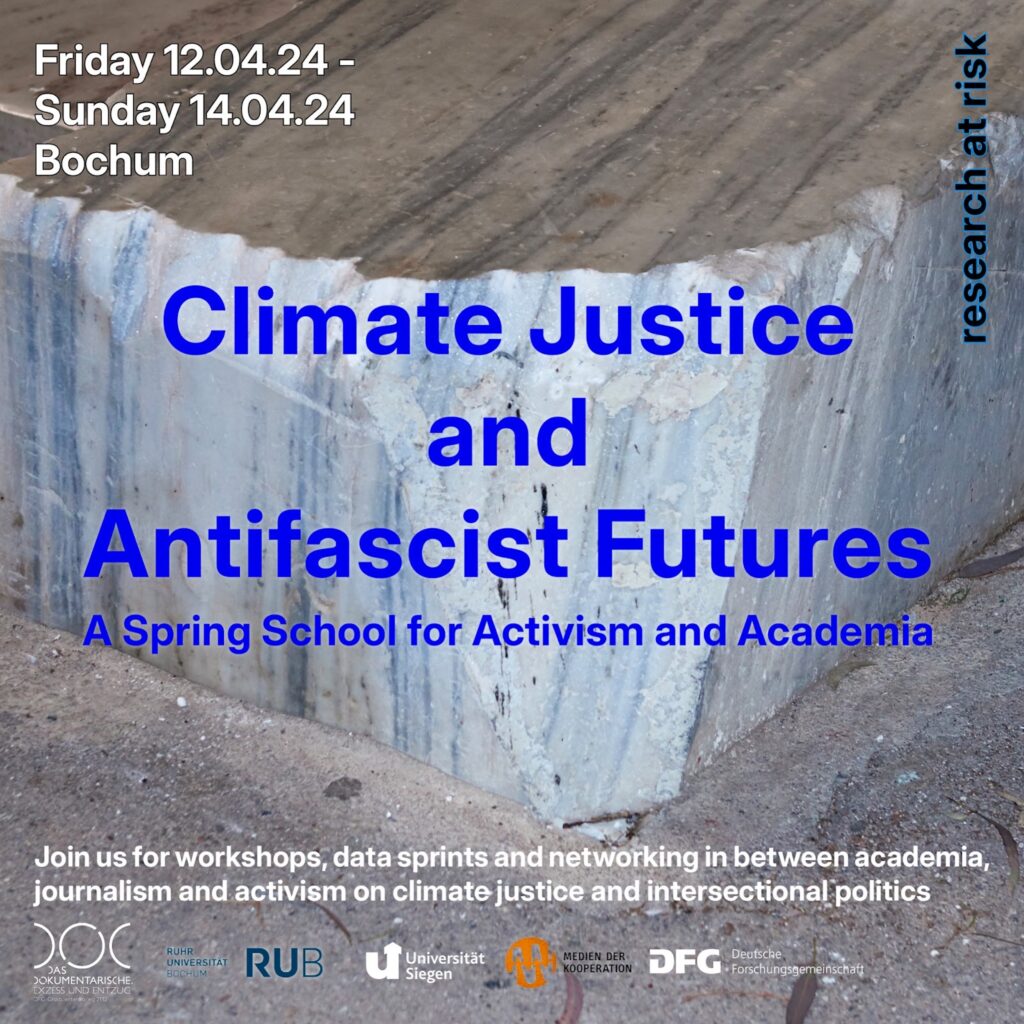
In Europe and beyond we are currently facing the undermining of already insufficient policies and actions against the climate catastrophe, the massive dying out of species and the garbage crisis. This dynamic coincides with a rise of right wing politics that work on the delegitimization and defamation of climate justice advocacy alongside racist, xenophobic, anti-feminist, anti-LGBTIQ*-policies and the preservation of existing national and geopolitical inequalities.
We want to build coalitions between climate justice groups and academia to fight these developments by inventing strategies between media, activism and academia. We invite activists, academics and journalists to participate in a weekend to work on collaborative approaches and collective organizing. Participants are invited to join in one of te following workshops: Narratives and Intersections of Delegitimization: Documentation, Analysis, Response, How to make a case for climate?, and Media studies and climate catastrophe.
Date: Friday, April 12th 2024 to Sunday April 14th 2024
Place: Bochum
Detailed information and a program will be sent to participants after registration.
Please register by March 15th, 2024 at research-at-risk@gfmedienwissenschaft.de.
For questions and support with travel costs and accommodation, please contact us: research-at-risk@gfmedienwissenschaft.de.
We welcome students, (media)scholars, journalists, activists, artists and other interested people. The working languages are English and German.
Further information on background and research tracks can be found here: https://mediaclimatejustice.org/
The detailed program can be found here: https://mediaclimatejustice.org/programm/
We will meet online.
The course introduces the technical setup including OSX, Webex, microphone set-up and presentation modes for hybrid events (especially lecture series, conferences) that take place at the Herrengarten (especially in 217/218) or US-C. For the Herrengarten, the focus is also on the existing setup of the Conference Owl.
Die Tagung findet am 8. MÄRZ am OBERGRABEN 25, 57072 SIEGEN (Gebäude
US-S) statt. Um 9:45 fängt die Veranstaltung an, ab 9:15 sind die Türen
offen. Um etwa 18 Uhr beginnt der informelle Teil der Veranstaltung.
WICHTIG: Wer teilnehmen möchte, meldet sich bitte bis zum 1. März
bei Laura Sūna (LAURA.SUNA@UNI-SIEGEN.DE) an. Bitte angeben, ob an der
gesamten Veranstaltung oder nur teilweise teilgenommen wird.
Programm 15:15 – 16:15 Uhr
Johannes Schick (Universität Siegen)
The Category Project of the Durkheim School
Christelle Gramaglia (Montpellier): Anthropology and/as Citizen Science III: Collaborative Sensing of Industrial Pollution in the Gulf of Fos (Marseille) – A Return to Common Sense?
All lectures take place in Cologne and also online.
This Lecture Series explores dynamics of sensing and sense making, and thus takes up a topic that is at the center of interdisciplinary work at the CRC “Media of Cooperation” (Siegen/Cologne). At the same time, it introduces the research of the CRC to researchers at the University of Cologne and various international working groups in and on the Mediterranean by using the well-established “60 Minutes” in Ethnography, Theory, Anthropology as a forum.
The increasing spread of sensor technologies and the equipping of smart devices with sensors restructures forms of perception, sensing and knowledge making. Sensors measure movements in the city, record air quality, temperatures and energy consumption, control production and logistics processes in interaction with algorithms and learning systems, track the behavior and well-being of people, recognize people in images and video recordings or re-organize (digital) terrains. Sensor data, their collection, analysis, and integration with other data formats, and their interaction with various forms of practice are constitutive not only of sensing, but also of sense making.
In this series of talks, we are interested in forms of sensing and sense making vis-à-vis major dynamics of socio-political and environmental crises in and beyond the Mediterranean, in particular (1) mobility and related border regimes, (2) growing environmental crises and their (non)management, and (3) forms of social mobilization (activism) and their control. All three areas are characterized by specific forms of socio-technical sensing and the engagement with it – sense making, both distributed among multiple actors, including humans, machines, and the environment itself. Sensor media are becoming increasingly ubiquitous, and come with a number of ethical and political challenges – such as the erosion of privacy, new forms of surveillance, and socio-technical proliferation of prejudices and various forms of bias. Often they are perceived as both – as drivers of, but also as possible solutions for different forms of social, political, technical and environmental crises.
In this lecture series, Sensing and Sense Making will be explored praxeologically – and thus in its various forms and formats. Part I will investigate forms of sense making in the context of deadly borders regimes, in hazardous environments and as part of social activism. Part II will look at the challenges and opportunities of ethnographic research and public interventions to engage with situations of crises and collaborative knowledge production.
Organized by Nina ter Laan, Carla Tiefenbacher and Martin Zillinger for the CRC “Media of Cooperation” Siegen/Cologne and the Department of Social and Cultural Anthropology (DoSCA), University of Cologne.
15:15 – 16:15 Uhr
tba
Erella Grassiani (Amsterdam): Anthropology and/as Citizen Science II The Tree as Weapon: (non) state securitization of trees in the Negev/Naqab
All lectures take place in Cologne and also online.
This Lecture Series explores dynamics of sensing and sense making, and thus takes up a topic that is at the center of interdisciplinary work at the CRC “Media of Cooperation” (Siegen/Cologne). At the same time, it introduces the research of the CRC to researchers at the University of Cologne and various international working groups in and on the Mediterranean by using the well-established “60 Minutes” in Ethnography, Theory, Anthropology as a forum.
The increasing spread of sensor technologies and the equipping of smart devices with sensors restructures forms of perception, sensing and knowledge making. Sensors measure movements in the city, record air quality, temperatures and energy consumption, control production and logistics processes in interaction with algorithms and learning systems, track the behavior and well-being of people, recognize people in images and video recordings or re-organize (digital) terrains. Sensor data, their collection, analysis, and integration with other data formats, and their interaction with various forms of practice are constitutive not only of sensing, but also of sense making.
In this series of talks, we are interested in forms of sensing and sense making vis-à-vis major dynamics of socio-political and environmental crises in and beyond the Mediterranean, in particular (1) mobility and related border regimes, (2) growing environmental crises and their (non)management, and (3) forms of social mobilization (activism) and their control. All three areas are characterized by specific forms of socio-technical sensing and the engagement with it – sense making, both distributed among multiple actors, including humans, machines, and the environment itself. Sensor media are becoming increasingly ubiquitous, and come with a number of ethical and political challenges – such as the erosion of privacy, new forms of surveillance, and socio-technical proliferation of prejudices and various forms of bias. Often they are perceived as both – as drivers of, but also as possible solutions for different forms of social, political, technical and environmental crises.
In this lecture series, Sensing and Sense Making will be explored praxeologically – and thus in its various forms and formats. Part I will investigate forms of sense making in the context of deadly borders regimes, in hazardous environments and as part of social activism. Part II will look at the challenges and opportunities of ethnographic research and public interventions to engage with situations of crises and collaborative knowledge production.
Organized by Nina ter Laan, Carla Tiefenbacher and Martin Zillinger for the CRC “Media of Cooperation” Siegen/Cologne and the Department of Social and Cultural Anthropology (DoSCA), University of Cologne.
In my presentation based on recent theoretical work, I offer a navigational matrix for interface critique based on three orientations: identifying traps and enclosures, surfacing asymmetries and augmenting alternatives. Aiming to bridge a range of practices and conceptual contributions from HCI, media art, vernacular critique and practitioner-based design, this framework nevertheless is elaborated mainly in terms of experiments with the specific design-abilities of apps, social media platform infrastructures and the web.
This workshop invites participants to consider how this conceptual matrix, along with related work in the interdisciplinary field of interface critique, can be extended and refined through exploration of other forms of interface relation, including, for example, idioms of voice interfaces, capture of gestures, conversational design of chatbots, immersion of virtual and augmented reality consumer devices, and onto-epistemologies of environmental sensors, among others. What are the changing stakes for testing user-experience design as it proliferates into settings of urban design, healthcare, automobiles, money or the cognitive assemblages of machine-learning systems? How have forms of criticism and critique been elaborated in such contexts? What (extra)disciplinary forms of expertise are mobilized, and what kinds of collective critical knowledge, concepts and methods might be established in support of new common literacies, technologies and infrastructures?
Michael Dieter will be in Siegen
*As the workshop is an internal event, external guests please contact Dr. Johannes Schick by email for registration, indicating their academic title, full name, their institution, their official email address and the title of the event they wish to attend.
This talk will discuss how to understand the role of critique in relation to the increasing proliferation of interfaces across everyday life from apps to sensors. While theorizations of interface critique can be readily be found in HCI proposals such as reflexive design or humanistic HCI, or broadly within the interdisciplinary field of media art, these cases are not always considered within broader ecologies of practice or ‘critical technical cultures’ from industry practitioners to vernacular subcultures that also grapple with the asymmetries and exploitative aspects of interaction design.
Drawing from software studies and media theoretical accounts of the interface as a techno-fluid milieu, I offer a navigational matrix to contextualize modes of interface critique at large, namely specifying traps and enclosures, surfacing asymmetries and augmenting alternatives. I argue that these orientations provide an invitation to develop new metacritical theories and common capacities, particularly through the possibilities of grappling with systems of domination otherwise built to prefigure our experiences of them.
Michael Dieter will be in Siegen.
Register here Frances Pope (Birmingham): Anthropology and/as Citizen Science I: Air of the Anthropocene
All lectures take place in Cologne and also online.
This Lecture Series explores dynamics of sensing and sense making, and thus takes up a topic that is at the center of interdisciplinary work at the CRC “Media of Cooperation” (Siegen/Cologne). At the same time, it introduces the research of the CRC to researchers at the University of Cologne and various international working groups in and on the Mediterranean by using the well-established “60 Minutes” in Ethnography, Theory, Anthropology as a forum.
The increasing spread of sensor technologies and the equipping of smart devices with sensors restructures forms of perception, sensing and knowledge making. Sensors measure movements in the city, record air quality, temperatures and energy consumption, control production and logistics processes in interaction with algorithms and learning systems, track the behavior and well-being of people, recognize people in images and video recordings or re-organize (digital) terrains. Sensor data, their collection, analysis, and integration with other data formats, and their interaction with various forms of practice are constitutive not only of sensing, but also of sense making.
In this series of talks, we are interested in forms of sensing and sense making vis-à-vis major dynamics of socio-political and environmental crises in and beyond the Mediterranean, in particular (1) mobility and related border regimes, (2) growing environmental crises and their (non)management, and (3) forms of social mobilization (activism) and their control. All three areas are characterized by specific forms of socio-technical sensing and the engagement with it – sense making, both distributed among multiple actors, including humans, machines, and the environment itself. Sensor media are becoming increasingly ubiquitous, and come with a number of ethical and political challenges – such as the erosion of privacy, new forms of surveillance, and socio-technical proliferation of prejudices and various forms of bias. Often they are perceived as both – as drivers of, but also as possible solutions for different forms of social, political, technical and environmental crises.
In this lecture series, Sensing and Sense Making will be explored praxeologically – and thus in its various forms and formats. Part I will investigate forms of sense making in the context of deadly borders regimes, in hazardous environments and as part of social activism. Part II will look at the challenges and opportunities of ethnographic research and public interventions to engage with situations of crises and collaborative knowledge production.
Organized by Nina ter Laan, Carla Tiefenbacher and Martin Zillinger for the CRC “Media of Cooperation” Siegen/Cologne and the Department of Social and Cultural Anthropology (DoSCA), University of Cologne.
14:15 – 15:15 Uhr
tba
15:15 – 16:15 Uhr
Yijun Sun (MGK) (Universität Siegen)
The Invention of Electronic Visuality: From Vacuum Tube to Computer Screen (online)
This talk will examine the history of the digital screenshot from its origins in computer graphics labs in the 1960s to contemporary methods for digital archiving and preservation, asking what this history tells us about the materiality of the digital and the ways in which visual artifacts efface the complexity of digital systems.
Siegen, 12th – 13th of December 2023
Organized by the Chair of Media Theory and the CRC 1187 “Media of Cooperation”
Herrengarten 3, third floor Rooms AH-A 228 (Tuesday) and AH-A 217/218 (Wednesday)
Meeting-Link:
https://uni-siegen.webex.com/uni-siegen/j.php?MTID=m5d1cad4ceb77c726b4bef592364a6824
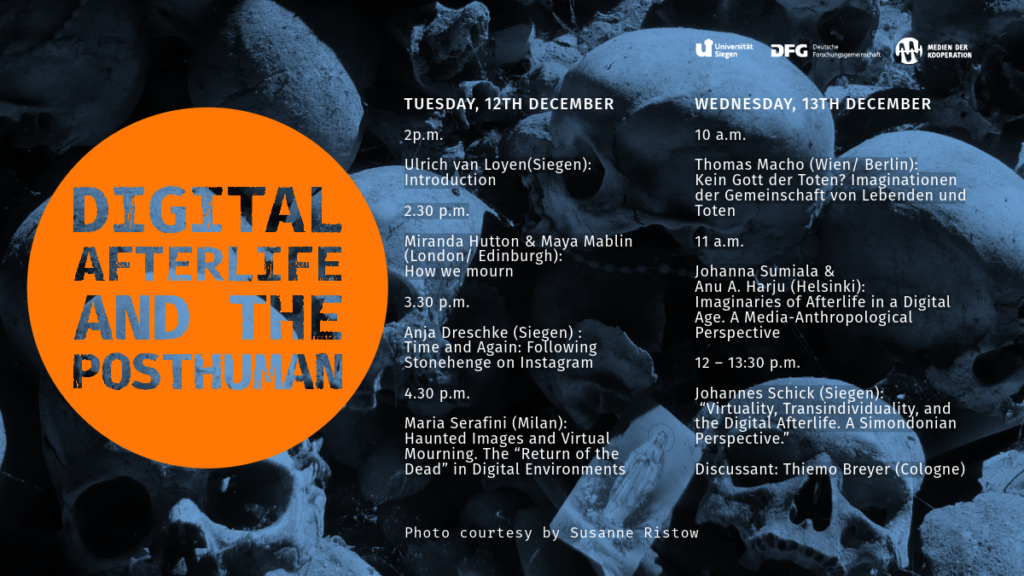
Rites of passage which contain dying and death or dissolve what Freud has called “the ambivalence of feelings toward the dead”, have been investigated by anthropologists for ages. However, it is only quite recently that we pay attention to the long farewell in the Internet – although the first virtual tomb stone was already set in 1993. Research on digital mourning quite often has to deal with the virtuality of survival, with accounts and footprints left in the Social Networks which can hardly be cancelled (Sisto 2018). The entire space of the Social networks seems to abound from ghosts and spirits, similar to the one which is increasingly occupied by Artificial Intelligence: by Chatbots for instance which are equipped with memoirs, argumentation strategies and even the voice of the person who in lifetime has decided to talk to us from beyond the grave (Mason-Robbie & Savin Baden 2020). It is at this very point that the questions of “virtual death” and of the Posthuman intersect (Stokes 2021).
The intention of our workshop in Siegen is thus twofold: we want to know which are contemporary forms of mourning, how digital techniques (smartphone photography e.g.) change the way we see death, how the ‘Farewell’ and its ‘rite de passage’ in the www are organized, by which medias and devices, how the respective media artefacts do enter the virtual space, what is their effect in the offline-world, and which are the social groups one could consider as the avantgarde of “virtual mourning”?
Furthermore, we would like to go on asking what follows from these practices for the conception of the human itself. The extensions of the Self in space and time, its multiple ways to instantiate itself and the possibility of merging with (virtual) others could also open up spaces to re-think the divide made between Westerners and ‘indigenous’ people and could invite us to reconceptualize ideas of personhood ascribed to the cultural other in the past (analogous to Marcel Mauss’ classical reconstruction of “personhood”, 1938).
The first section of the workshop shall be dedicated to projects in the realm of (secular) mourning and grieving, to practices of digital commemoration, the circulation of images etc. The second part should deal with the digital practices of Farewell, with funeral rituals and the Internet, or with digital heritage. The third section will rather raise treat conceptual questions as mentioned above.
Literature
Mason-Robbie V., & Savin-Baden M. (2020). Digital Afterlife: Death Matters in a Digital Age. CRC Press.
Sisto D. (2018). La morte si fa social. Bollati Boringhieri, Turin.
Stokes P. (2021). Digital Souls: A Philosophy of Online Death. Bloomsbury.
Thiemo Breyer, philosopher, phenomenologist, Cologne
Anja Dreschke, Filmmaker, photographer and anthropologist, Siegen
Anu A. Harju, Social sciences, PI of the research group: “Digital Death”, Helsinki
Miranda Hutton, photographer and anthropologist
Ulrich van Loyen, Media Studies, Siegen
Maya Mablin, anthropologist with great expertise in the field of Global Christianity, Edinburgh
Thomas Macho, philosopher, Director of the International Research Center for Cultural Studies, Vienna
Johannes Schick, philosopher, with special expertise in the field of philosophy of technology
Maria Serafini, philosopher, Milano
Johanna M. Sumiala, media studies, principal investigator of the Research Group: “Digital Death: Transforming history, rituals, and afterlife” (https://www.helsinki.fi/en/researchgroups/digital-death-transforming-history-rituals-and-afterlife/people) Helsinki
Tuesday, 12th December – AH-A 228
2p.m.
Ulrich van Loyen (Siegen): Introduction
2.30 p.m.
Miranda Hutton & Maya Mablin (London/ Edinburgh): How we mourn
3.30 p.m.
Anja Dreschke (Siegen) : Time and Again: Following Stonehenge on Instagram
4.30 p.m.
Maria Serafini (Milan): Haunted Images and Virtual Mourning. The “Return of the Dead” in Digital Environments
Wednesday, 13th December – AH-A 217/218
10 a.m.
Thomas Macho (Wien/ Berlin): Kein Gott der Toten? Imaginationen der Gemeinschaft von Lebenden und Toten
11 a.m.
Johanna Sumiala & Anu A. Harju (Helsinki): Imaginaries of Afterlife in a Digital Age. A Media-Anthropological Perspective
12 – 13:30 p.m.
Johannes Schick (Siegen): “Virtuality, Transindividuality, and the Digital Afterlife. A Simondonian Perspective.”
Discussant: Thiemo Breyer (Cologne)
You can find past events in our archive!
Selected lectures and events are available as recordings in our media library!